Who we recommend it to
We recommend K45MT to cabinet-door shops, decorative-panel producers and custom-furniture factories processing MDF, plywood and flat solid-wood components.
Single Head CNC Router · Manual Tool Change
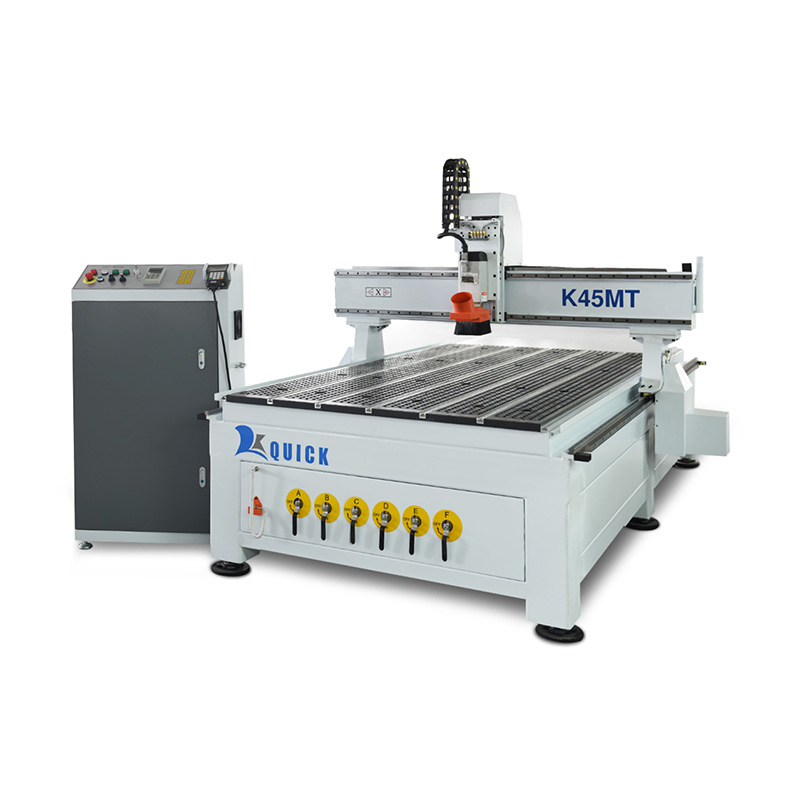
K45MT is a straightforward three-axis router for cabinet doors, decorative panels, plywood furniture parts, table components and other flat workpieces machined mainly from the top.
Quick answer: choose K45MT when most jobs run with one cutter or only need an occasional manual tool change. If a normal program keeps calling for several cutters, dense drilling or automatic sheet handling, we will point you to a better-fit configuration instead.
Send us the part drawing and tool list. We will check the actual workflow first, then tell you whether K45MT makes sense or whether ATC would save you more time.
Buyer Fit
This is a focused router for flat parts, a limited tool set and top-side machining. We do not try to dress it up as a complete furniture production line.
We recommend K45MT to cabinet-door shops, decorative-panel producers and custom-furniture factories processing MDF, plywood and flat solid-wood components.
This model makes sense when manual loading and an occasional cutter change are a small part of the day, not the thing holding production back.
Send the actual part, smallest piece, tool list, hole map and output target. A “1325 table” by itself tells us almost nothing about the right machine.
Use our CNC router for woodworking guide when you are still comparing machine types. Use our CNC router size guide when working area and factory layout are the main questions.
Why K45MT
More automation is not automatically better. If your parts are simple, your tool count is low and manual loading already fits the shop, paying for features you rarely use can be a bad deal.
If one cutter completes most jobs, manual tool change stays simple and the machine does not need an ATC just to look more impressive on paper.
Cabinet doors, decorative panels, plywood furniture parts and table components are a natural fit when machining is mainly from the top.
When tool changes, drilling and sheet handling are not the bottleneck, K45MT keeps the machine decision focused instead of adding automation that does not solve a real production problem.
The line is simple: if tool changes start controlling cycle time, we stop pushing K45MT and compare an ATC router with you.
Technical Specifications
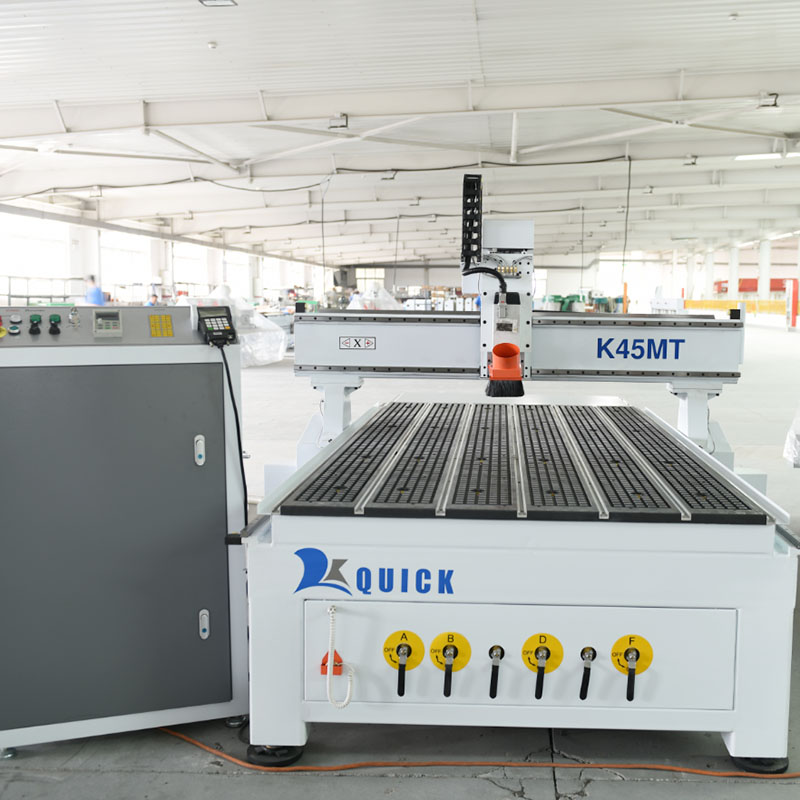
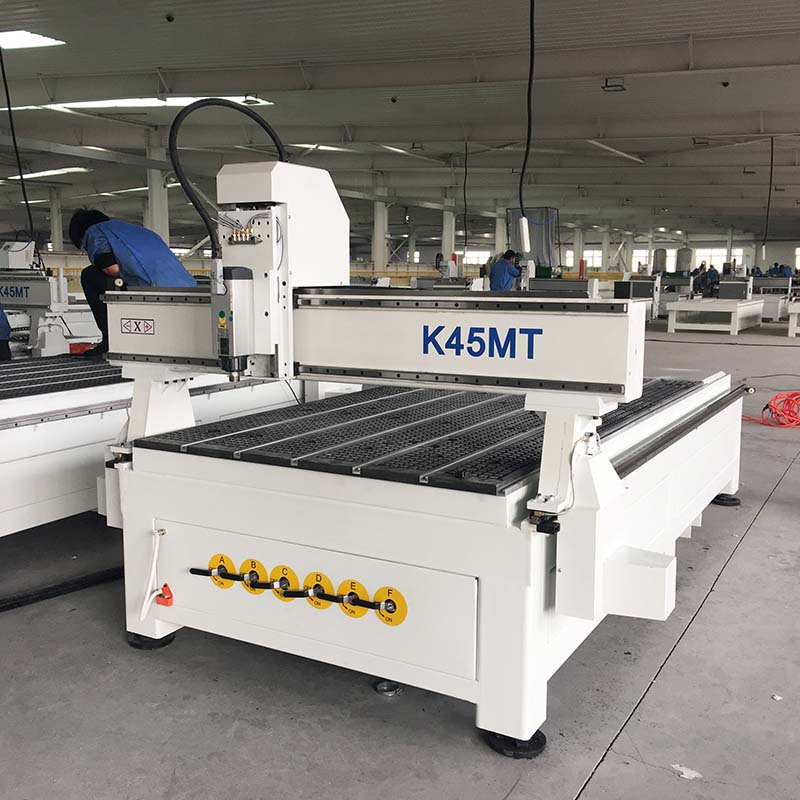
Some parts of K45MT are the machine platform. Others, such as spindle details, vacuum layout and voltage, need to match what you actually cut. The table below keeps those two things separate.
The 200 mm figure is Z-axis machine travel. It is not a promise that a 200 mm-thick part will fit. Usable clearance changes with the spoilboard, fixture, cutter, spindle nose, dust hood and safe retract height.
| Specification | K45MT baseline | What we check for your job |
|---|---|---|
| Machine type | Three-axis, single-spindle wood CNC router | K45MT platform |
| Tool changing | Manual tool change | If your normal program uses several cutters, we compare ATC instead |
| X/Y working area | 1300 × 2500 mm | Largest sheet, finished-part size and fixture space |
| Z-axis travel | 200 mm | Actual usable clearance after spoilboard, fixture, cutter and dust hood are included |
| Spindle | Air-cooled spindle | Power and model are selected from material, tool size, depth and duty cycle |
| Reference spindle speed | Up to 18,000 rpm in the reference configuration | Exact limit follows the selected spindle |
| X/Y transmission | Rack-and-pinion transmission | K45MT reference platform |
| Z transmission | Ball-screw transmission | K45MT reference platform |
| Drive system | Stepper-motor configuration | Matched to the selected machine configuration |
| Workholding | Vacuum-capable workholding | Vacuum-only, clamps, fixtures or a hybrid setup based on the smallest part and board porosity |
| Vacuum system | 7.5 kW reference pump configuration | Pump model, quantity and zone layout are matched to the table and workpiece |
| Controller | Handheld three-axis controller | Exact controller model and CAM/postprocessor compatibility |
| Program workflow | Controller-compatible G-code and approved CAM postprocessor | Your software version, postprocessor and representative program |
| Voltage | Configured for the destination factory | Voltage, phase and frequency |
| Performance results | No generic accuracy number is claimed here | Measured values are used only when the matching machine or test record supports them |
| Dimensions and packing | Confirmed with the final machine layout | Factory access, service clearance, loading route and packing arrangement |
Suitable / Not Suitable
Core Applications
We configure K45MT for profiles, glass openings, grooves, pockets, engraving, relief routing and panel cutout. Send us the CAM tool list before we approve manual tool change for a multi-process door.
Our recommendation: when a door program repeatedly uses several profile, groove, engraving and cutout tools, we normally move the project to ATC.
Table and desk panels, wardrobe and bed components, storage parts, slots, grooves, pockets, profile cutting and limited top-side spindle drilling.
We configure top-side profiles, pockets and decorative work after reviewing grain, moisture, knots, stock flatness and workholding.
Configuration Decisions
We quote K45MT when one tool completes most jobs. For repeated multi-tool programs, we recommend an ATC configuration.
We use the smallest part, board porosity and cut-through sequence to select vacuum, clamps, fixtures or a hybrid table.
We can keep limited top-side holes in the spindle workflow. For dense or horizontal holes, we recommend a PTP or drill-bank configuration.
We size the spindle and clearance from the material, tool diameter, depth, duty cycle and fixture—not from spindle power alone.
Selection Example
Imagine a furniture-door program that needs six cutters for profiling, grooving, engraving and cutout. The 1300 × 2500 mm table may be perfectly suitable, but the operator would still have to stop the machine again and again to change cutters and reset tool length.
That is the point where table size stops being the main question. The tool list becomes the real machine-selection question.
For that kind of repeated multi-tool program, we would compare an ATC router instead of trying to force the job onto K45MT.
Our recommendation: buy K45MT when manual changes stay occasional. If several cutters appear in every normal program, send us the CAM tool list and we will compare the real workflow with ATC.
Material and Workholding Boundaries
| Material or workpiece | Suitable processes | Main risk and control |
|---|---|---|
| MDF and HDF | Door profiles, decorative panels, grooves, pockets, engraving and relief routing | Fine dust, vacuum leakage, fuzzy edges, burning and small-part movement; use effective extraction and review tabs, onion skin or auxiliary holding |
| Plywood | Furniture-panel cutting, slots, grooves, pockets and profiles | Veneer tear-out, internal voids, warping and adhesive-related tool wear; test finish-critical or double-sided panels |
| Particle board and laminated panels | Simple panel cutting, grooves, slots and limited top-side drilling | Coating chipping, porous core and connector-hole requirements; do not treat the router as a complete cabinet line |
| Solid wood | Table tops, flat door parts, profiles, pockets and decorative components | Grain, moisture, knots, internal stress, burning and tear-out; clamps or fixtures may be more reliable than vacuum alone |
| Small furniture parts | Conditional profile cutting and pocketing | The remaining sealed area after cut-through may be insufficient; provide the smallest-part dimensions and nesting file |
Send us representative material when you process high-gloss panels, decorative plywood, unfamiliar solid-wood species, small nested parts or work with a defined tolerance or finish requirement. We apply the result only to the recorded material, tool, workholding and program conditions.
Production Workflow
Drilling Boundary
We can configure K45MT for limited vertical spindle drilling when the holes are accessible from the top and the quantity does not create a production bottleneck.
Send us the hole diameter, depth, direction, quantity, connector type and drawing or CAM file. For dense connector patterns, horizontal holes or six-side processing, we will recommend equipment from our furniture CNC machine range.
We will not sell ATC as a substitute for horizontal drilling. ATC changes cutters; it does not create horizontal drilling capability.
Factory Testing and Evidence
Every Quick CNC machine is assembled, inspected and tested before shipment. For K45MT, the exact checks depend on the spindle, controller, table, vacuum system, voltage and any acceptance items agreed for your order.
If we show a measured value, test duration or pass result, it needs to come from the matching model or serial-machine record. We do not borrow numbers from another machine and pretend they belong here.
Axis movement, reference functions and dry-cycle checks according to the approved plan.
Applicable spindle condition, axis geometry, squareness and perpendicularity checks.
Bare-table or surfaced-spoilboard condition and vacuum-system checks where fitted.
Electrical functions, emergency-stop operation and protective grounding checks.
Continuous running and representative material cutting when included in the order.
Quick CNC's company-wide QC framework includes CMM inspection, laser interferometer testing, Ballbar testing and 24–72-hour continuous-operation testing. This does not mean every K45MT receives every listed method; the applicable combination and results follow the corresponding test plan or record.
Safety, Maintenance and Downtime
Before maintenance or jam clearing, isolate electrical, vacuum, pneumatic and other stored-energy sources according to the machine-specific and site-specific procedure.
Stop the machine after smoke, sparks, burning smell, severe vibration, uncontrolled movement, repeated breaker trips, spindle collision or failure of a guard, interlock or emergency stop.
For the complete support boundary, see Quick CNC service and technical support.
Engineering RFQ
Two shops can both ask for a 1325 router and still need completely different machines. These nine inputs let us compare K45MT with ATC, drilling and workholding options before we quote.
Our engineering and sales teams may also request finish and tolerance requirements, floor layout, facility power, dust system, unloading route, budget, required delivery date, shipping term and certificate requirements.
Installation, Delivery and Support
Send us the voltage, phase, frequency, breaker, cable, grounding, floor material and load capacity, dust collection, loading and service space, entrance route, lifting method, software workstation, network policy and installation method.
We will confirm the complete layout because the 1300 × 2500 mm working area is not the required factory footprint. Auxiliary equipment, material handling, operator access and maintenance clearance require additional space.
Our standard production lead time is approximately 45 days after we receive the deposit and confirm the machine configuration, voltage, options, drawings and other required technical details. International shipping time is not included.
We provide a standard one-year machine warranty from the date you receive the machine. Wearing parts, incorrect operation, improper maintenance, unauthorized modification and human-caused damage are excluded unless the final agreement states otherwise.
We provide manuals, operation videos, remote technical guidance, online training, maintenance guidance, troubleshooting and spare-parts support. We can arrange paid on-site service according to the final agreement.
We confirm parts, freight, labor, travel cost, on-site service and other commercial responsibilities after diagnosis and according to the signed agreement.
Quick CNC supplies CE-certified machines and operates under an ISO 9001 quality management system. We confirm the exact K45MT configuration, destination country and document scope before you order.
CE does not prove machining accuracy or output. ISO 9001 does not certify an individual machine's dimensional result.
Frequently Asked Questions
Yes. We recommend K45MT when most jobs use one cutter or only occasional manual changes between operations or batches. When repeated cutter changes interrupt every normal program, we recommend an ATC router.
We recommend ATC when four to eight cutters are repeatedly used inside one normal program. We make that decision from the CAM tool list and complete cycle—not from the appearance of the specification sheet.
Yes. We configure K45MT for these materials after checking the spindle, tooling, workholding and dust-extraction conditions. We also review material density, coating, grain, moisture, thickness and finish expectations.
Not automatically. Send us the smallest-part size, board type and nesting layout. We may specify tabs, onion skin, mechanical fixtures or a different cutting order.
Yes, for limited top-side spindle drilling when the quantity and hole pattern are commercially suitable. For dense connector holes, horizontal drilling or six-side processing, we recommend a drill-bank, PTP or six-side drilling solution.
No. We calculate usable clearance from the spoilboard, fixture, cutter projection, spindle nose, dust hood and safe retract height.
Usually, yes, after we verify that the software version and postprocessor match the selected controller. Send us the software name, version, postprocessor and representative program before production.
Yes. We can arrange a representative test after you define the material, drawing, tool, workholding, parameters and acceptance criteria. We apply the result only to the recorded test conditions, not to every material or production setup.
Our standard production lead time is approximately 45 days, excluding international shipping. We provide a standard one-year warranty from the date you receive the machine, plus manuals, videos, remote guidance, online training, maintenance guidance and troubleshooting. Exact commercial responsibilities follow the final signed agreement.
Final Configuration Review
Send the part, material, size, smallest piece, tool count, hole requirements, output target, software, voltage and destination. We will check K45MT first. If another configuration makes more sense, we will tell you before you spend the money.
Tell us your material, working size and production needs. Our engineers will recommend a suitable CNC machine for your business.