CNC Drilling and Cutting Furniture Production Line RC1
RC1 connects panel loading, labeling, bottom drilling and grooving, CNC cutting, and unloading so cabinet and panel-furniture factories can reduce repeated board handling between separate stations.
Actual output and staffing depend on panel size, hole quantity, nesting layout, toolpath, material supply, sorting and downstream capacity.
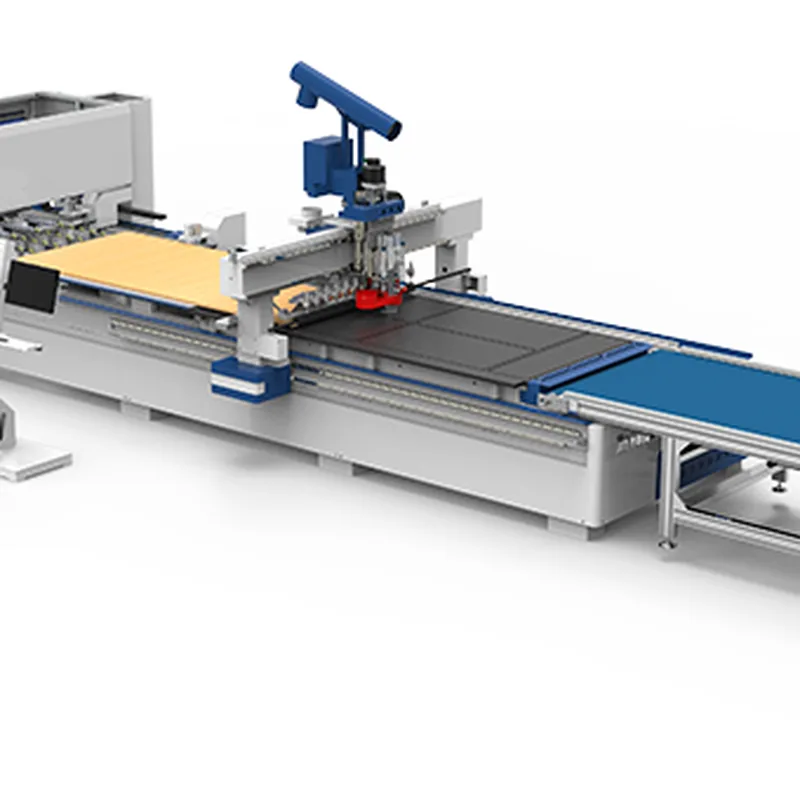
Made for Cabinet and Panel-Furniture Production
RC1 is strongest when your factory repeatedly processes sheet goods into cabinet, wardrobe, closet and other panel-furniture parts. The main materials are MDF, particle board, plywood and melamine-faced panels.
Best production fit
Repeat or batch panel orders where labeling, drilling/grooving, nesting cutting and panel transfer must stay coordinated.
Main workpieces
Cabinet sides, shelves, partitions, wardrobe panels and other sheet-based furniture components.
Do not force the application
For acrylic, plastic, soft aluminum, foam or unrelated job-shop work, we first determine whether a general CNC router is a better machine than an automated furniture line.
What Changes When Five Separate Steps Become One Connected Line
| Typical disconnected process | RC1 connected process | Why it matters in a furniture factory |
|---|---|---|
| Operator loads a panel manually | Automatic panel loading | Reduces repeated heavy sheet handling at the cutting station. |
| Part information is handled separately | Automatic labeling before machining | Helps keep panel identification linked with the production job. |
| Panel is moved or flipped for selected drilling/grooving | Bottom drilling and grooving integrated in the line | Reduces one source of manual transfer and re-positioning. |
| Panel moves to a separate cutting station | CNC cutting follows the connected machining sequence | Keeps drilling/grooving and cutting in the same production route. |
| Operator removes the processed sheet from the machine | Unloading platform supports the next step | Improves continuity before sorting, edge banding or further drilling. |
RC1's value is not simply a faster cutting feed. The main production gain comes from removing repeated board carrying, flipping, identification and re-positioning between disconnected processes.
Use RC1 When Handling and Combined Machining Are the Bottleneck
RC1 is a strong fit when
- panels need labeling, drilling/grooving and nesting cutting in the same production route
- operators repeatedly carry or flip boards between separate stations
- batch production justifies automatic loading and unloading
- part identification and machining data need to stay connected.
A simpler nesting CNC can be enough when
- the job is mainly cutting and grooving
- drilling demand is limited
- manual loading/unloading is acceptable
- separate drilling is not slowing the factory.
Add or keep dedicated drilling when
- parts require many horizontal edge holes
- the job needs extensive drilling on multiple panel faces
- six-side drilling is a major downstream operation.
RC1 should not be assumed to replace a dedicated six-side drilling machine for every hole pattern.
RC1 Technical Specifications
| Item | RC1 Reference Specification |
|---|---|
| Floor space | 15000 × 2900 × 2600 mm |
| Working area | 1220 × 2800 mm |
| Repositioning resolution | ±0.02 mm |
| Control system | Quick Custom |
| Spindle configuration | 9 kW ATC × 1 + 6 kW ATC × 1 |
| Spindle speed | 24,000 rpm |
| Maximum speed | 70 m/min |
| Bed structure | Welded integrated bed |
| Total power | 25 kW |
| Working voltage | AC 380 V / 50 Hz |
| Unloading platform | Included |
Structure Built to Keep Panels Moving Without Repeated Re-Positioning
The RC1 handling system uses suspended suction loading, with a published stack-height reference of up to 800 mm. A three-gripper transfer design holds and positions the panel as it moves through the line, reducing the need for secondary positioning between the connected machining areas.
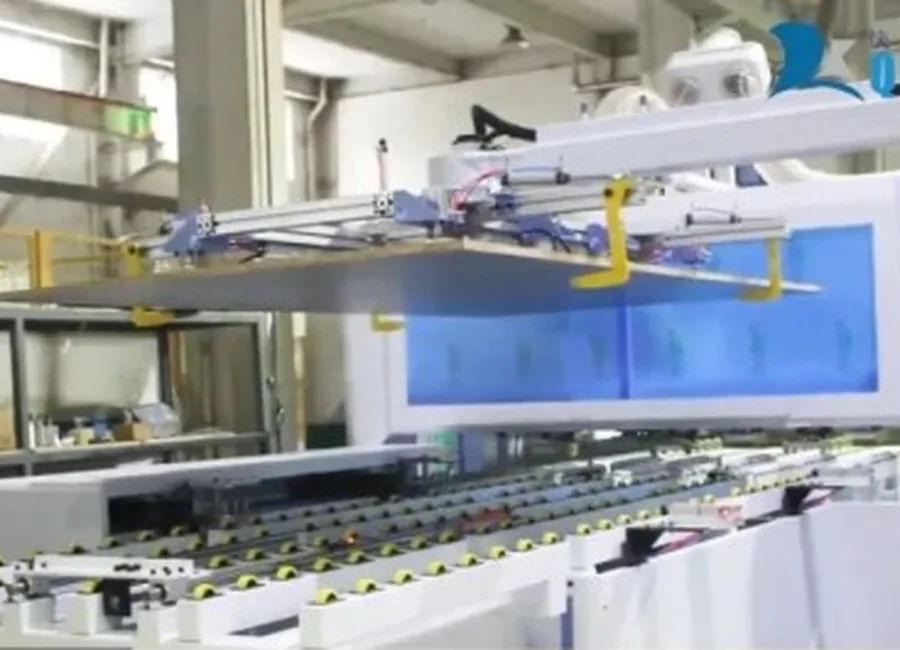
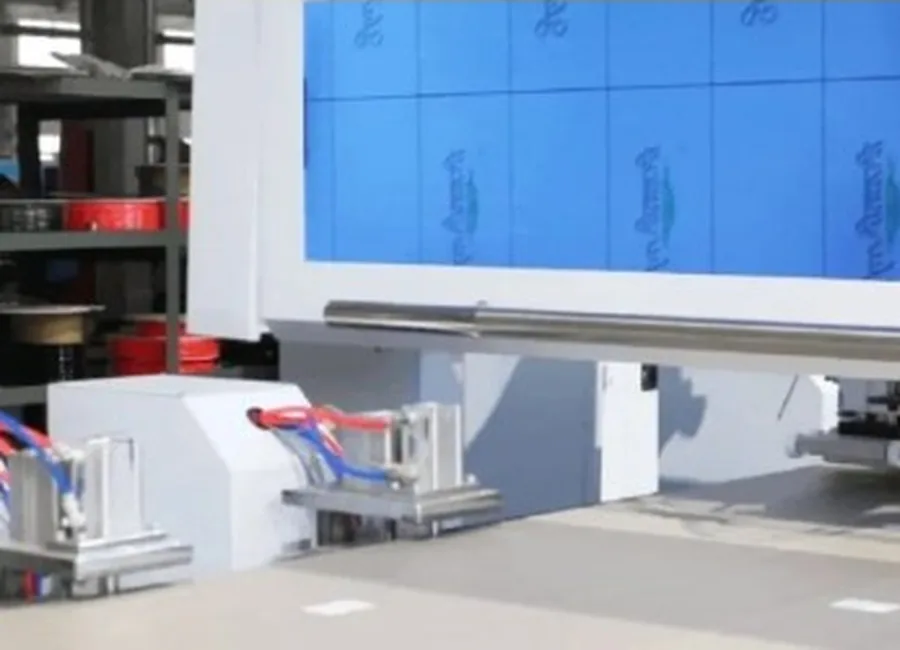
For coated or finished furniture panels, reliable sheet separation and controlled transfer matter as much as axis speed. Panel flatness, surface condition and storage quality should therefore be reviewed during line planning.
Three Decisions That Define the RC1 Configuration
1. What drilling is actually required?
RC1 is designed around integrated bottom drilling/grooving plus CNC cutting. If your parts also need intensive horizontal edge holes or complete multi-face drilling, we determine whether a downstream six-side drilling process is still required.
2. How will production data enter the line?
The technical offer should match your existing cabinet design, nesting, labeling and CNC data process. We confirm the controller/HMI and required software interface for the final build instead of assuming compatibility from a software name alone.
3. What happens after cutting?
Edge banding, further drilling, sorting and assembly must be able to accept RC1 output. Increasing cutting capacity alone does not improve the factory if the next station becomes the new bottleneck.
Fit the Line to Your Factory, Not the Other Way Around
RC1 occupies approximately 15000 × 2900 × 2600 mm as a machine reference, but a production layout needs more than the machine footprint. We also plan material staging, loading access, unloading space, operator movement, maintenance access, dust collection and electrical placement.
For a new line or factory rearrangement, send the available installation area and the position of upstream panel storage and downstream edge banding/drilling equipment. This lets us plan material flow before the machine is built.
Drilling, Grooving, Cutting, Hold-Down, and Sample Validation
RC1's published process includes bottom drilling and slotting before the panel reaches the CNC cutting area. The strongest use case is a panel-furniture part where those operations can be completed in one connected sequence without manually flipping and carrying the sheet.
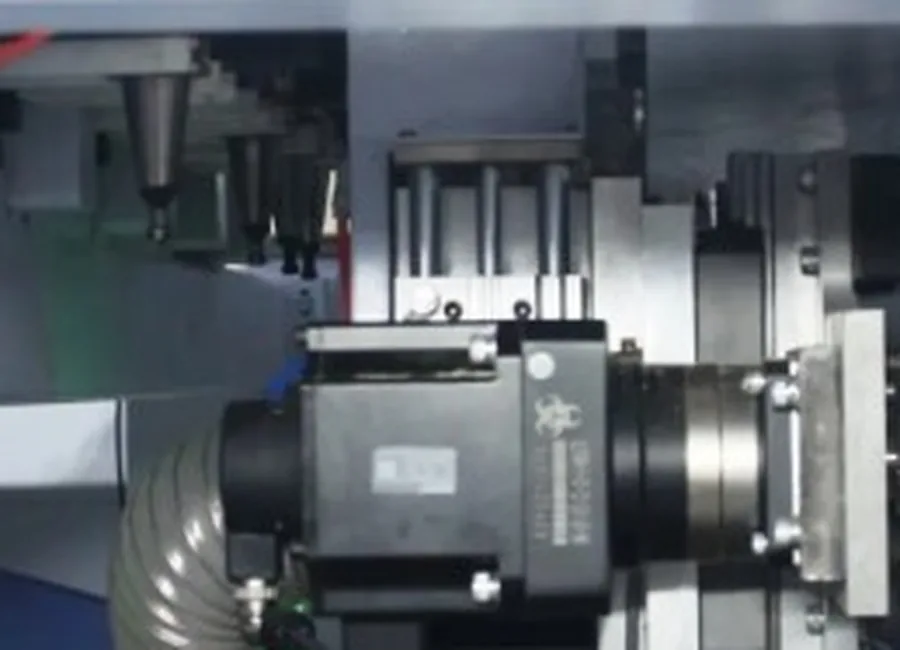
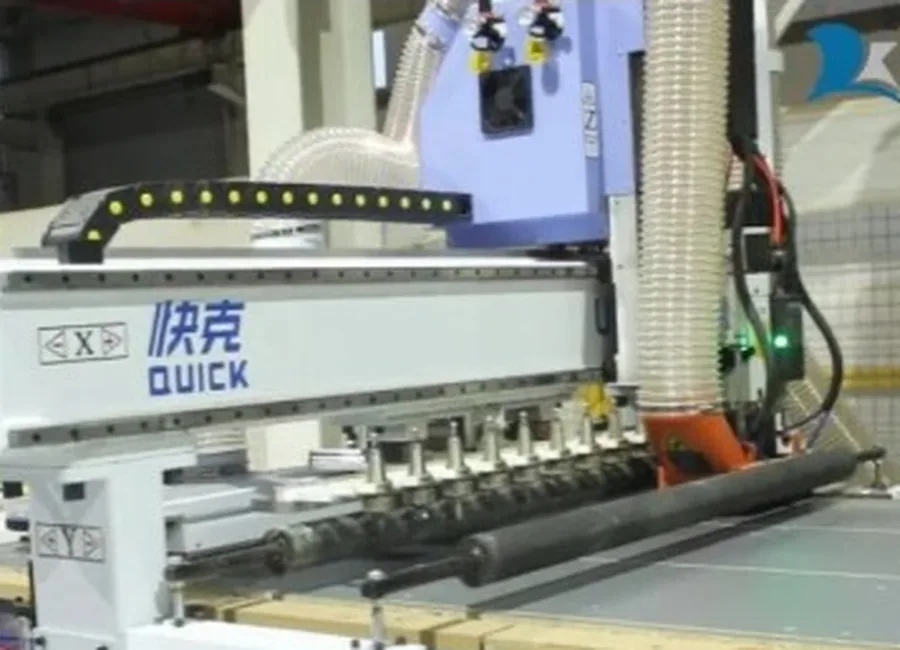
For a production sample, the meaningful checks are your real hole diameter and depth, groove width and depth, nested cut geometry, smallest part after cut-through, edge quality, hold-down stability and dimensional inspection method. That gives your team evidence from the part you actually manufacture instead of a generic demonstration panel.
Pre-Shipment Verification Should Match the RC1 Process
Quick CNC's published quality process includes dimensional inspection, pre-delivery inspection, material-thickness checks, structural-fit verification, component-accuracy checks and linear-guide calibration. For an RC1 order, the useful acceptance record is the one tied to the actual machine and agreed production test.
| RC1 verification point | What the factory should confirm before shipment |
|---|---|
| Loading and transfer | Panel pick-up, sheet separation and stable transfer through the connected line. |
| Labeling | Label content and part identification follow the agreed production data. |
| Drilling / grooving | Required hole and groove operations on the agreed sample panel. |
| Nesting cutting | Cut geometry, edge condition and smallest-part hold-down on the agreed sample. |
| Unloading | Processed parts move out of the cutting area as planned for the next operation. |
| Dimensional check | Measurement method and acceptance points are defined before the sample test. |
Any destination-specific certificate or compliance document should be confirmed for the final model configuration and destination before order confirmation.
RC1 vs Nesting CNC vs Six-Side Drilling
| Production need | Recommended direction | Reason |
|---|---|---|
| Mainly sheet nesting and cutting, limited drilling | Nesting CNC | A connected drilling-and-handling line may add cost and complexity without solving the main bottleneck. |
| Automatic loading + labeling + bottom drilling/grooving + cutting + unloading | RC1 | This is the production route RC1 is designed to connect. |
| Many horizontal edge holes, vertical holes and multi-face drilling on cut panels | Six-Side Drilling Machine | Dedicated drilling architecture is more appropriate when drilling is the main secondary operation. |
| Storage + RC1 + edge banding + six-side drilling + sorting or other automation | Broader furniture production line | The entire line must be balanced around output and downstream capacity. |
See our Six-Side Drilling Machine when horizontal and multi-face drilling are a major part of the panel route.
See the RC1 Line in Operation
Use the RC1 machine video to review the connected line layout and machine movement. For a purchasing decision, video should be followed by a sample run based on your own cabinet or wardrobe panel so drilling, groove quality, cut edge and part dimensions can be checked against your production requirement.
Use 80–100 Sheets per Shift as a Capacity Check, Not Just a Headline
RC1 is published with a reference of approximately 80–100 sheets per eight-hour shift, and one operator can operate the connected line under suitable production conditions. These figures are most useful when compared with your current order mix.
What reduces output
More holes, longer grooves, complex nesting, small parts, extra tool changes, difficult sheet separation and slower downstream handling.
What determines labor
RC1 can reduce labor inside the connected loading-to-unloading process, but sorting, edge banding, secondary drilling, assembly and material replenishment may still require additional staff.
What we compare
Your current sheets per shift, operator count, panel transfers and downstream capacity show whether RC1 removes the real bottleneck or simply moves it elsewhere.
Get the First RC1 Proposal With Five Inputs
Send these first
- Main panel material and thickness
- Maximum panel size
- One representative drawing or production file
- Required sheets per shift
- Destination country
We only ask for deeper project data when it affects the line
After the first fit check, our engineer may request the hole pattern, factory layout, existing software/data process, dust collection, electrical supply and downstream edge-banding or drilling equipment.
This keeps the first quotation step simple while still giving the engineering team enough information to determine whether RC1 is the right machine.
Order Quantity, Lead Time, Packing, and Shipping
MOQ
No minimum order quantity for RC1.
Production lead time
Approximately 45 days after the order and final configuration are confirmed. Custom engineering or order changes can affect the schedule.
Shipping
RC1 is prepared for export and normally shipped by container. Final packing, shipping terms and unloading responsibility follow the signed order.
Installation, Warranty, and After-Sales Support
Quick CNC provides manuals, operation videos, remote technical guidance and online training. Paid on-site service can be arranged when required.
The standard machine warranty is one year from receipt of the machine. Final warranty coverage, exclusions, travel cost and service responsibilities follow the signed order. Wearing parts, incorrect operation, improper maintenance and unauthorized modification are handled according to the agreed warranty terms.
FAQ
What exactly does RC1 combine?
RC1 connects panel loading, labeling, bottom drilling/grooving, CNC cutting and unloading for cabinet and panel-furniture production.
Can one operator run RC1?
Yes, the RC1 production reference states that one operator can operate the connected line. Staffing outside the line still depends on material replenishment, sorting, edge banding, secondary drilling and assembly.
Is 80–100 sheets per eight-hour shift guaranteed?
It is a production reference for suitable conditions, not a universal guarantee. Hole quantity, groove length, nesting complexity, toolpath, sheet handling and downstream capacity can change the result.
What do the 9 kW and 6 kW ATC spindles each do?
RC1 is specified with one 9 kW ATC spindle and one 6 kW ATC spindle. The exact spindle and tool sequence for your drilling, grooving and cutting operations should be listed in the technical offer for your confirmed configuration.
Does RC1 replace a six-side drilling machine?
Not automatically. RC1 is clearly positioned for integrated bottom drilling/grooving and cutting. If your panels require many horizontal edge holes, vertical holes or multi-face drilling, we review whether a downstream six-side drilling machine is still required.
What is the Quick Custom control system?
Quick Custom is the control-system designation listed for RC1. Your technical offer should identify the controller/HMI and the software or data interface included in the confirmed build.
Can RC1 work with our cabinet production software?
Software fit is confirmed from your actual data process. Send one representative production file or describe the current design, nesting, labeling and CNC data route so the required interface can be checked before order.
Which materials are the main fit?
MDF, particle board, plywood and melamine-faced furniture panels are the main RC1 application. Other materials should be reviewed separately rather than assumed to be suitable for the same production setup.
What should we send for the first quotation?
Start with panel material/thickness, maximum panel size, one representative drawing or production file, required sheets per shift and destination country.
Tell Us the Panel, the Output, and the One Process You Want to Remove
Whether your current problem is manual board handling, repeated flipping, separate labeling, drilling between machines or a cutting bottleneck, Quick CNC can compare that production route with RC1 and prepare the correct line configuration.
First step: material + thickness + panel size + one production file + sheets per shift + destination.