PTP-3013 · Point-to-Point Door & Furniture Machining
PTP CNC Router for Doors and Furniture Panels
If your doors or furniture parts need boring plus routing, PTP-3013 lets you keep more of that work on one machine. Movable Schmalz pods support the part where it needs support, the HSD 12V4H boring head handles furniture holes, and the 9 kW HSD ATC spindle takes care of grooves, pockets and profiles. The goal is simple: fewer extra setups when the part can stay safely clamped.
Already have a drawing? Send the material, part size, hole directions, routing work and target output. We can use the real part to check workholding, tool access and machine configuration.
Quick Answer: Is a PTP CNC Router the Right Machine for Your Parts?
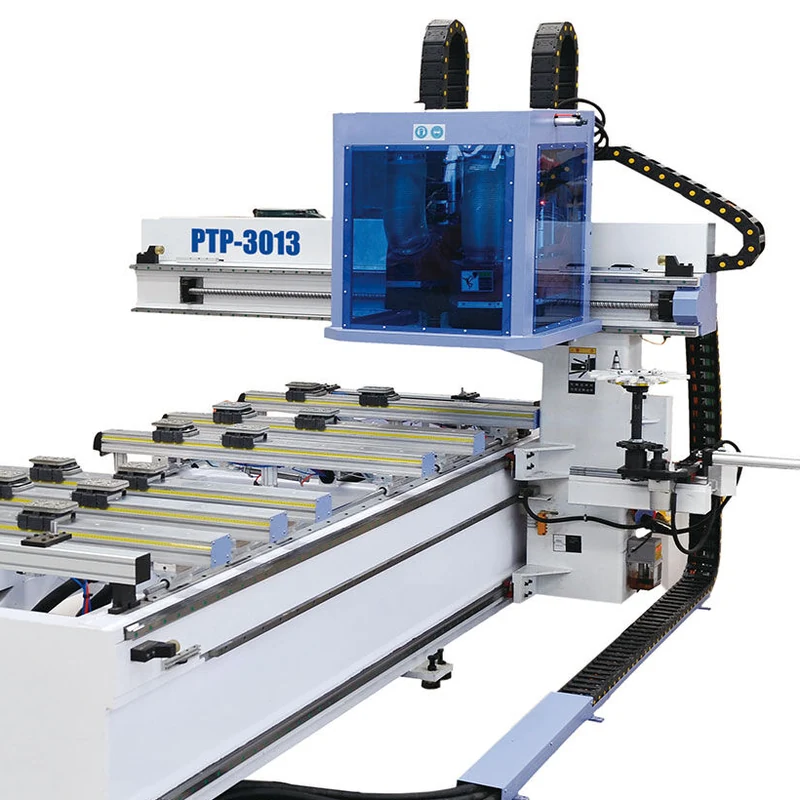
A PTP CNC router, also called a point-to-point CNC machine, is a strong fit when you machine individual or pre-cut doors and furniture parts that need both boring and routing. PTP-3013 uses movable pod-and-rail workholding instead of a full flat vacuum table, so support can be planned around hole locations, grooves and routed profiles.
| Buyer question | PTP-3013 answer |
|---|---|
| Best fit | Pre-cut doors, cabinet parts and furniture components that need boring plus routing. |
| Main advantage | Movable pod support can keep selected drilling and routing areas open while the part stays supported. |
| Working area | 1300 × 3000 × 200 mm listed machine working area. Confirm the final part envelope and tool clearance from your drawing. |
| Boring | HSD 12V4H boring head for accessible vertical and horizontal furniture-hole work. |
| Routing | 9 kW HSD spindle, up to 24,000 rpm, with an 8-position carousel tool magazine. |
| Not the first choice for | Full-sheet nesting, drilling-dominant six-side production, or heavy metal and stone machining. |
| Lead time | Approx. 45 days after the order and machine configuration are finalized. |
| Warranty | 12 months. |
| Best RFQ input | Part drawing, material, hole map, routing work, target output and factory utilities. |
When PTP-3013 Is the Right Fit
PTP-3013 makes the most sense when the part is already cut to size and needs several operations on the same machine. Think door parts, cabinet components and shaped furniture pieces that need furniture drilling plus grooves, pockets or routed profiles.
Doors, cabinet parts and furniture components
A good fit for cabinet doors, interior door components, cabinet parts, furniture panels and shaped wood parts that need drilling, grooving, pocketing, profiling or engraving.
Main materials
The core use is wood-based furniture work: solid wood, MDF/HDF, plywood, particleboard and melamine-faced panels.
Best production pattern
The machine is most useful when one part needs more than one operation and movable support helps keep holes, grooves or profile paths clear. If your main job is full-sheet cutting, start with a nesting CNC instead.

Why Pod-and-Rail Workholding Changes the Process
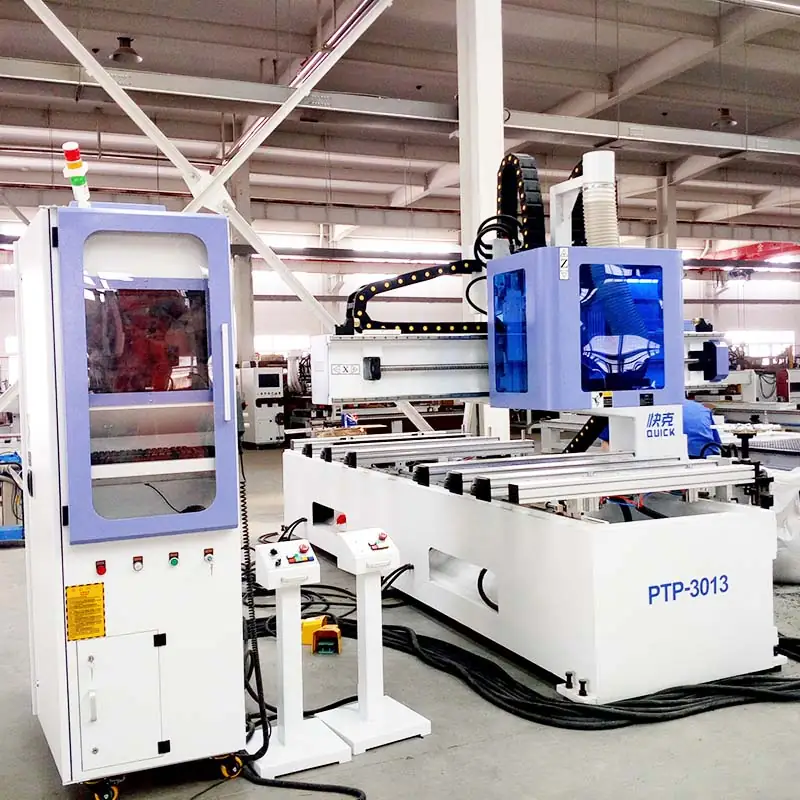
The six Schmalz rails and eighteen vacuum pods can be moved to suit the real part. That matters because the best support point is not always the same place on every door or furniture component. We position the pods where the part needs support and keep the drilling or routing path clear where possible.
What happens with separate setups
You locate the part, drill it, move or reset it, then set it again for grooves, pockets or profile routing. Every extra setup means more handling and another chance for positioning error.
What the PTP setup changes
Plan the pods around the machining zones, locate the part, run the boring work, change router tools automatically and continue with grooves, pockets or profiles on the same platform when tool access allows it.
Choose PTP-3013 When It Removes Extra Setups
PTP-3013 is a good fit when
- Doors or furniture parts need both furniture drilling and routed features.
- Workpiece shapes and sizes change, so support positions need to move with the part.
- Hinge or connector holes, grooves, pockets and profiles appear in the same production mix.
- You process individual or pre-cut components rather than mainly optimizing full sheets.
- Multi-tool routing programs are being interrupted by manual tool changes or extra setups.
Start with another machine when
- Your main task is full-sheet nesting and sheet-yield optimization; start with a nesting CNC router.
- Your main bottleneck is dense multi-face drilling with minimum flipping; compare a six-side drilling machine.
- You need automatic labeling, loading, unloading or sorting; evaluate a connected furniture production line.
- You need steel, stainless steel, stone or heavy metal removal; PTP-3013 is not the correct machine platform.
PTP-3013 Specifications and What They Mean in Production
| Item | PTP-3013 specification | Production meaning |
|---|---|---|
| Working area | 1300 × 3000 × 200 mm | Use the largest real workpiece to check travel, support and tool-access clearance. |
| Repositioning resolution | 0.02 mm | This is a machine-motion specification, not a guaranteed finished-part tolerance. |
| X-Y drive | Rack-and-pinion gear drive | Rack-and-pinion drive supports fast X-Y travel across the 1300 × 3000 mm working area. |
| Z drive | Ball screw | Ball-screw Z-axis motion supports controlled vertical positioning for drilling and routing operations. |
| Linear guide | Linear square guide | Linear square guides support stable machine movement during drilling and routing. |
| Maximum speed | 60,000 mm/min | Machine maximum travel speed; it should not be used as a universal cutting feed. |
| Maximum cutting speed | 30,000 mm/min | Practical feed depends on material, cutter, depth, workholding and finish requirement. |
| Spindle | 9 kW HSD; 24,000 rpm | Handles grooves, pockets, profiles, engraving and milling with the selected cutter and machining parameters. |
| Inverter | 11 kW | The 11 kW inverter controls spindle speed for different routing operations and materials. |
| Boring head | HSD 12V4H | Dedicated furniture drilling/boring unit for vertical and horizontal hole requirements that are accessible in the planned setup. |
| Tool magazine | Carousel, 8 tool positions | Keeps multiple router tools available so programs can move between grooving, pocketing and profiling without repeated manual tool changes. |
| Servo system | Yaskawa | Yaskawa servo motors drive the machine axes for programmed positioning and machining movement. |
| Control | SYNTEC | Coordinates machine motion, programs and machining functions. |
| Software / code / interface | ALPHACAM / G-code / USB 2.0 | ALPHACAM and G-code support let your team prepare machining programs and transfer them through the listed interface. |
| Collet | ER32; 3.175 / 6 / 12.7 mm listed | Final tool selection still follows cutter shank, operation and material. |
| Reference voltage | AC 380 V, 50–60 Hz, 3-phase | Machine voltage is matched to the destination electrical supply before production. |
| Standard workholding | 6 Schmalz rails, 18 Schmalz pods | Pod positions are planned around part geometry, hole locations and router paths. |
| Positioning/support | 16 positioning air cylinders; 4 panel lifting blades | Supports part locating and handling within the model configuration. |
| Other listed equipment | Air pump, tool sensor, automatic lubrication, dust hood | Plan the factory air supply, dust extraction and installation space around the final machine layout. |
Three Parts of the Machine That Matter Every Day
1. Movable Schmalz workholding
You can move the support points with the part instead of forcing every job onto one fixed table layout. That is useful when a hole, groove or profile would otherwise run straight into the fixture.
2. Dedicated boring head
The HSD 12V4H handles furniture-hole work separately from the main router spindle. On parts with many holes plus routed details, that gives the drilling work its own tool system instead of making the spindle do everything.
3. 9 kW ATC routing spindle
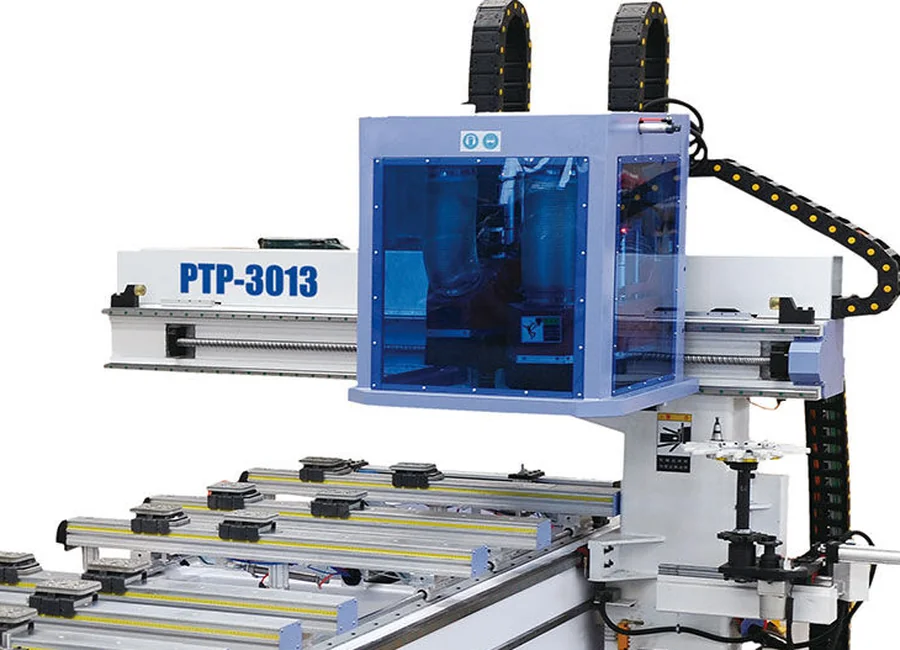
The HSD spindle does the router work, while the 8-position carousel keeps several tools ready. The useful part is not the number eight by itself. It is fewer stops for manual tool changes during a normal program.
How We Configure PTP-3013 From Your Part Drawing
We do not start with spindle power and work backwards. We start with the part. Once we know what has to be drilled, routed and held, it becomes much easier to see whether PTP-3013 is the right machine and how the setup should look.
- Part size and shape: maximum and minimum length, width, thickness and any shaped geometry.
- Hole map: vertical and horizontal holes, hinge or connector patterns, diameters and depths.
- Router work: grooves, pockets, profiles, slots, engraving and other spindle operations.
- Pod layout: support points, edge access, tool clearance and possible collision zones.
- Tool sequence: the tools used in a normal program and whether the 8-position carousel covers that sequence.
- Output target: pieces per shift, product mix, operator count and any part flipping that may be needed.
- Factory setup: electrical supply, compressed air, dust extraction, installation space and program transfer method.
How We Estimate Output Without Making Up a Pieces-per-Hour Number
There is no honest universal pieces-per-hour number for PTP work. Cycle time changes with hole count and direction, routing length, cutting depth, tool changes, loading, positioning and whether the part must be turned for an inaccessible face.
1. Send a real production part
Use a door or furniture component that represents the harder end of your normal work, not the easiest sample in the factory.
2. Tell us the output you actually need
Give us the target pieces per shift, product mix and operator count. Then we can judge whether the planned process is practical.
3. Break down the cycle
We look at locating, pod setup, boring, tool changes, routing, any required flipping and unloading before talking about capacity.
What to Check on a Sample Door or Furniture Part
If you want a sample run before shipment, the useful question is not “did the machine move?” It is whether the part comes out the way the approved drawing says it should.
| Check | What to verify | Why it matters |
|---|---|---|
| Part locating | The component seats against the planned positioning points. | A bad start position follows the part through every later operation. |
| Vacuum holding | The part stays secure through the planned boring and routing sequence. | The pod layout has to hold the part without blocking the tool path. |
| Vertical / horizontal boring | Hole position, diameter and depth against the approved drawing where accessible. | Furniture hardware depends on hole location, not on the boring-head model name. |
| Grooves and pockets | Width, depth and location against the drawing. | These are real finished-part requirements, not just machine-motion numbers. |
| Profile routing | Finished contour and critical dimensions. | This shows whether the workholding and tool path work together on the actual part. |
| Tool sequence | The required routing tools run in the planned program sequence. | The 8-position carousel only helps if it covers the tools the job really uses. |
Put the critical finished-part dimensions on the drawing and agree how they will be checked. The listed 0.02 mm figure is repositioning resolution, not a promise that every finished part will hold 0.02 mm tolerance.
What We Check Before Your PTP CNC Ships
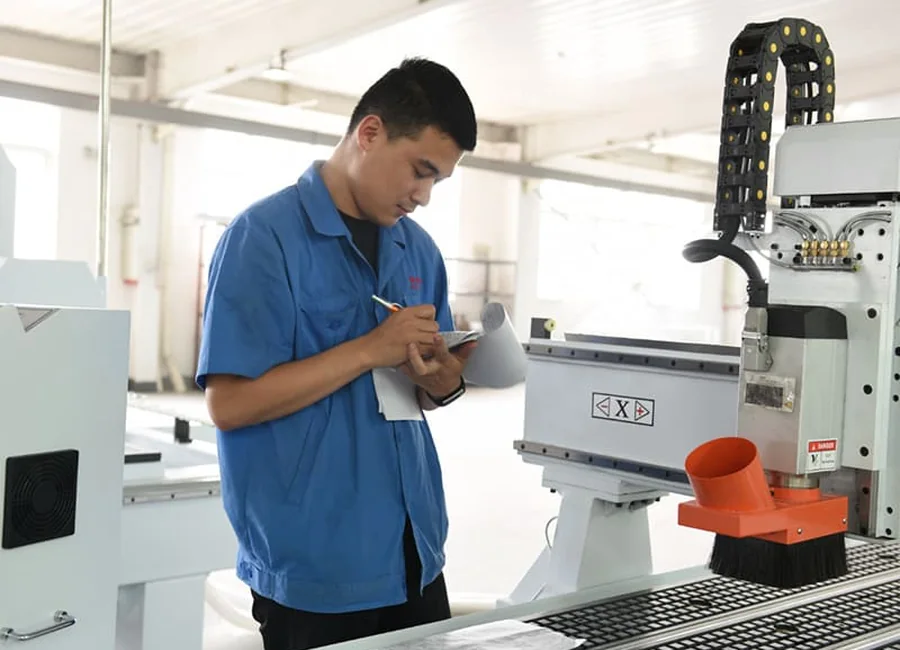
Before shipment, we check the machine frame and assembly, electrical system, axis movement and packing. That is the basic machine check.
For PTP-3013, we also run the ordered spindle, boring head, automatic tool changer, pod-and-rail workholding and positioning functions. If your project has a critical hole pattern, groove or routed profile, put it on the drawing so the acceptance check is tied to the real job.
Need destination-specific machine documents? List them in the RFQ. We will confirm what can be supplied with the order instead of promising documents that were never agreed.
PTP vs Nesting vs Six-Side Drilling: Choose the Production Flow First
| Production need | PTP-3013 | Nesting CNC | Six-side drilling |
|---|---|---|---|
| Individual or pre-cut doors and furniture parts | Strong fit | Possible, but the table/process is optimized for sheets | Strong for drilling-focused panels |
| Movable support around holes and routed profiles | Core strength | Usually a flat vacuum table | Different clamping and feeding approach |
| Full-sheet nesting and yield optimization | Not the first choice | Core strength | Not a sheet-nesting machine |
| Boring plus multi-tool routing on one component | Core use case | Depends on drill configuration | Routing capability varies by machine |
| Dense multi-face panel drilling with minimum flipping | Depends on hole directions and tool access | Often needs a secondary drilling process | Core strength |
We would rather recommend the simplest production route that finishes the part. More functions only make sense when your parts actually use them.
Send These Details and We Can Quote the Right PTP-3013 Setup
- Product type: door, cabinet part, furniture panel or other component
- Maximum and minimum part dimensions
- Material and thickness
- PDF/DXF/CAD drawing when available
- Vertical and horizontal hole layout, diameters and depths
- Grooves, pockets, profiles and engraving operations
- Normal tool list or number of tools per program
- Target pieces per shift and production mix
- Factory voltage, compressed air and dust extraction
- Destination country and installation/service expectations
Order, Lead Time, Packing and Shipping
One machine is fine
PTP-3013 can be ordered as a single configured machine. The quote follows the final configuration, destination and service needs.
Approx. 45-day production planning
Standard production lead time is about 45 days after the order and machine configuration are finalized. Freight time is separate and depends on the route and destination.
Export packing and container shipping
The machine is prepared for export packing and normally ships by container. Voltage, packing and shipping details are confirmed for the destination before shipment.
Installation, 12-Month Warranty and Support
Our service team supports installation guidance, operator training, troubleshooting and spare-parts coordination. For PTP-3013, the handover should cover controller use, pod positioning, boring and routing, tool setting, lubrication, dust extraction and routine maintenance.
Standard warranty: 12 months. Installation guidance, training and after-sales support are arranged according to the ordered configuration and destination before shipment.
PTP CNC Router FAQ
Why choose PTP-3013 instead of a flat-table router?
Choose PTP-3013 when movable pod support and boring plus routing matter on individual doors, panels or shaped parts. If your main job is full-sheet nesting, a flat-table nesting CNC is usually the better place to start.
What does the HSD 12V4H boring head do?
It gives the machine a dedicated furniture-boring function for accessible vertical and horizontal hole work. Send the real hole map and we can check the drilling sequence against the part.
Does 0.02 mm mean my finished parts will hold 0.02 mm tolerance?
No. The 0.02 mm figure is repositioning resolution. Finished-part accuracy still depends on calibration, tooling, material, workholding, toolpath and how the part is measured. Put the required tolerance on the drawing.
How do you estimate production output?
We break down the real cycle: loading, locating, hole count and direction, routing path, cut depth, tool changes, any flipping and unloading. Then we compare that with your pieces-per-shift target.
Is the 8-tool carousel enough?
It is enough when your normal routing program fits inside the tool plan. Send the operations or tool list and we can check whether the standard 8 positions cover the sequence.
Can PTP-3013 machine materials other than wood panels?
Yes, suitable tooling and workholding can be matched to acrylic, PVC, plastics, foam, suitable composites and aluminum composite panels. Soft aluminum needs its own cutter, chip-control, cutting-parameter and workholding plan, so we treat it as a separate application rather than assuming the wood setup will work.
Have a Difficult Door or Furniture Part? Send That One.
Send the drawing and the output you need. We will look at the hole directions, pod layout, boring work, routing steps, tool plan and factory conditions. If PTP-3013 is not the cleanest route, we would rather tell you that than push the wrong machine.
Review My Part for PTP-3013