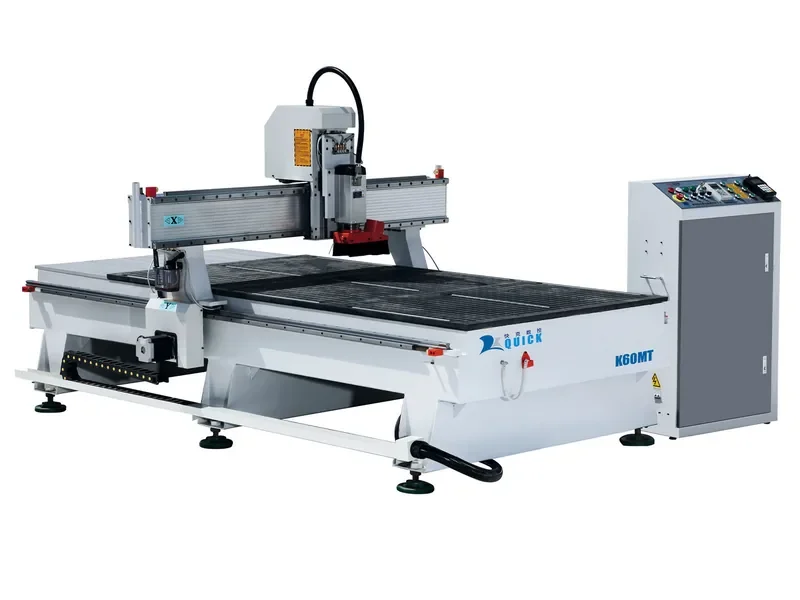
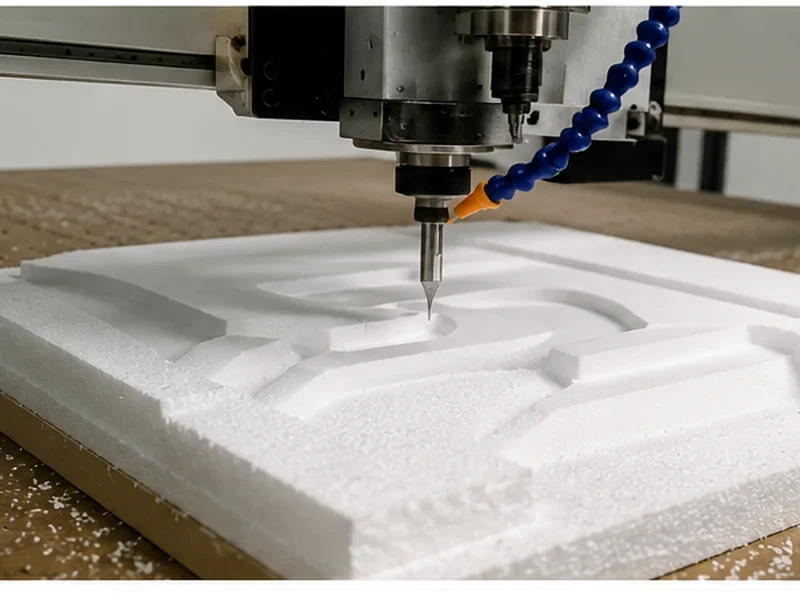
What Is a Point-to-Point CNC Machine?
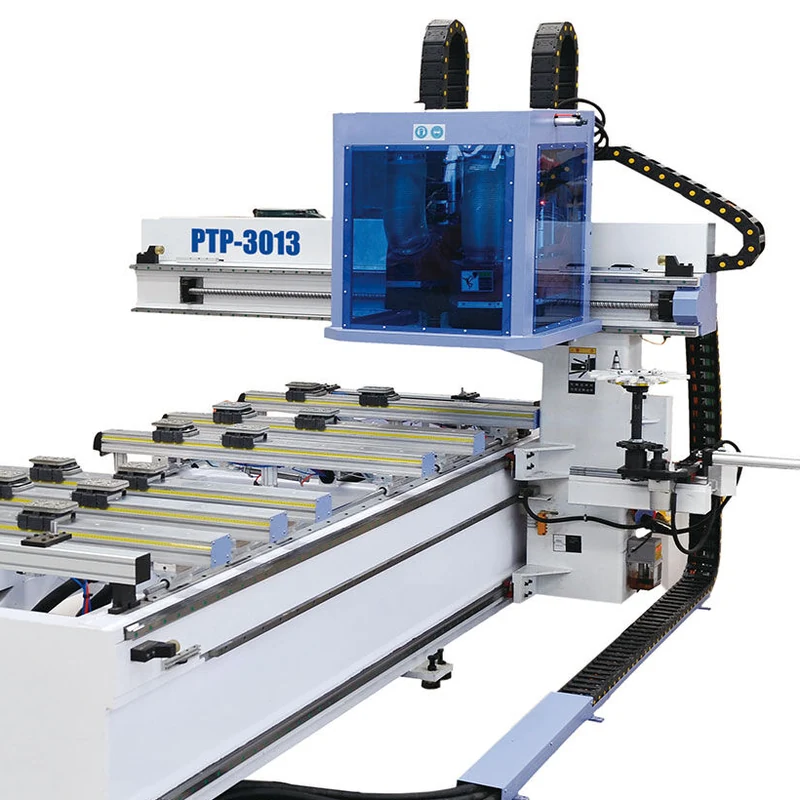
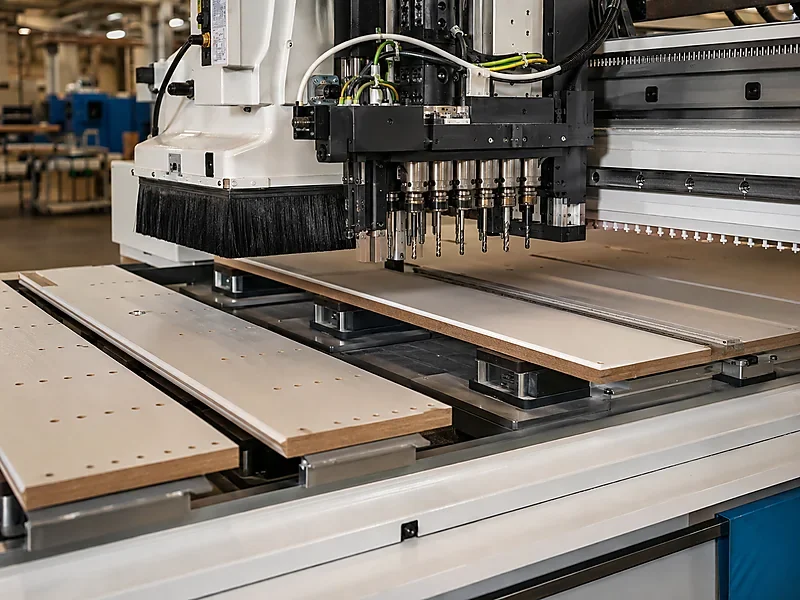
A point-to-point CNC machine, often called a PTP CNC, is mainly used to machine individual panels or parts after they have already been cut to size.
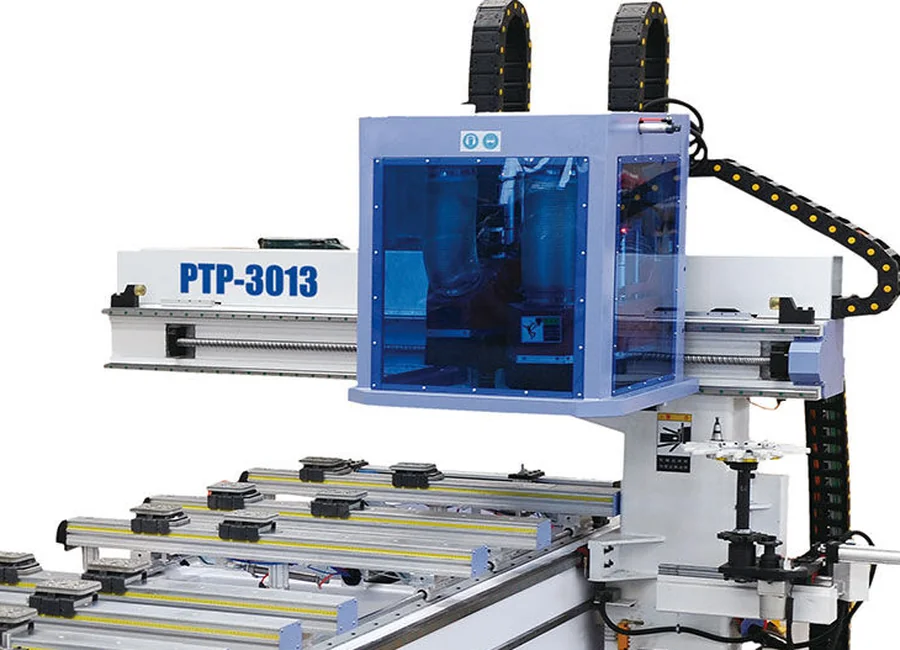
Think of cabinet sides, doors, rails and furniture parts that still need holes, grooves, pockets, cutouts or routing. Many PTP machines hold the part on pods and rails so the tool can reach areas that are harder to access on a flat nesting table.
If your process starts with pre-cut parts and those parts still need several machining operations, PTP is worth looking at. If your process starts with full sheets and the main job is cutting them into parts, start with nesting CNC. If drilling is slowing the whole line down, a dedicated drilling or six-sided drilling machine may make more sense.
Start with the parts you make every day
Send us 2–3 typical parts and tell us how you make them now. That is usually enough to see whether PTP, nesting or a drilling machine fits the job better.
Send Your Part DrawingsBefore You Compare Machines, Look at What Reaches the CNC
The easiest way to choose the wrong machine is to start with names and specifications before looking at the parts.
If a full MDF or plywood sheet goes straight to the CNC, you are looking at a very different production flow from a factory where a beam saw has already cut every part to size. The same is true for a door shop that needs lock pockets and edge work, or a cabinet line where side-hole drilling is the real bottleneck.
So before comparing spindle power, drill heads or tool changers, answer one simple question: what does the part look like when it arrives at this machine, and what still needs to be done before it can move to the next process?
Five Things That Tell You Which Machine You Need
You do not need to start with spindle power, drill-head size or tool positions. Start with the parts. Once these five things are clear, the machine choice gets much easier.
1. Does a full sheet or a finished-size part arrive at the machine?
This is the first split. If a full MDF or plywood sheet goes onto the CNC, nesting is normally the first machine to look at. If the panel has already been cut to size and still needs holes, grooves, pockets or edge work, PTP becomes much more interesting.
2. Where does the tool need to reach?
Look at the top, bottom and four edges of the part. Mark the vertical holes, horizontal holes, grooves, pockets, cutouts and profiles. Do not assume a machine can reach an operation just because the part fits inside the working area.
3. Can the machine hold the part without getting in the way?
This matters more than many specification sheets suggest. A pod, clamp or support can sit exactly where the drill or router needs to go. Small rails, narrow doors and irregular parts are especially worth checking.
4. What work is still happening before and after this CNC?
If operators still have to cut, label, flip, move, drill and reference the part again, the CNC cycle time tells only part of the story. Look at how many times the part is handled before it is actually ready for the next process.
5. Which part gives you the most trouble now?
Start with that one. A difficult cabinet side, door or furniture part quickly shows whether you need more drilling directions, better workholding, more tools or a completely different machine layout.
If you can show us one easy part and one difficult part, we can normally learn more from those drawings than from a long list of machine specifications.
PTP Makes Sense in These Jobs—and Not in Others
PTP is a strong fit when
- Your panels or doors are already cut to size before they reach the CNC.
- The same part needs drilling plus routing, grooves, pockets or cutouts.
- You need selected edge access for door or furniture-part machining.
- You run mixed batches and the CAD/CAM or barcode flow is already under control.
- You already have a panel saw or beam saw doing the sizing work.
Look at another machine first when
- Your main job is cutting full sheets into cabinet parts.
- Most work is simple top-face cutting and routing.
- Horizontal or multi-face drilling is the main thing slowing production down.
- Your parts cannot be identified and referenced reliably before loading.
- The required edge or bottom work is outside the reach of the proposed setup.
A flexible PTP machine does not fix an unclear process. If the incoming part, reference edge and machining faces are not clear, it is difficult to compare machine setups properly.
“Point-to-Point” Is Simpler Than It Sounds
The basic CNC meaning
In the strict CNC sense, point-to-point means the machine moves to programmed positions and performs an operation there. Drilling a row of shelf-pin holes is a simple example.
How the woodworking industry uses the name
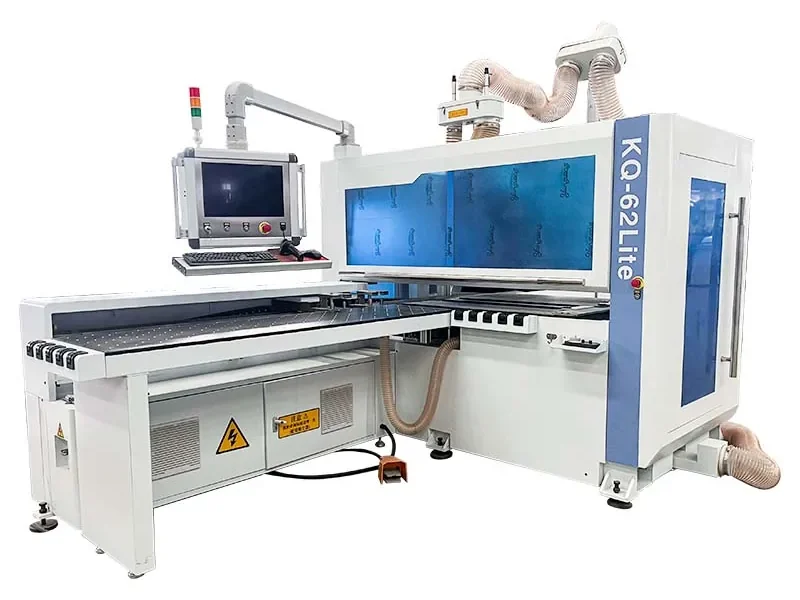
In woodworking, PTP is also used for machining centers that process one part at a time. Modern machines can include a router spindle, drill head, saw or grooving unit, tool changer and other aggregates, so a PTP machine can do much more than just drill point-by-point holes.
PTP and pod-and-rail are not the same thing. PTP describes the machining concept or machine category. Pod-and-rail describes how the part is supported. Always check the workholding and machining units separately.
What Happens From the Part File to the Finished Component
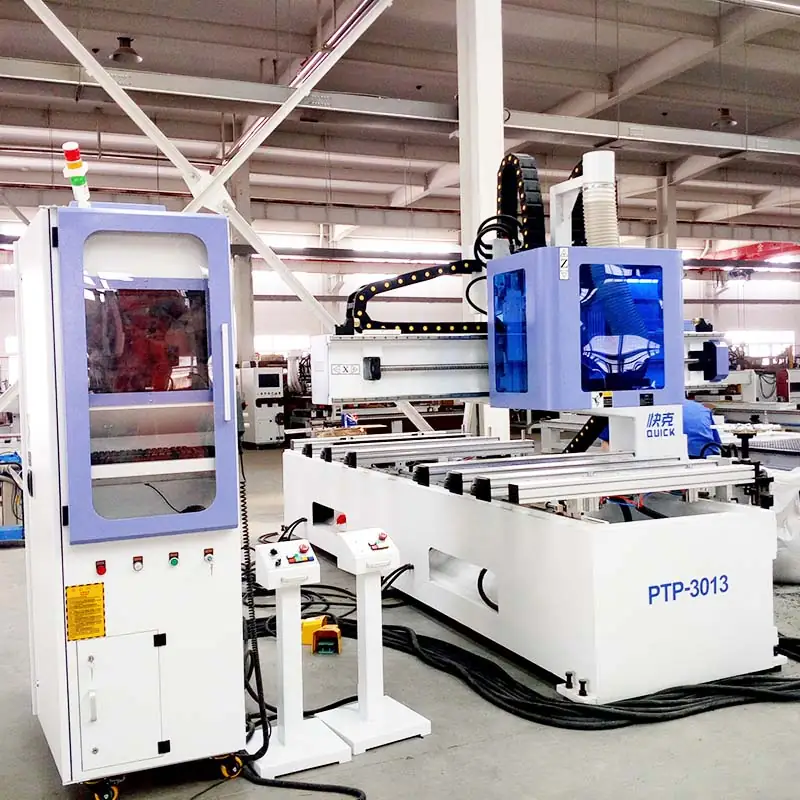
Prepare the part file
CAD or cabinet-design data defines the part. CAM adds drilling, routing, grooving and other operations, then the postprocessor turns that into code the machine can run.
Cut and identify the part
Most PTP work starts with a part that has already been sized on a panel saw, beam saw or another cutting machine. The part needs the right label or program before loading.
Set the pods, rails and references
The part has to be supported without putting a pod or clamp in the way of a drill, router bit or aggregate. This is especially important on narrow or irregular parts.
Run the drilling and routing
The machine follows the programmed sequence, changes tools when the setup allows it, and completes the required holes, grooves, pockets, profiles or cutouts.
Check the finished part
Look at hole position, groove and pocket size, edge relationship, surface quality and repeatability—not just whether the cycle finished without an alarm.
One real door, cabinet side or furniture part tells us more than a long equipment list. It quickly shows which faces need machining, how many tools are involved and whether another process will still be needed.
A Drill Bank and a Spindle Do Not Tell You Whether the Part Will Run
Start with workholding
If the part cannot be held properly, stop there. Check pod and rail range, clamps, stops and support for small parts. A support sitting in the toolpath can make an otherwise simple operation impossible.
Then look at drilling directions
Check which vertical and horizontal holes the exact drilling unit can reach. “Drill bank included” does not tell you enough.
Look at the routing work
Check the pockets, grooves, cutouts and profiles on your parts. Then decide how many tools you actually need and whether automatic tool changing will save meaningful time.
Check any special edge work
Edge routing, sawing, lock machining or angled work may need a special aggregate or a different machine layout. Check the actual access direction before adding options.
Make sure files reach the machine cleanly
The machine is only part of the system. If drawings cannot move cleanly from your design software into the CNC program, operators end up fixing files, tool settings and programs by hand.
Do not forget part handling
Loading height, part weight, dual work zones, labeling and downstream flow matter because the CNC only produces while parts keep moving through it.
More spindles, aggregates and tool positions can make a quotation look impressive, but they only make sense when your parts actually use them. Add an option because it saves real production time or removes another process—not just because the specification looks better.
PTP CNC vs Nesting CNC vs Six-Sided Drilling
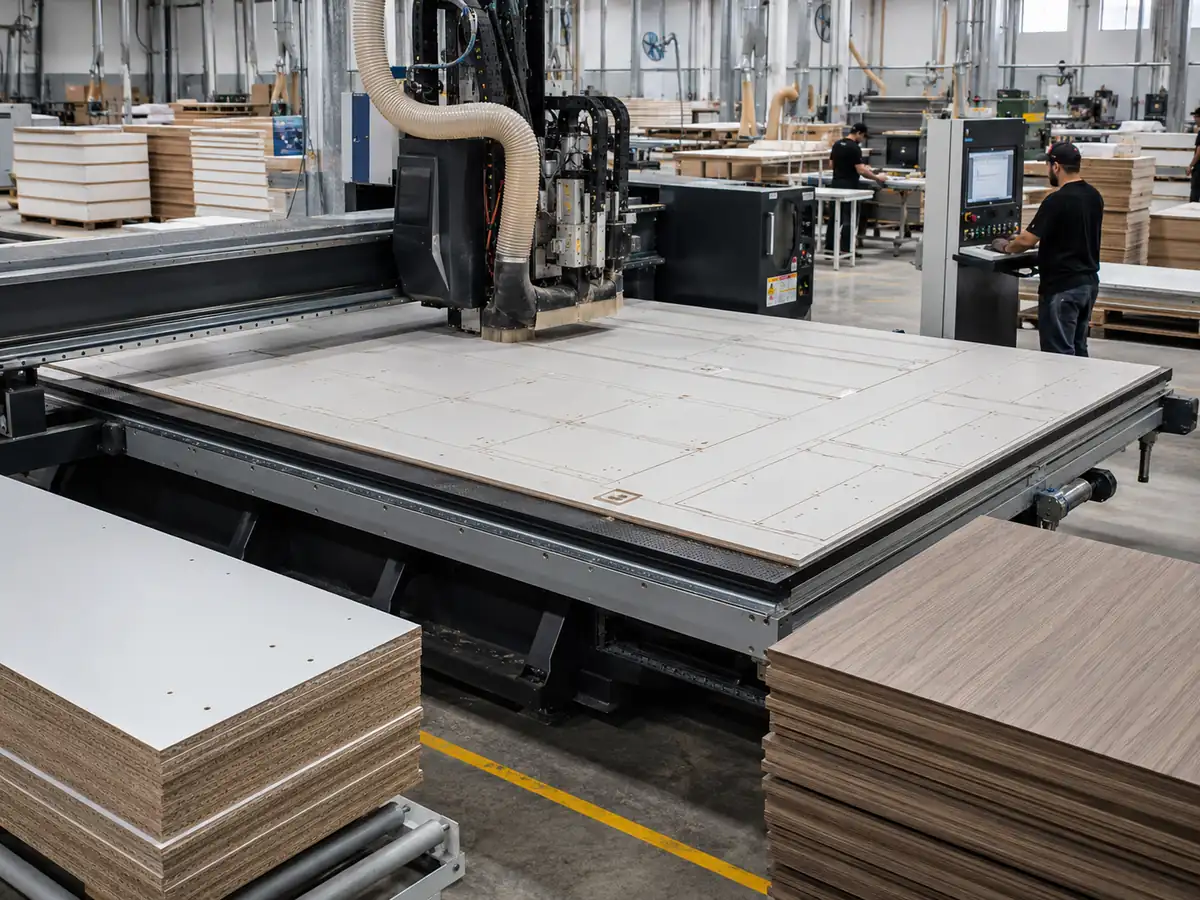
| What to compare | PTP CNC | Nesting CNC | Six-sided / dedicated drilling |
|---|---|---|---|
| What goes into the machine? | A pre-cut panel, door or component | A full sheet | An individual sized panel |
| What is it best at? | Flexible drilling, routing, grooves, pockets and selected edge work on individual parts | Cutting full sheets, nesting parts and doing top-face work | Fast repeated drilling on several faces |
| How is the part held? | Pods, rails, clamps or model-specific supports | Flat vacuum table and spoilboard | Clamps, grippers or through-feed supports |
| Is upstream cutting usually part of the workflow? | Often yes—when PTP is used after a panel or beam saw | No—the nesting process does the cutting | Yes |
| When does it stand out? | When one finished part needs several different machining operations | When full-sheet conversion and material use are the main priorities | When drilling output is the bottleneck |
Do not compare these machines by rapid speed alone. Compare how many finished parts come out of the whole process after cutting, sorting, loading, flipping, drilling and rework are included.
Use Your Hardest Part to Check the Machine
1. Mark every operation on the drawing
Show the top, bottom and four edges. Mark vertical holes, horizontal holes, grooves, pockets, cutouts, profiles and any angled work. If an operation is not assigned to a spindle, drill unit or aggregate, it will still need another process.
2. Check the smallest part as carefully as the biggest one
Maximum size only tells you whether a large part fits. Narrow rails, small doors, thin panels and irregular shapes are often harder to hold. Make sure the machine can support them without blocking the toolpath.
3. Look for pod and clamp conflicts
A hole may be inside the machine’s travel and still be impossible to machine if a pod or clamp sits in the same place. For difficult parts, look at the actual support layout rather than relying on working-area numbers.
4. Separate drilling work from routing work
Count the holes and note their directions, then look at how much routing each part needs. If drilling dominates the cycle, a drilling-focused machine may be the better investment. If pockets, profiles and edge work matter too, PTP becomes more attractive.
5. Think about changeovers
Mixed batches are not the problem. The problem starts when operators have to search for programs, guess which edge is the reference, or rebuild pod positions from memory.
6. Make sure the software path is clear
Know how a drawing gets from the design software to the CNC. The postprocessor, controller format, barcode data and tool database need to work together before the machine goes into production.
Panel Saw + PTP, Nesting, or Six-Sided Drilling? Follow the Part.
These machines solve different stages of cabinet and furniture production. The cleanest comparison is to follow the panel from the full sheet to the finished component.
Panel Saw + PTP
Typical flow:
Panel saw or beam saw → label → PTP drilling/routing → edge banding or assembly.
Start here when sheet cutting already works well and pre-cut parts still need holes, grooves, pockets, routing or selected edge work.
Watch for: part identification, pod/clamp conflicts, small-part support and actual edge access.
Nesting CNC
Typical flow:
Full sheet → nesting cutting + top-face machining → sorting → edge banding → secondary drilling if needed.
Start here when you want the CNC to receive full MDF, plywood or panel sheets and handle cutting plus compatible top-face work in one setup.
Watch for: what still happens after cutting. Fast nesting does not help much if many parts still need flipping, side drilling or another CNC operation.
Nesting + Six-Sided Drilling
Typical flow:
Nesting cutting → sorting/edge banding as required → six-sided drilling → assembly.
Start here when panel cutting is already handled and repeated vertical, horizontal or connector drilling is the main bottleneck.
Watch for: parts that still need pockets, routing or special edge machining beyond a drilling-focused setup.
Do not ask which machine is faster until you know which operations it removes from the rest of the line. A slightly longer CNC cycle can still be the better setup if the part leaves with less flipping, moving and secondary work.
| Your production situation | Start by looking at | Why |
|---|---|---|
| Panels are already cut accurately, but individual parts still need several machining operations. | Panel Saw + PTP | Keep the cutting process and let PTP finish the pre-cut component. |
| You want to load a full sheet and cut cabinet parts directly. | Nesting CNC | Nesting handles sheet conversion and compatible top-face work in one setup. |
| Sizing or nesting already works, but side holes and repeated drilling are slowing production. | Six-Sided Drilling | Move the drilling load to a machine built around multi-face panel drilling. |
The machine should fit the work before and after it. If operators still spend too much time moving, flipping, sorting or re-referencing parts, a faster spindle will not solve the real bottleneck.
Use One Cabinet Side Panel to Compare the Machines
Take one real part and mark every operation. A cabinet side panel quickly shows the difference between nesting, PTP and six-sided drilling.
Example part
Assume the panel needs its outside profile, vertical shelf-pin holes, connector holes, a back-panel groove, a small routed pocket and horizontal holes on one edge.
If you start from a full sheet
Nesting is the natural first machine to compare. It can cut the part and complete compatible top-face holes, grooves, pockets and routing in the same setup. The key question is what remains afterward—especially horizontal or side holes.
If the panel is already cut to size
PTP becomes more attractive because the job is now about finishing an individual component. Vertical drilling, grooves, pockets and routing can be planned around the finished-size part. Horizontal holes may also fit the same route when the selected drilling unit or aggregate can reach them and the workholding keeps the edge clear.
If drilling is most of the remaining work
Compare six-sided drilling as well. When sized panels mainly need repeated vertical, horizontal and connector holes with little complex routing, a drilling-focused machine may be the better use of production capacity.
| What the part needs | Nesting CNC | PTP CNC | Six-Sided Drilling |
|---|---|---|---|
| Cut the part from a full sheet | Strong fit | Not the main reason to choose it | Not its job |
| Vertical holes, groove or routed pocket | Good fit when the setup supports the operations | Strong fit with the right drilling/routing setup | Strong for drilling; routing depends on machine functions |
| Horizontal edge holes | May need another process | Possible with the right unit/aggregate and clear workholding | One of the main reasons to compare it |
| Best starting condition | Full sheet | Pre-cut individual part | Sized individual panel |
Do not compare these machines only by spindle power or rapid speed. Ask: how close to finished is this part when it leaves the machine?
Use the same method for doors, shelves, drawer parts and other furniture components: mark the operations first, then see which machine finishes the largest share of the work with the least unnecessary handling.
Five Ways a PTP Purchase Goes Wrong
- Treating “PTP” as the full specification. It tells you very little about the actual drill head, spindle, workholding, tool changer or software.
- Looking only at CNC cycle time. Cutting, sorting, setup, loading and secondary operations can take more time than the machining itself.
- Forgetting small and awkward parts. These are often harder to hold than the largest panel.
- Assuming every edge is reachable. Machine geometry, tool length, pods and clamps all affect access.
- Leaving software until the end. The machine and postprocessor need to work as one production system.
If someone says “the machine can do it,” ask a few more questions: which unit does the operation, from which direction, with which tool, and how will the part be held while it happens?
Put Real Parts Against the Setup Before You Buy
You do not need to prepare a thick technical file before talking about the machine. Start with a few real parts. Before the setup is finalized, make sure the important operations on those parts can actually be completed the way you expect.
- Mark the required holes, grooves, pockets and machining directions on a real part drawing.
- Check which machine unit will do each operation.
- Look at the workholding for your largest, smallest and most difficult parts.
- Make sure the CAD/CAM and postprocessor path matches the controller.
- Use a typical part to confirm the holes, grooves, pockets and other machining results needed for your production.
- Check floor space, loading, utilities and what happens immediately before and after the CNC.
Send a Few Parts First. We Can Narrow the Machine Down From There.
Quick CNC was established in 2006 and supplies CNC router and panel-furniture processing equipment. For a PTP project, we start with the parts you make and how you make them now. Once that is clear, it becomes much easier to see which machine fits the work.
Show us the parts
Send a few typical drawings, especially the part that gives you the most trouble now. We look at the material, size, holes, grooves, pockets, edge work and other operations.
Show us how the parts move through your factory
Tell us where they are cut, what still needs drilling or routing afterward, and where operators have to move, flip or reference the part again.
Match the machine to the work
From there, we can compare PTP, nesting, a drill-bank router or dedicated drilling, then match the workholding, drilling units, spindle, tools, software and part handling to the parts you actually produce.
You can also review the Quick CNC PTP CNC Router for Doors and Furniture Panels as a starting point. The exact setup still needs to match the parts and operations you plan to run.
Questions We Often Hear About PTP CNC Machines
What does PTP mean in CNC?
PTP means point-to-point. In CNC control it describes moving to programmed positions for machining; in woodworking it is also used for part-by-part CNC machining centers.
Is a point-to-point machine the same as a CNC router?
A PTP machine is CNC equipment and many setups include a router spindle, but PTP is not one fixed hardware package. Check the drill head, spindle, tool changer, workholding and machining directions on the actual machine.
Is pod-and-rail the same as point-to-point?
No. PTP describes the machining concept or machine category; pod-and-rail describes the workholding. They are often used together, but they are not the same thing.
Can a PTP CNC machine route as well as drill?
Yes, when the setup has the required routing spindle, tools, control functions and postprocessor. Check your actual operations against the installed units.
Does a PTP CNC machine need a panel saw?
Not always. In a common pre-cut-part workflow, a panel or beam saw is used upstream. If you want the CNC to start from full sheets, nesting CNC is usually the first option to compare.
Which is better, PTP CNC or nesting CNC?
Choose PTP when pre-cut parts still need flexible drilling and routing. Choose nesting when full-sheet cutting and top-face machining are the main job. Compare the whole production route, not just CNC cycle time.
Can a PTP machine drill horizontal holes?
Only when the selected setup has the required horizontal drilling unit, spindle orientation or aggregate and the workholding leaves the hole accessible.
What should I send when I ask about a PTP CNC machine?
Start with 2–3 part drawings, material and thickness, smallest and largest part size, required holes/grooves, your current process and output target.
Technical References
- WOOD TEC PEDIA: Point-to-Point
- HOMAG: CNC Machining Centers
- Biesse: Wood Multi-Machining
- Felder Group: CNC Machine Centres
These references explain the general machine categories and process differences. The capabilities of an individual machine still depend on its actual configuration.

Frannie
Hello, I’m Frannie, a CNC machinery specialist with 15 years of experience in the woodworking CNC industry. I help furniture factories, cabinet makers, woodworking workshops, and production businesses choose CNC machines that match their production needs, factory size, budget, and efficiency goals.
My work focuses on solving real production problems, including replacing outdated equipment, improving machining efficiency, reducing labor costs, and upgrading to smarter CNC solutions. I also support customers with machine installation guidance, operation training, video support, and on-site training when needed, helping them use their machines more confidently and effectively.