Quick answer: What is computer numerical control?
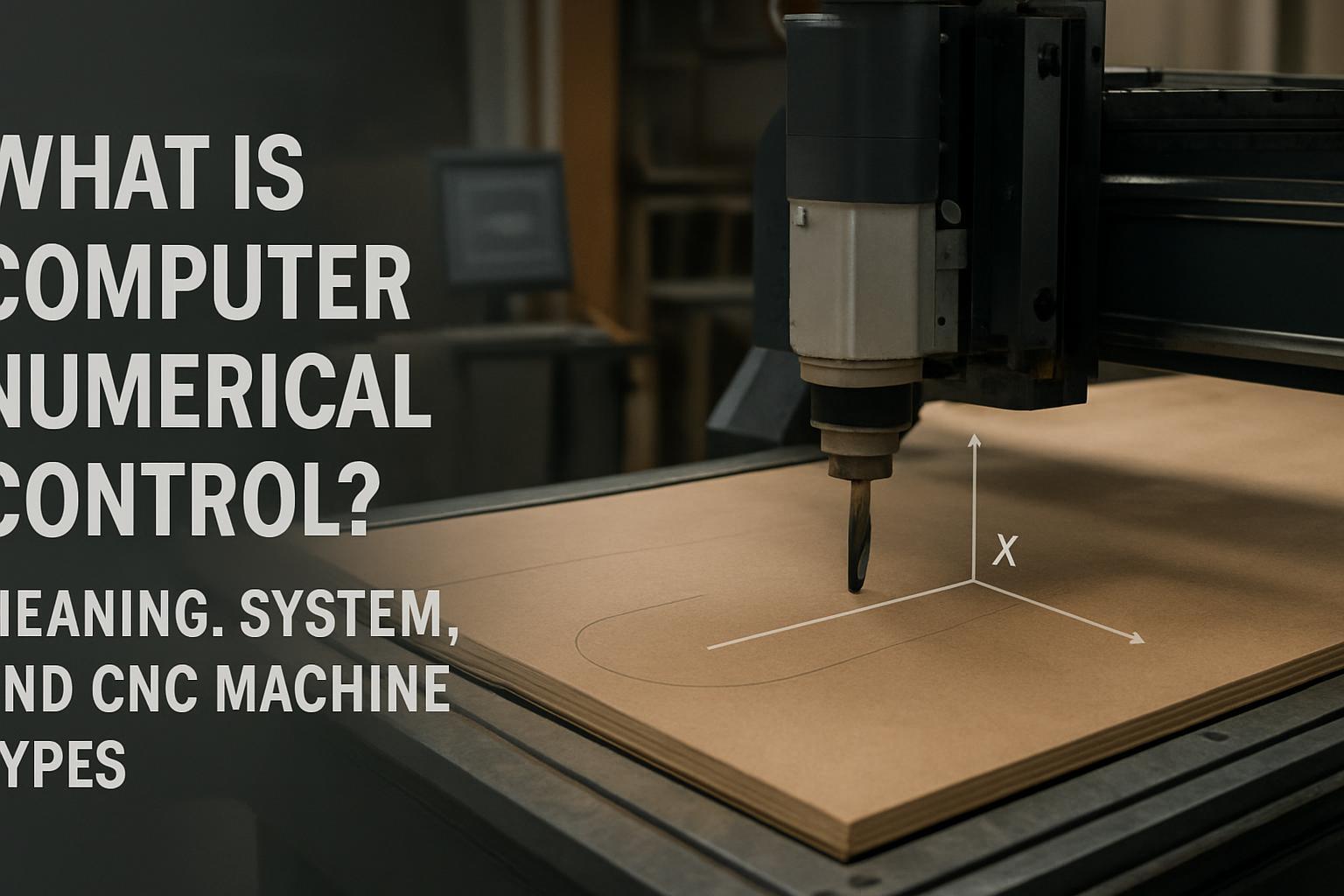
Computer Numerical Control (CNC) is a manufacturing method where a computer uses programmed numerical instructions to control machine tools. In simple terms, CNC turns a digital design into precise machine movement, so a machine can cut, drill, carve, mill, turn, or route materials with repeatable accuracy.
This matters because repeatability is hard to achieve by hand. CNC helps shops and factories produce the same hole pattern, groove, or cut profile again and again, with fewer measuring mistakes and less variation between operators.
For a broader definition and background, see PTC’s overview, “What Is Computer Numerical Control (CNC)?” and the Wikipedia entry on Computer numerical control.
What does CNC stand for? (CNC meaning, and what it does NOT stand for)
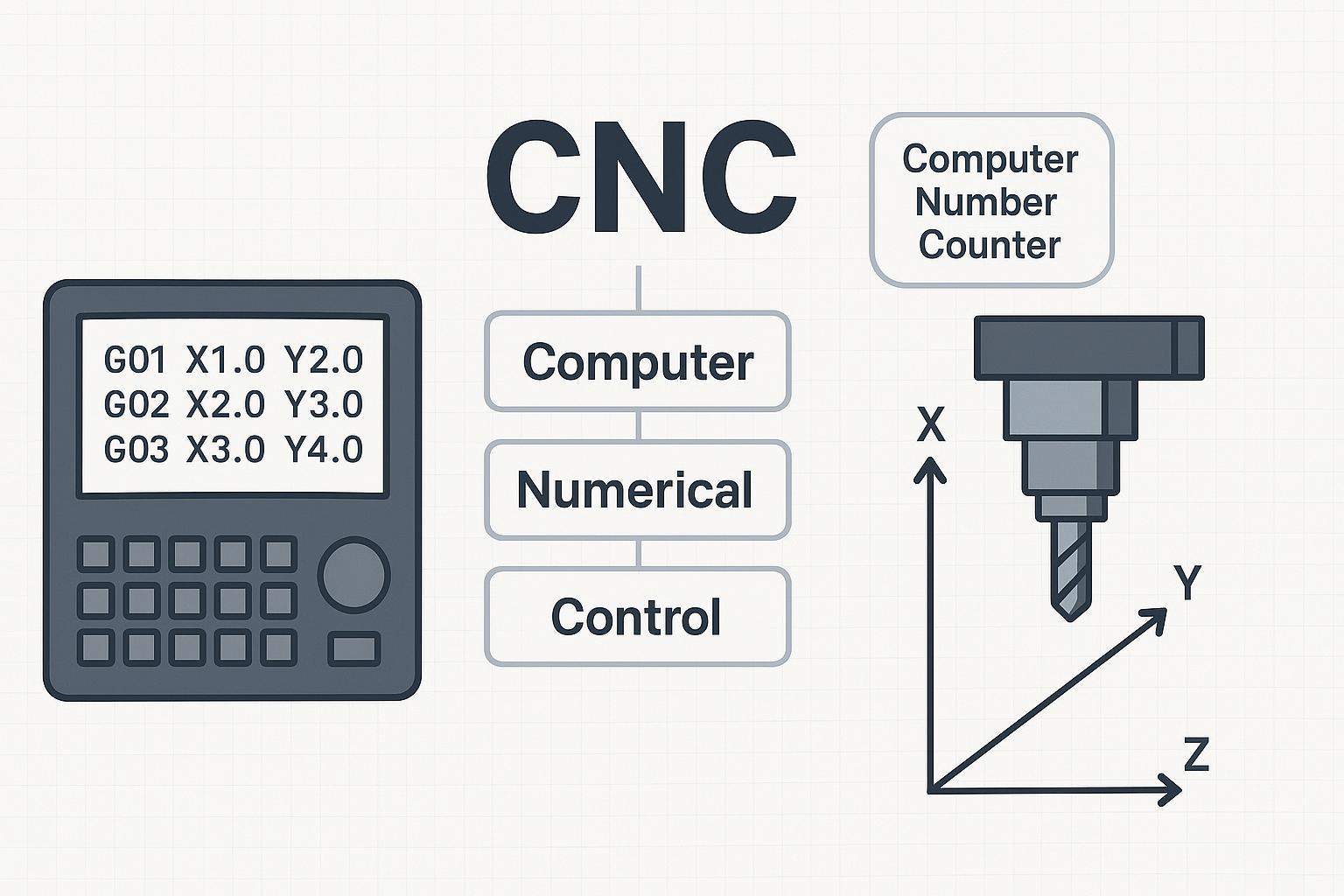
CNC stands for Computer Numerical Control. If you’re searching for the meaning CNC in plain language, it simply means a computer runs numerical instructions that control how a machine moves and cuts.
That sounds technical, but the idea is straightforward: the “computer” reads a program, the “numerical” part means the program is made of numbers (coordinates, speeds, feed rates), and the “control” part means those numbers control how the machine moves and cuts.
Does CNC stand for “Computer Number Counter”?
No. CNC does not stand for Computer Number Counter. CNC stands for Computer Numerical Control.
People often search that phrase because they’re trying to make sense of the acronym. The correct meaning is about controlling a machine using numerical instructions.
What is a “C and C machine”?
In most cases, “C and C machine” is a misheard or misspelled way of saying CNC machine.
When someone says “a CNC,” they usually mean “a machine tool controlled by a computer program,” not a separate category called “C and C.”
Is “computerized numerical control” the same thing?
You’ll sometimes see phrases like “computerized numerical control machine.” In common usage, that’s usually the same idea: a machine controlled by computerized numerical instructions.
How does computer numerical control work?
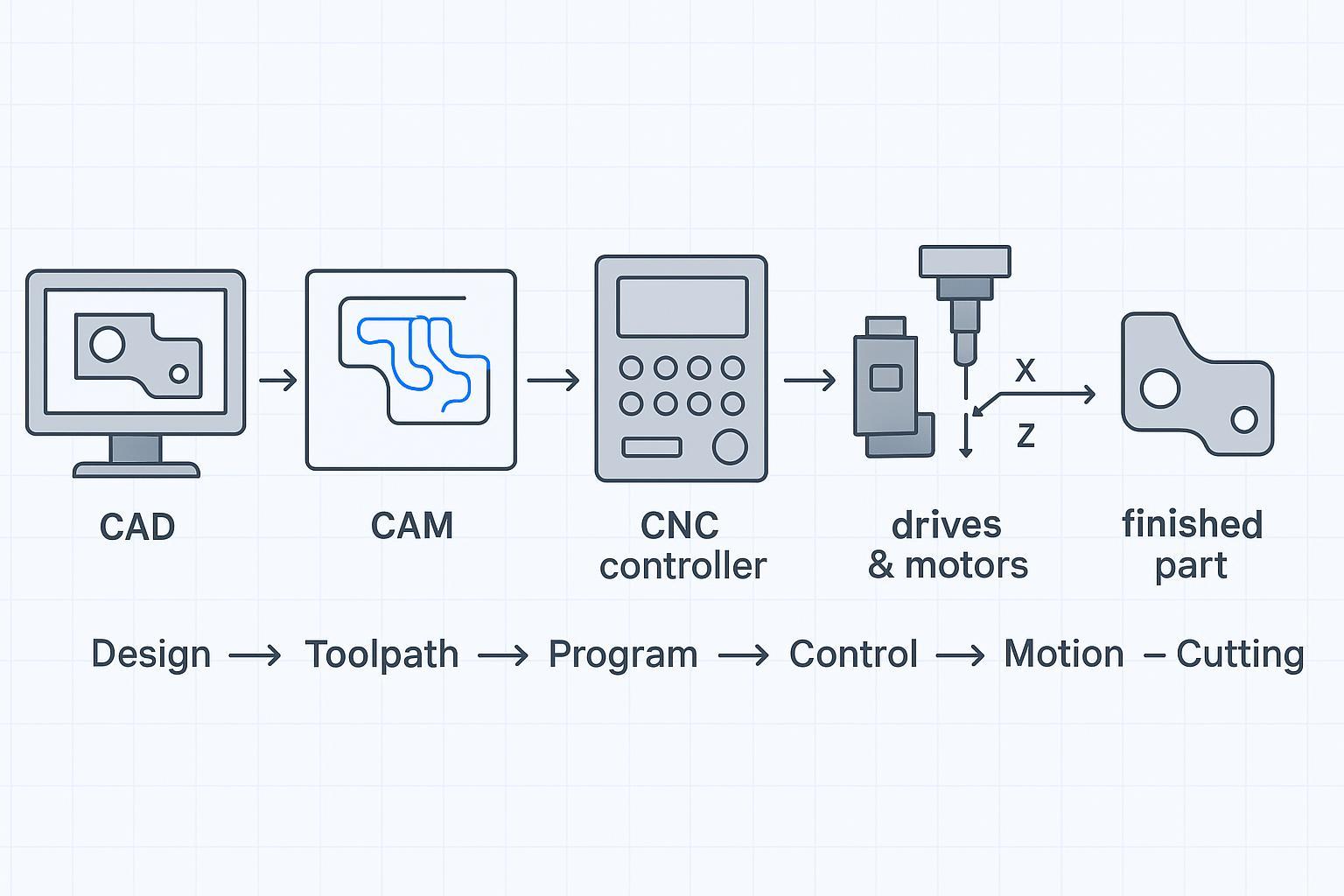
At a high level, CNC works like this: you design something on a computer, software turns that design into a toolpath, and the machine follows that toolpath.
Here’s the typical workflow in plain English.
Step | What happens | What it produces |
|---|---|---|
CAD design | You draw the part, panel, pattern, or cabinet component in CAD software. | A digital drawing/model |
CAM toolpath | CAM software decides how the tool should move to make that design. | Toolpath strategy (cuts, drills, pockets) |
G-code program | The toolpath is converted into machine-readable commands (often G-code). | A CNC program file |
CNC controller | The controller reads the program and coordinates motion and machine actions. | Motion/control signals |
Drives + motors | Motor drives power the motors to move along X/Y/Z (and sometimes A/B/C). | Precise axis movement |
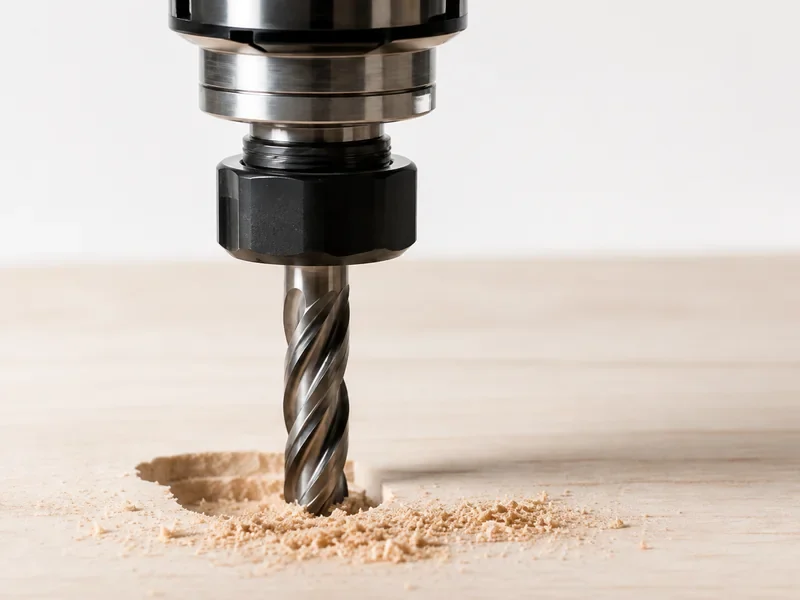
Spindle/tool does the work | The cutting tool removes material (routing, drilling, milling, turning, etc.). | Finished part |
A simple way to remember it:
CAD defines the part, CAM plans the process, and the CNC controller executes it.
A note on woodworking workflows
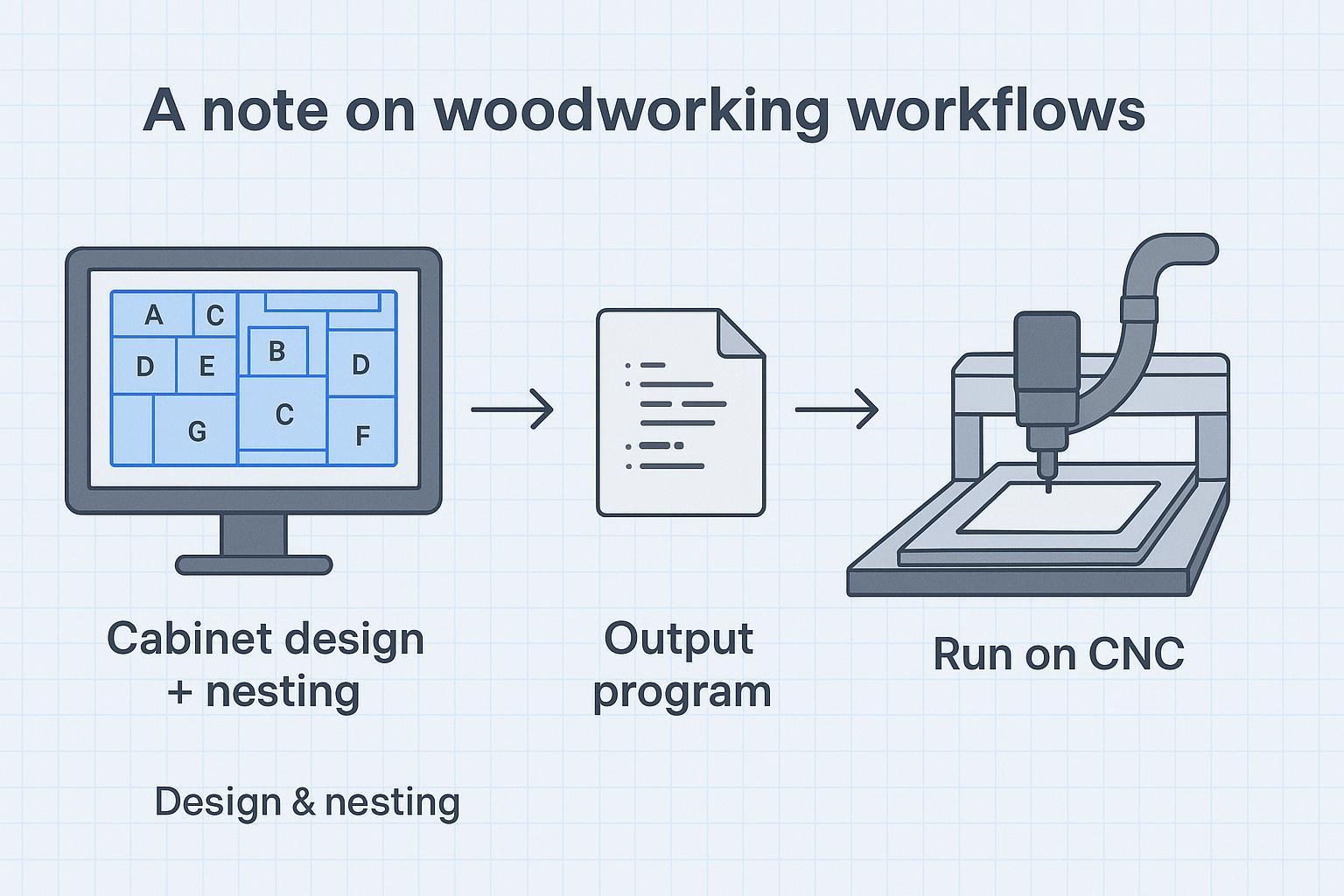
In cabinet making and panel furniture production, the “CAD/CAM” step may be handled by cabinet design + nesting software. The point is the same: the software outputs a program that the CNC can run.
YouTube: a practical walkthrough
If you prefer watching the workflow, here’s a relevant Quick CNC channel video:
<div data-type="node-video" data-provider="youtube" data-url="https://www.youtube.com/watch?v=QUJ-Nf4s7ng" data-embed-url="https://www.youtube.com/embed/QUJ-Nf4s7ng"></div>
What is a computer numerical control system?
A computer numerical control system is the combination of software and hardware that reads a program and controls the machine’s motion and functions.
Think of it as a coordinated package, not just a machine frame with a motor.
Component | What it does |
|---|---|
CAD/CAM (or nesting) software | Creates designs and turns them into toolpaths/programs |
CNC program (often G-code) | Provides the numerical instructions for motion and machine actions |
CNC controller (MCU/HMI) | Interprets the program and coordinates the machine |
Drives | Convert controller commands into controlled power for the motors |
Servo or stepper motors | Move the axes (and sometimes control auxiliary motion) |
Spindle + cutting tool | Performs cutting, drilling, carving, routing, etc. |
Machine frame + table | Provides rigidity and holds the workpiece stable |
Sensors/limits/feedback | Helps with safety and positioning; some systems use feedback for higher accuracy |
Workholding | Vacuum table, clamps, fixtures, pods, etc. |
Dust extraction / coolant (process dependent) | Keeps the process stable and safe (especially important in woodworking) |
Key takeaway: Buying “a CNC” is never just buying hardware. Software compatibility, post-processors, workholding, tooling, training, and support determine whether CNC actually improves output.
NC vs CNC: what’s the difference?
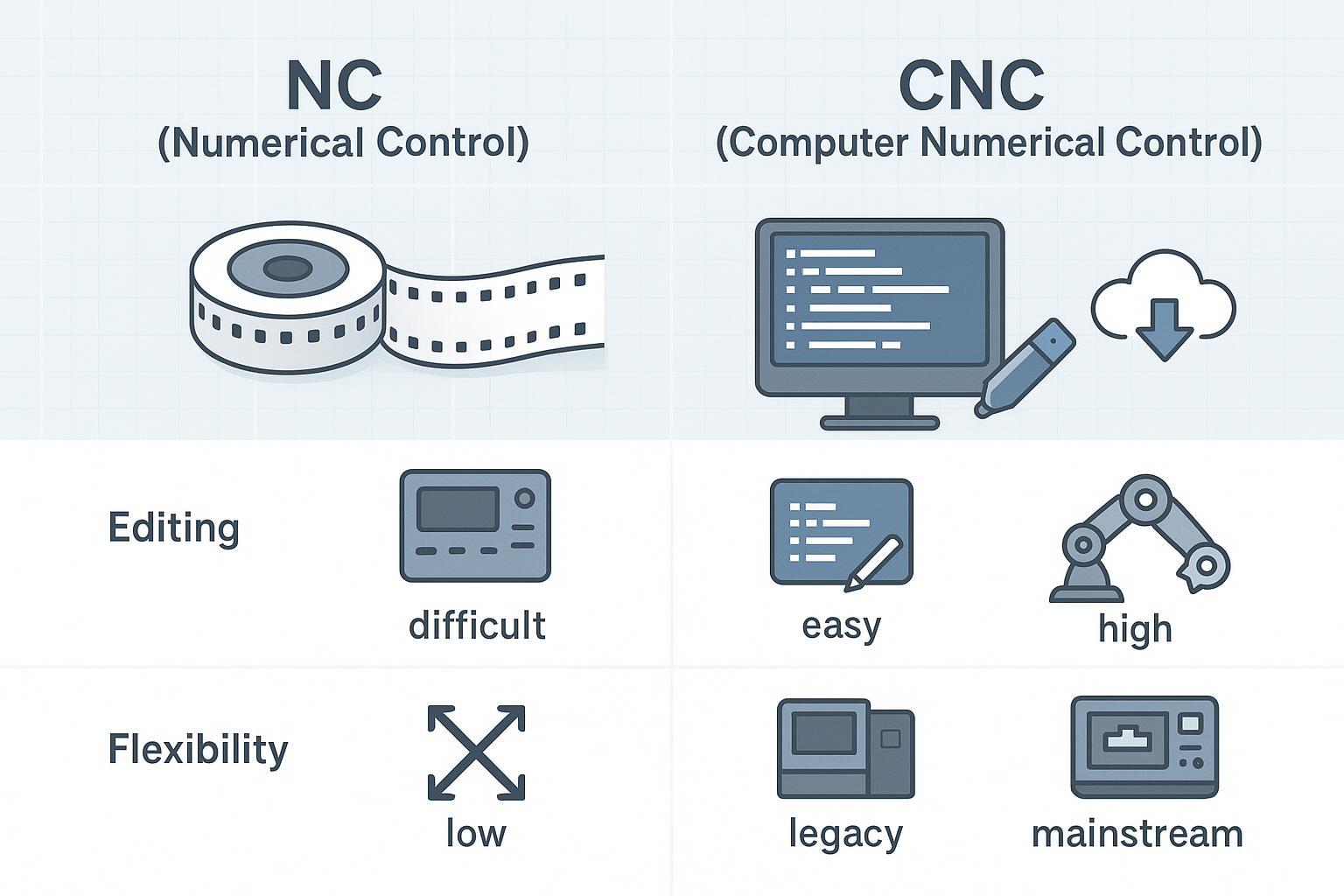
If you’re searching NC numerical control, here’s the short version: NC is the older concept of controlling machines using numerical instructions. CNC adds computer control, which makes programs easier to store, edit, reuse, and automate.
Here’s the short comparison.
Item | NC (Numerical Control) | CNC (Computer Numerical Control) |
|---|---|---|
Control method | Earlier systems often used punched tape/cards or fixed media | Programs are stored and run on a computer-based controller |
Editing programs | Harder and slower to change | Easier to edit, save, copy, and optimize |
Flexibility | Lower | Higher, better for frequent changeovers |
Typical use today | Older/legacy concept | Mainstream standard for modern machine tools |
Is CNC a machine or a control method?
CNC is not one specific machine. CNC is a control method.
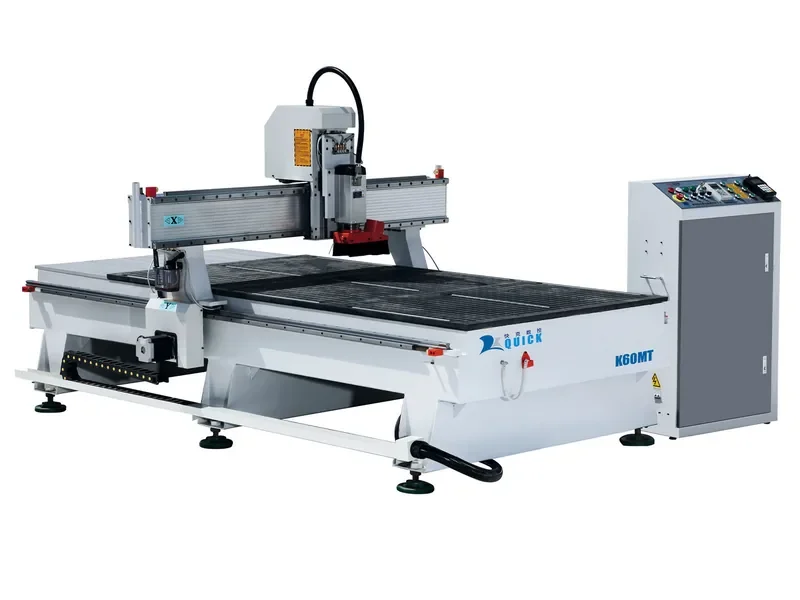
A “CNC machine” could be a router, a mill, a lathe, a laser cutter, a plasma cutter, and more. What makes it CNC is that a controller runs a program that controls the machine’s motion and actions.
This point matters for buyers because “the right CNC machine” depends on what you make, what materials you cut, and what kind of parts you produce.
Common types of computer numerical control machine tools
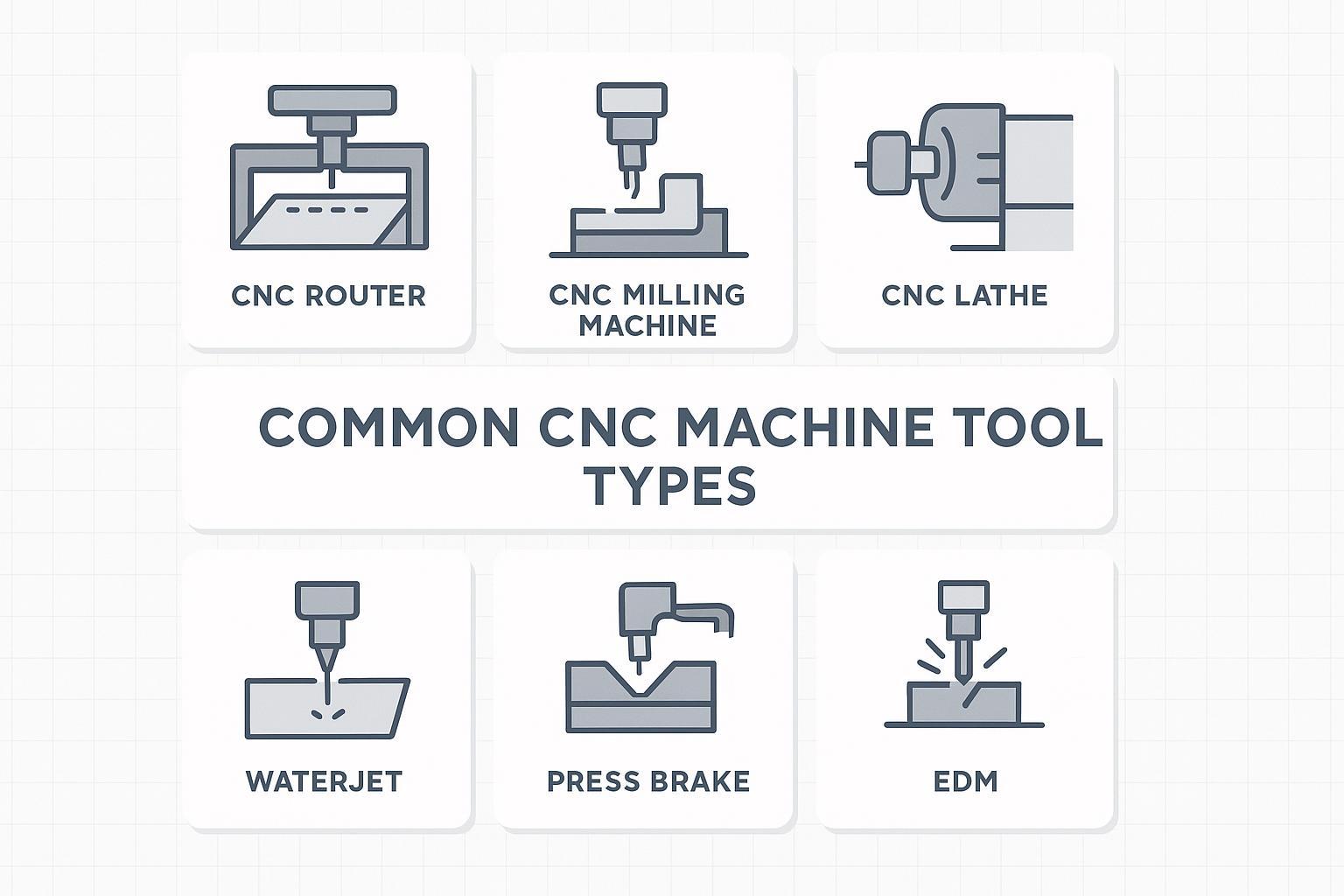
When people search “computer numerical control machine tools,” they’re usually asking what kinds of machines use CNC.
Here are common types, plus what they’re typically used for.
CNC machine tool type | Common uses | Typical materials |
|---|---|---|
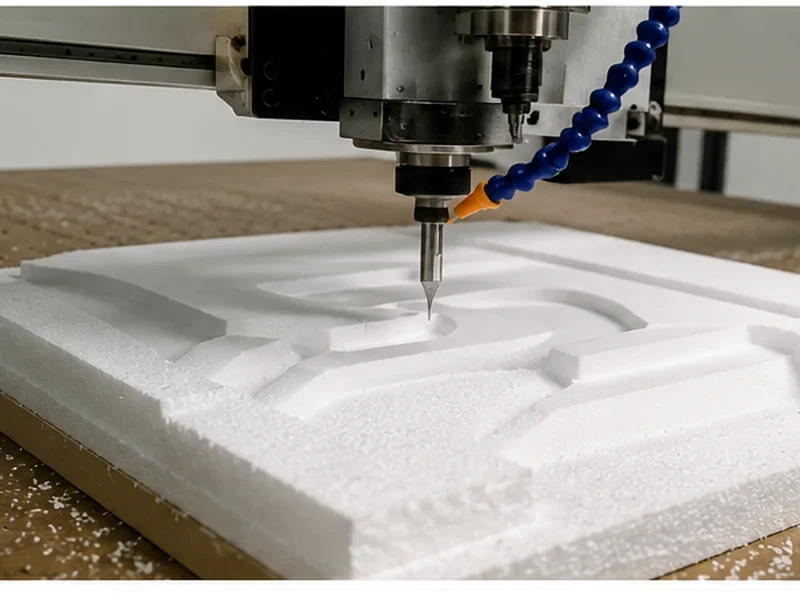
CNC router | Cabinet parts, furniture panels, wood doors, signs, molds | Wood, MDF, plywood, plastics, foam (and sometimes light aluminum) |
CNC milling machine | Precision parts, molds, metal components | Aluminum, steel, brass, plastics |
CNC lathe | Round parts, shafts, turned components | Metals and plastics (and wood on wood lathes) |
CNC laser cutter | Fine cutting/engraving on sheet goods | Acrylic, wood (engraving), sheet metal (fiber laser) |
CNC plasma cutter | Fast cutting of metal plate | Steel and other conductive metals |
CNC waterjet | Cutting without heat distortion | Metals, stone, glass, composites |
CNC press brake | Bending sheet metal | Sheet metal |
CNC grinding machine | Precision finishing | Hardened metals |
CNC EDM | Electrical discharge machining for hard metals and molds | Hard metals |
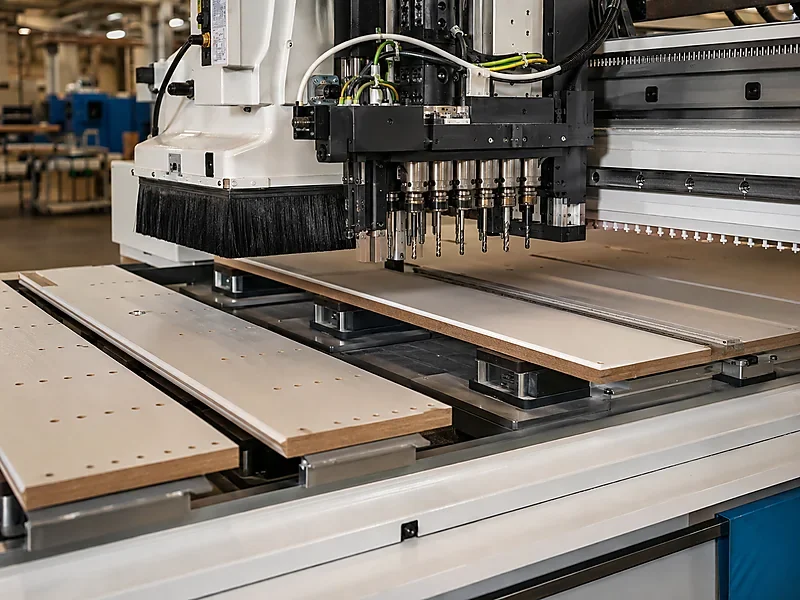
For woodworking, CNC most often shows up as CNC routers, nesting CNC machines, and integrated panel furniture production equipment.
If you’re exploring that side of CNC, the Quick CNC CNC router category is a good place to see common configurations used in wood and panel processing.
What is computer numerical control machining?
Computer numerical control machining (often shortened to CNC machining) is the process of using CNC-controlled machine tools to manufacture parts.
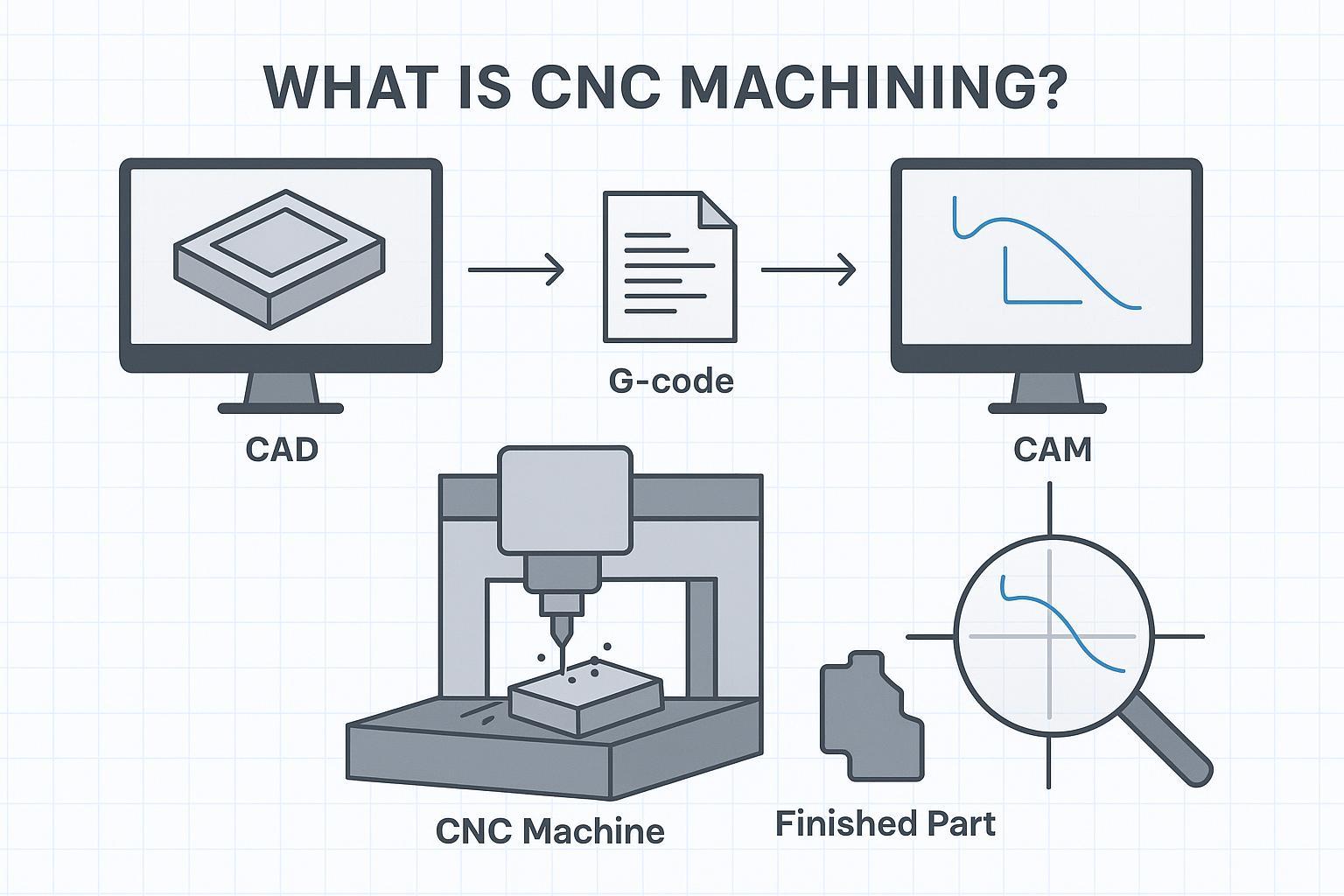
Many CNC machining explainers focus on metalworking and subtractive manufacturing. That’s fair, because CNC mills and lathes are common in metal part production.
But the core idea applies in woodworking too: you’re still converting a design into a toolpath and running it on a CNC-controlled machine. The difference is usually the machine type (router vs mill) and the process details (dust collection, vacuum hold-down, tooling geometry, feeds/speeds for wood).
For an overview from a CAD/CAM software perspective, Autodesk explains the workflow in “What is CNC machining and how does it work?”.
How CNC is used in woodworking, cabinet making, furniture, doors, and sign making
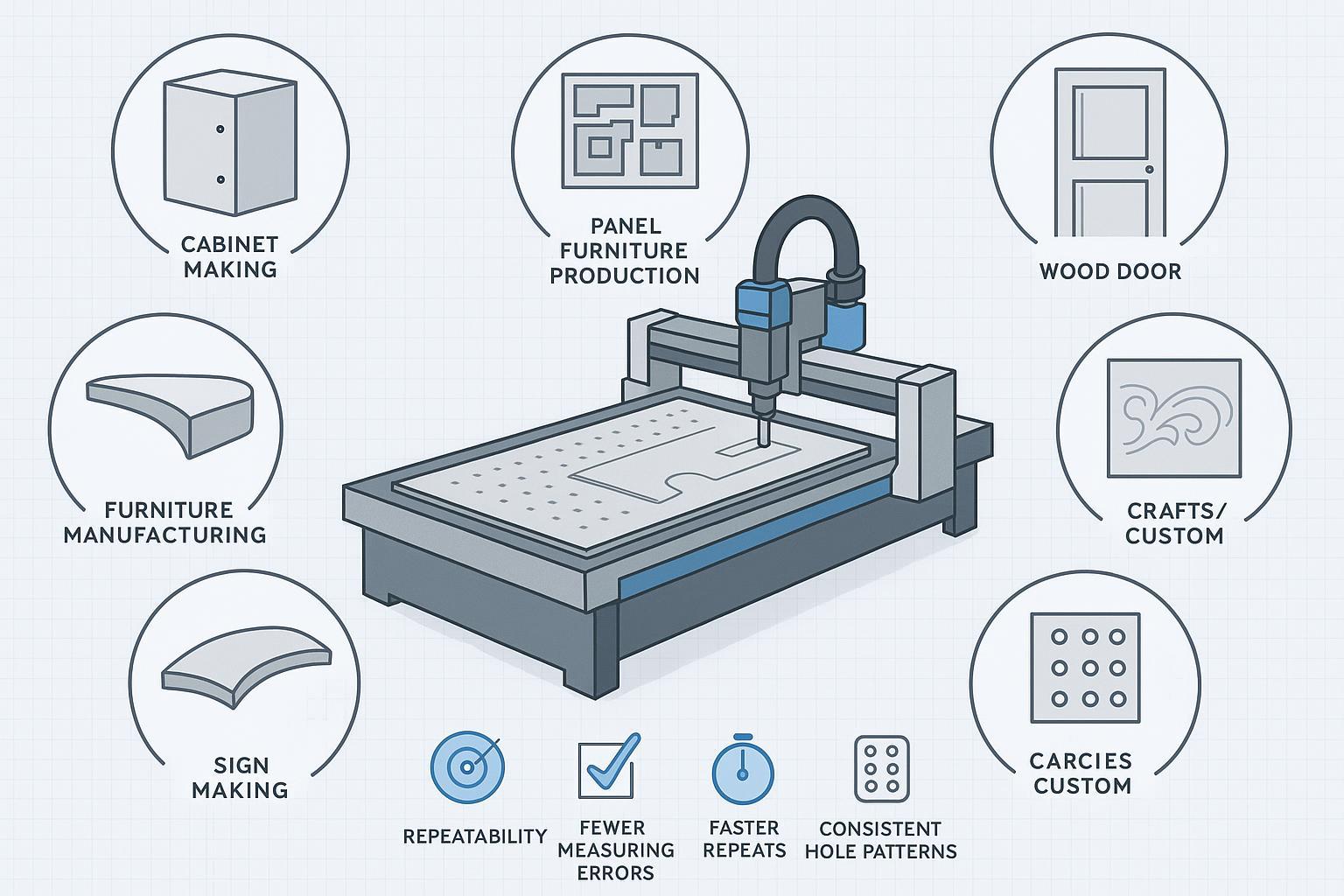
If you run a woodworking or panel shop, the question usually isn’t “Is CNC real?” It’s “Where does CNC fit in my workflow?”
Here are common applications that translate CNC from an abstract concept into shop-floor outcomes.
Industry / shop type | Typical CNC applications | What you gain |
|---|---|---|
Cabinet making | Panel cutting, drilling, grooving, hinge/lock/connector holes, cabinet doors | Fewer measuring errors, consistent hole patterns, faster repeats |
Panel furniture production | Nesting, sheet optimization, modular part processing | Better material utilization, fewer manual transfers, stable throughput |
Wood door production | Door carving, lock holes, hinge slots, decorative grooves | Repeatable hardware fit, consistent style details |
Furniture manufacturing | Tabletops, chair backs, curved components, decorative panels | Reliable duplication, easier batch production |
Sign making | Acrylic letters, PVC signs, foam boards, display panels | Cleaner repeat work, easier customization |
Crafts / custom shops | Relief carving, models, ornaments, custom gifts | More complex shapes with less handwork |
In many of these workflows, CNC isn’t replacing craftsmanship. It’s replacing the part that’s hardest to scale: manual layout, repeated drilling patterns, and operator-to-operator variation.
If you’re building a panel workflow, it can also help to look beyond a single router and think in “cells” (drilling, cutting, labeling, edge banding). For example, Quick CNC’s furniture CNC machine category and the CNC drilling and cutting furniture production line show how shops often combine steps.
CNC router vs CNC mill vs CNC lathe: which one fits your work?
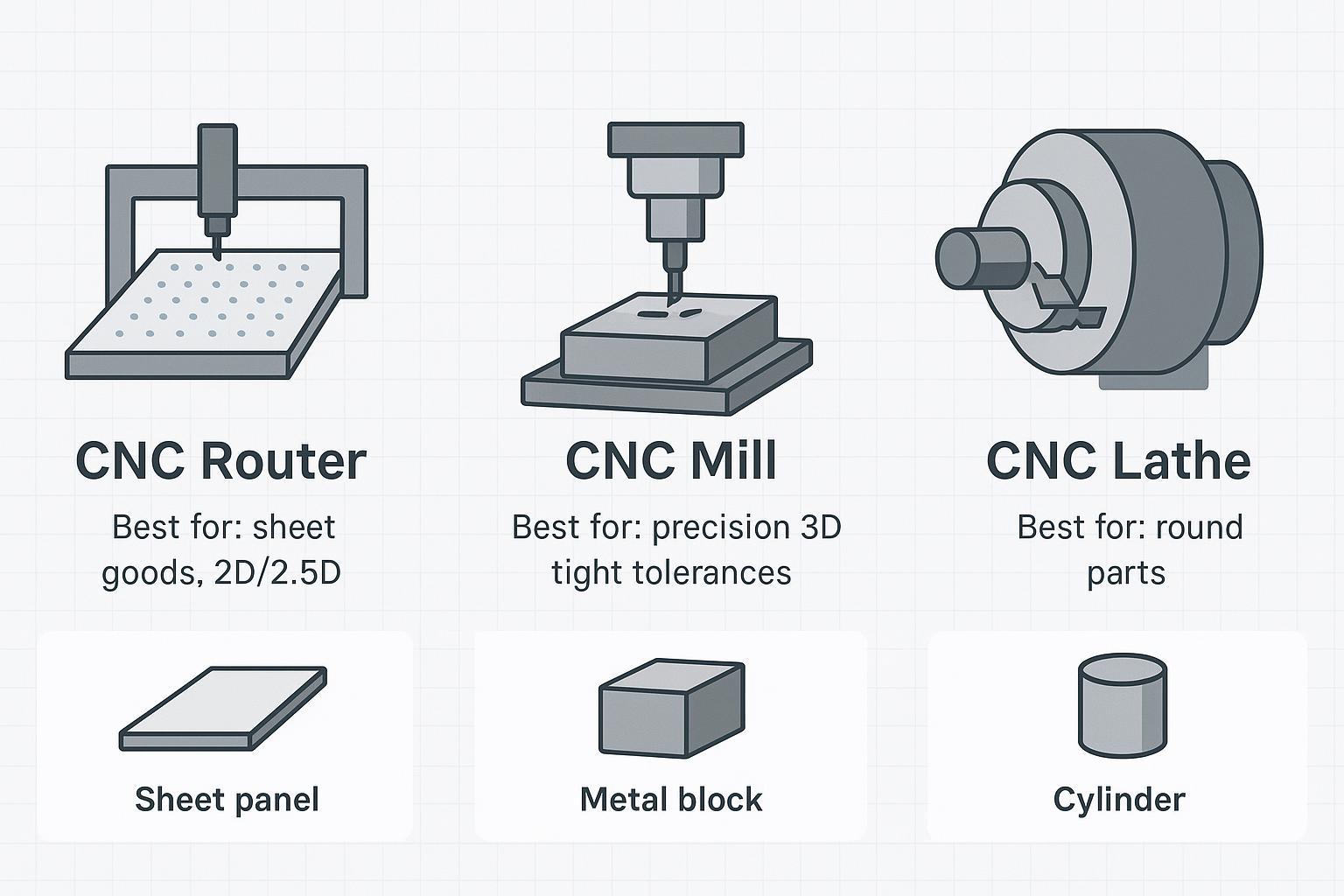
Beginners often lump everything into “CNC.” But the best machine type depends on the shape of your parts and your materials.
Machine | Best for | Typical workpieces |
|---|---|---|
CNC router | Flat sheets and panel work, 2D/2.5D cutting, carving, drilling patterns | MDF/plywood sheets, cabinet parts, signs |
CNC mill | High-precision 3D metal parts, tighter tolerances | Metal blocks/plates, molds, precision components |
CNC lathe | Round parts that spin during cutting | Shafts, cylinders, turned parts |
A quick rule of thumb:
- If you mainly process 4×8 sheets for cabinets, furniture panels, doors, or signs, a CNC router (often with vacuum hold-down, and optionally ATC) is usually the most relevant CNC machine.
- If you’re machining metal blocks to tight tolerances, a CNC mill is usually the right starting point.
- If your parts are round and symmetric, look at a CNC lathe.
Do you need programming skills to use CNC?
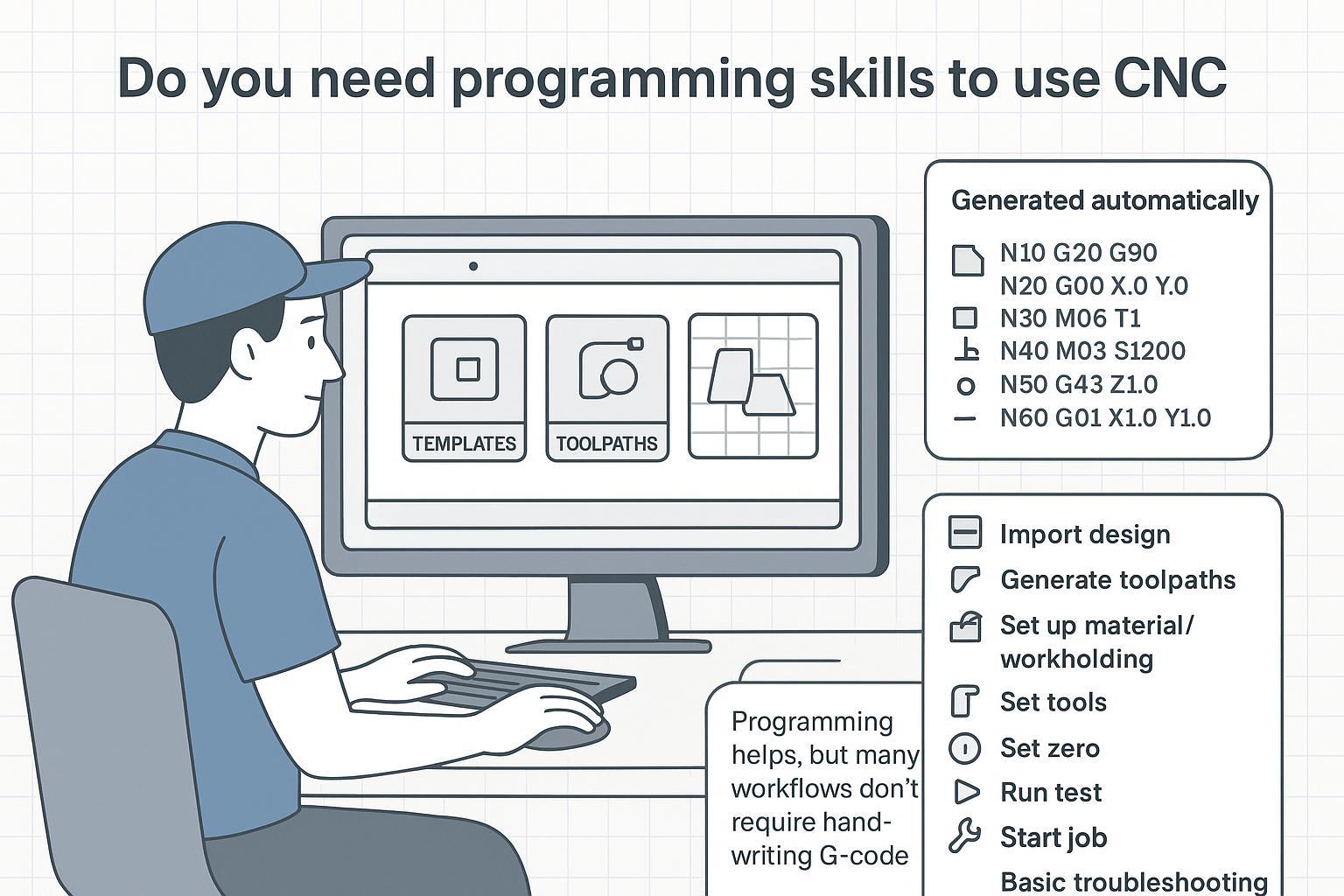
Not necessarily.
Modern CNC workflows often don’t require operators to write G-code line by line every day. In many woodworking and cabinet shops, the operator’s day-to-day work looks more like:
- load or import the design file
- generate toolpaths in CAM or nesting software (often using templates)
- set up the material and workholding
- set tools, set the origin/zero point, run a test, and start the job
That said, CNC still isn’t “push one button and forget it.” Operators need training for setup, safety, tooling, feeds/speeds, and basic troubleshooting.
Pro tip: When you evaluate a CNC system, evaluate the whole workflow: software, post-processor, controller UI, training, and support. A great machine that doesn’t fit your design-to-production flow can slow you down.
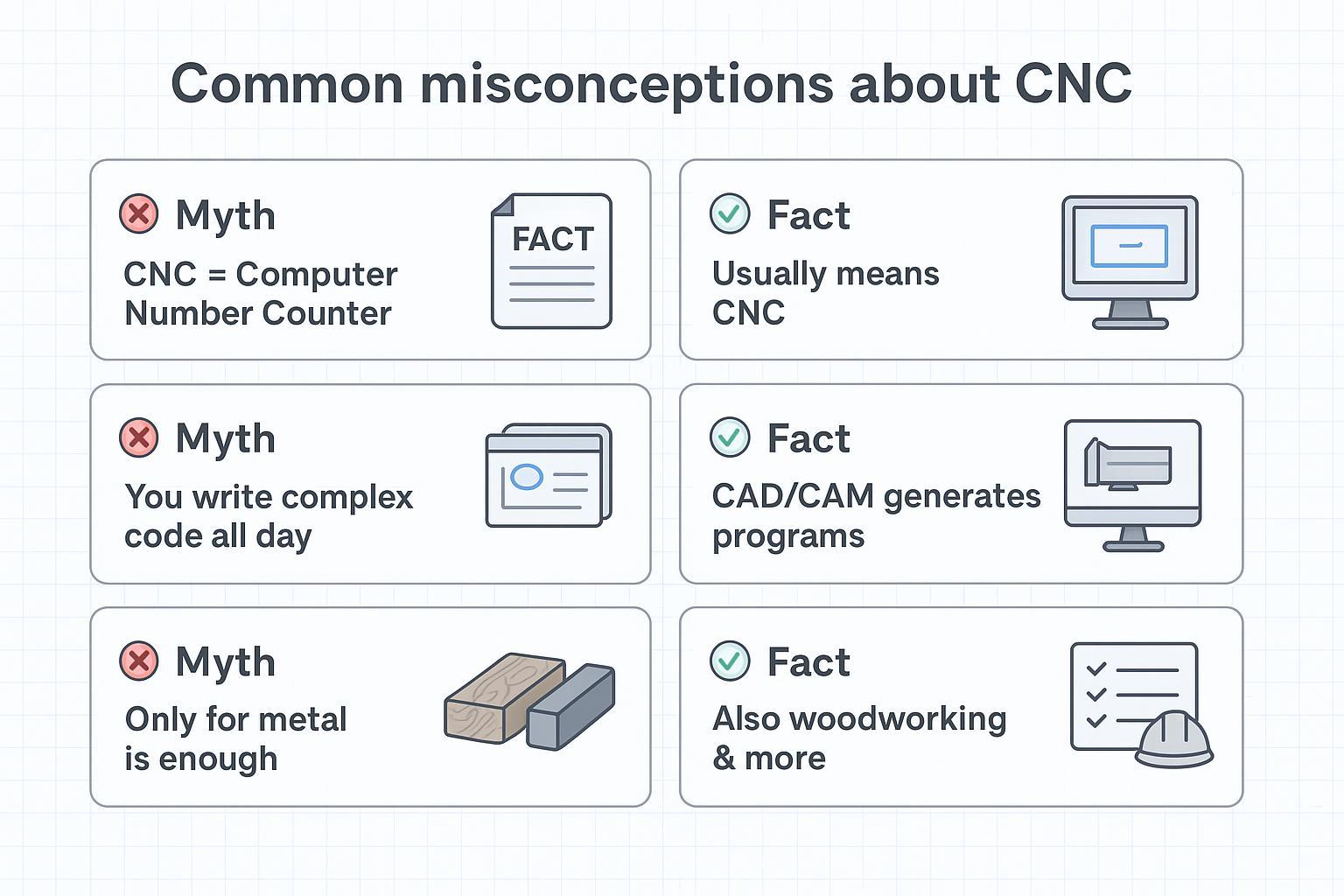
Common misconceptions about CNC (myth vs fact)
Myth | Fact |
|---|---|
“CNC stands for Computer Number Counter.” | CNC stands for Computer Numerical Control, meaning numerical instructions control machine motion. |
“A ‘C and C machine’ is different from a CNC machine.” | Most of the time it’s a misheard/misspelled CNC machine. |
“Operating CNC means you write complex code all day.” | G-code is the underlying language, but many workflows generate programs through CAD/CAM or nesting software. Operators still need setup and safety skills. |
“CNC is only for metal machining.” | CNC is common in metalworking, but also widely used in woodworking, cabinet making, furniture production, and sign making. |
“Buying a CNC machine is only buying hardware.” | Real success depends on the full CNC system: software, controller compatibility, tooling, workholding, dust collection, training, and support. |
“Once you buy CNC, production becomes efficient automatically.” | CNC improves repeatability and consistency, but results depend on integration, process setup, and operator training. |
Next steps: explore CNC routers for woodworking and panel production
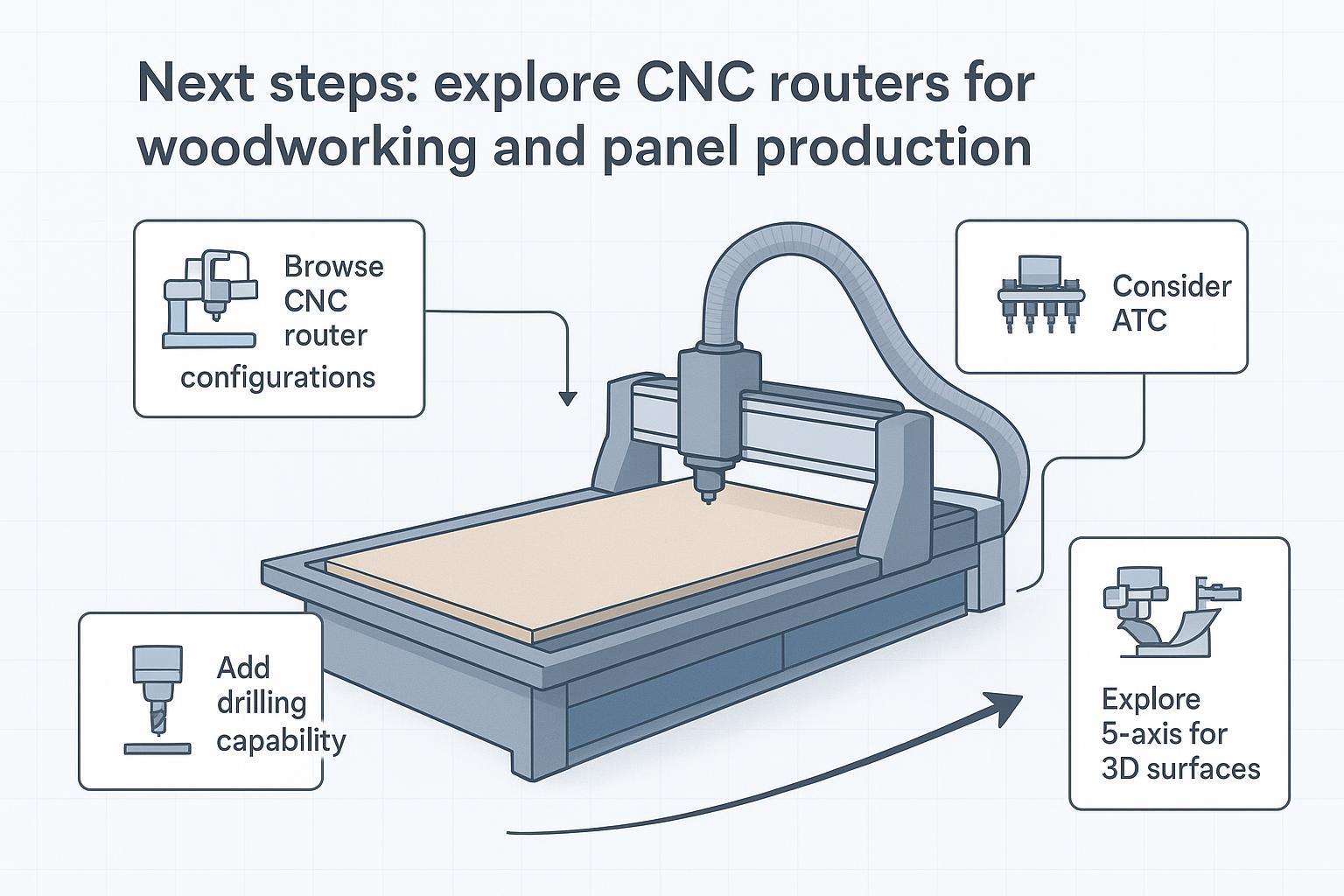
If CNC is new to you, the easiest way to make it real is to look at the machine category that matches your work.
- Explore common configurations in the Quick CNC CNC router lineup.
- If you run many different jobs and want fewer manual tool swaps, an ATC configuration is worth learning. Here’s an example of a 12-tool linear ATC CNC router and a woodworking-focused UA-481 ATC CNC router.
- For more complex 3D surfaces, see what a 5-axis wood CNC router is designed to handle.
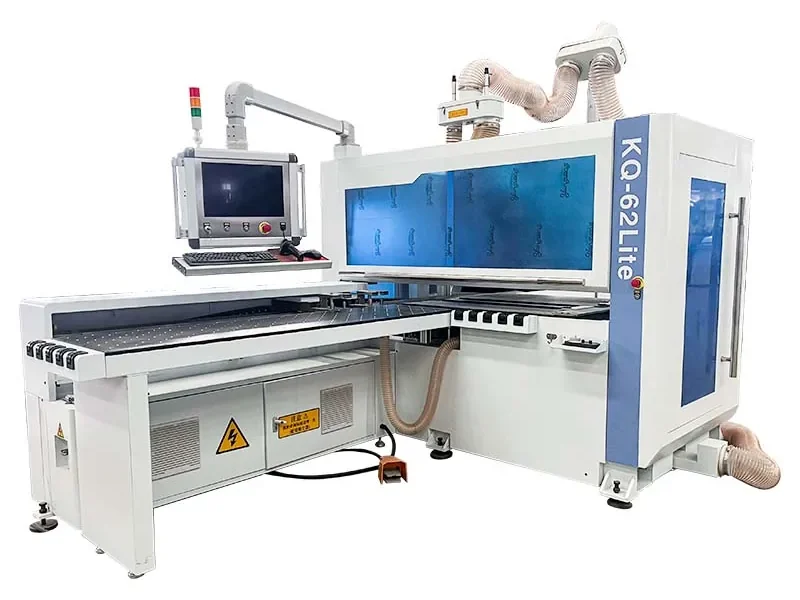
If your process includes drilling patterns on multiple faces, a dedicated drilling step may matter as much as cutting. For reference, here’s a six-side drilling machine.
FAQ about computer numerical control
What is computer numerical control?
Computer numerical control is a method of controlling machine tools with a computer program, so the machine can move and machine parts repeatedly and accurately.
What does CNC stand for?
CNC stands for Computer Numerical Control.
Does CNC stand for computer number counter?
No. CNC stands for Computer Numerical Control, not Computer Number Counter.
What is a C and C machine?
Most of the time, “C and C machine” is a misheard or misspelled way of referring to a CNC machine.
What is the meaning of CNC machinery?
The phrase CNC machinery meaning usually refers to machine tools controlled by CNC programs, such as CNC routers, CNC mills, and CNC lathes.
What is computerized numerical control machine?
“Computerized numerical control machine” is a common phrasing variant for a computer numerical control machine, meaning a machine controlled by computerized numerical instructions.
What is computer numerical control machining?
Computer numerical control machining is the process of making parts using CNC-controlled machine tools, by converting designs into machine programs and running them on the equipment.
What is the difference between NC and CNC?
NC is the older concept of numerical machine control. CNC uses a computer-based controller, making it easier to store, edit, and reuse programs, and to run more flexible automation.
What are computer numerical control machine tools?
They are machine tools controlled by CNC, such as CNC routers, mills, lathes, laser cutters, plasma cutters, waterjets, grinders, and EDM machines.
What is a computer numerical control system?
A computer numerical control system includes the controller, software, drives, motors, sensors, and machine tool components that work together to execute a CNC program.
Is CNC hard to learn?
CNC has a learning curve, but with proper training many operators can learn the basic workflow without a programming background, especially in common woodworking and cabinet production jobs.

Frannie
Hello, I’m Frannie, a CNC machinery specialist with 15 years of experience in the woodworking CNC industry. I help furniture factories, cabinet makers, woodworking workshops, and production businesses choose CNC machines that match their production needs, factory size, budget, and efficiency goals.
My work focuses on solving real production problems, including replacing outdated equipment, improving machining efficiency, reducing labor costs, and upgrading to smarter CNC solutions. I also support customers with machine installation guidance, operation training, video support, and on-site training when needed, helping them use their machines more confidently and effectively.