ATC or regular router? Start with the work you do every day.
ATC is worth paying for when manual tool changes keep stopping a normal job, pulling the operator back to the machine, or breaking up a program that should run straight through. If most of your work uses one or two tools, or the real delay is loading, drilling, workholding, programming, dust extraction, edge banding, or material flow, ATC will not fix the part of the process that is actually slowing you down.
Start here: pick one job you run often. Count the tools, the manual changes, the waiting time, and how often that job repeats. That tells you much more than comparing magazine sizes in a catalog.
If You’re Asking “Do I Really Need ATC?”, Start With One Normal Job
Do not start with the most complicated part your factory has ever made. Start with the work you run every week. How many tools does that program really use? How often does someone stop the machine to change them? And what could that operator or router be doing instead?
This page helps you answer three practical questions: whether ATC is solving a real production problem, whether the extra cost can pay back, and what machine setup makes sense if tool changing really is the bottleneck.
The Short Version
ATC saves stop-and-change time
It cuts the interruption between tools. It does not magically raise feed rate, spindle power, accuracy, or loading speed.
A bigger tool count does not automatically mean you need ATC
What matters is how often the tools change, how repeatable the job is, and whether the recovered time is actually useful.
Sometimes the right answer is a different machine
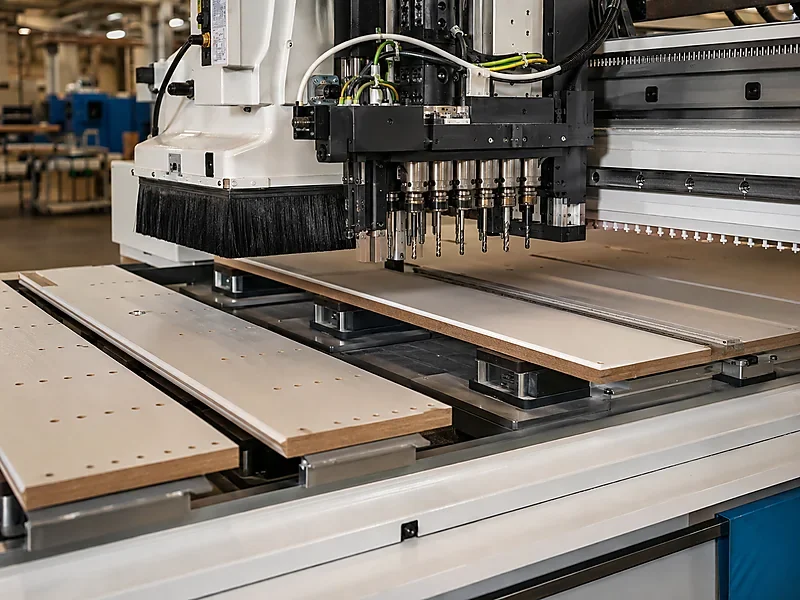
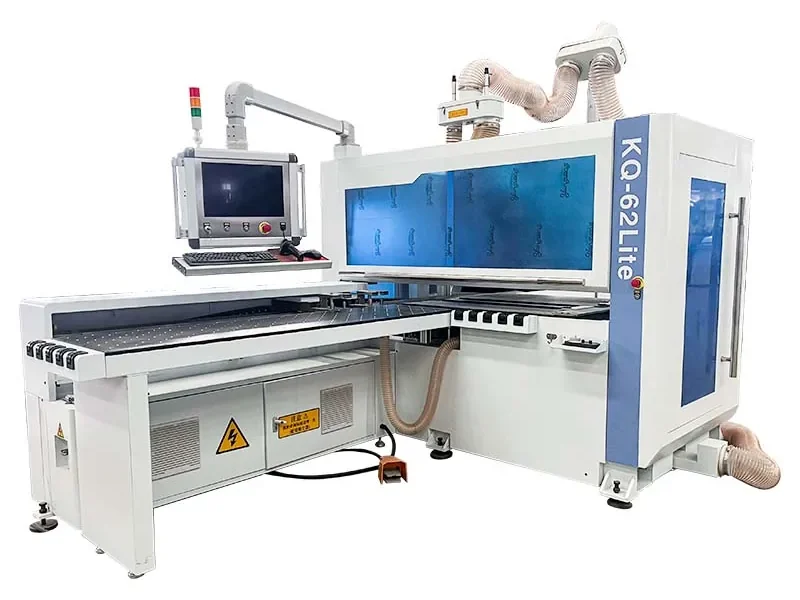
If drilling, loading, side holes, or material flow is the real bottleneck, a drill bank, nesting cell, PTP router, six-sided drilling machine, or better workholding may make more sense.
Do You Really Need ATC Right Now?
ATC probably makes sense
- Normal programs repeatedly call several tools.
- Manual changes interrupt every batch or every part.
- The operator must leave other productive work to change tools.
- Orders are repeated enough to maintain a stable tool library.
- Recovered machine time can produce saleable parts or protect delivery dates.
A regular router is still enough
- Most work is completed with one cutter.
- Tool changes are occasional and do not delay output.
- The shop is still proving its product mix and programming workflow.
- Working area, vacuum holding, dust control, tooling, or software needs investment first.
- There is no reliable demand for the extra recovered capacity.
Look at a different machine path first
- Dense drilling is the main cycle constraint.
- Full-sheet loading, labeling, unloading, or sorting limits output.
- Side holes or six-face processing are required.
- Part geometry requires rotary, angled, or five-axis access.
- The same fixed tool set repeats so often that a multi-head layout deserves comparison.
What Does ATC Actually Change in the Day-to-Day Job?
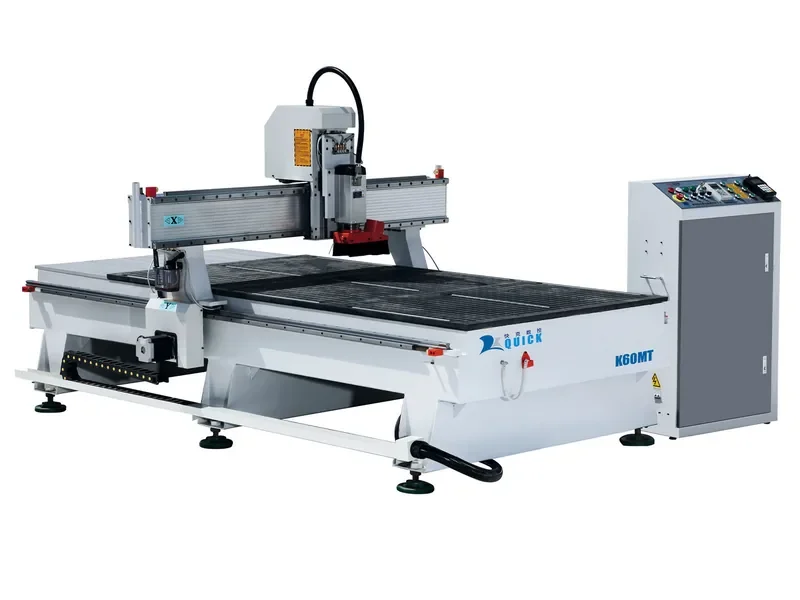
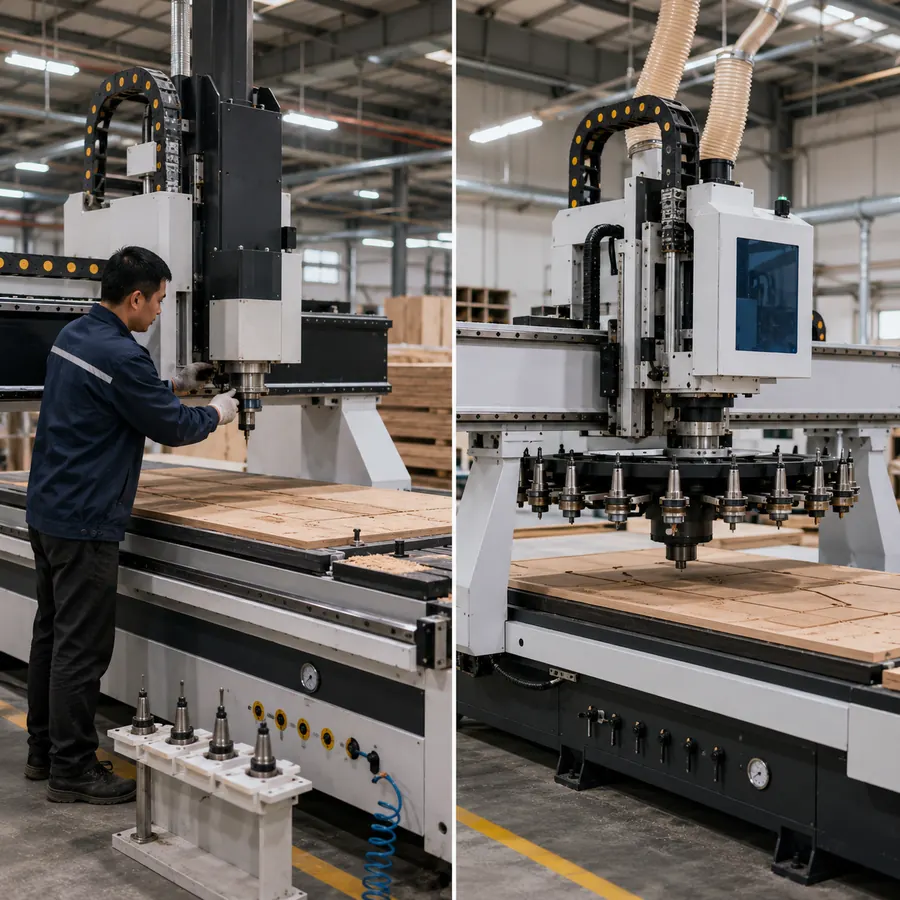
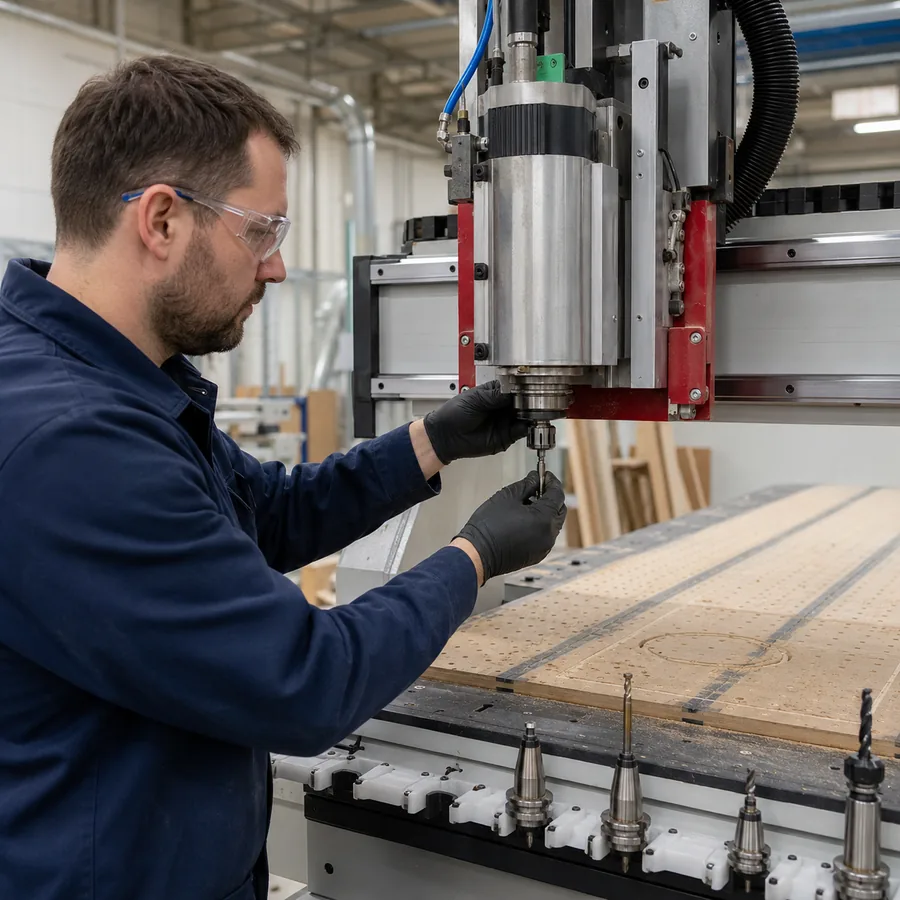
The simple difference is this: on a regular router, the operator stops and installs the next cutter. On an ATC router, the program calls a prepared tool from the magazine and the machine makes the change itself.
That matters when one job needs cutting, grooving, pocketing, drilling, engraving, profiling, roughing, or finishing with several tools. Instead of waiting for someone at every change, the program can keep moving through the sequence.
What ATC does not fix by itself
- Material removal rate: feed, speed, depth of cut, tool geometry, spindle capability, rigidity, and workholding still control cutting performance.
- Finished-part accuracy: machine geometry, motion system, tooling, calibration, material movement, fixtures, programming, and inspection remain decisive.
- Drilling throughput: a router bit changing automatically does not replace a suitable drill bank or drilling center when hole density dominates the cycle.
- Sheet handling: ATC does not load, label, unload, sort, edge-band, or assemble panels unless those systems are included in a wider solution.
- Axis access: automatic tool changing does not convert a three-axis machine into a rotary, true four-axis, or five-axis platform.
A Quick Way to Tell Whether ATC Is Worth Paying For
Take one job you run often and score the six points below from 0 to 2. This is only a quick shop-floor check, not a formal standard. If the score looks promising, use your real cycle times for the ROI calculation in the next section.
| Decision factor | 0 points | 1 point | 2 points |
|---|---|---|---|
| Tools used in one normal program | One tool | Two or three tools | Several tools in a repeated sequence |
| Manual tool-change frequency | Occasional | Repeated on some jobs | Repeated every batch or cycle |
| Operator interruption | Operator is already at the machine | Operator leaves another task sometimes | Tool changes regularly interrupt loading, inspection, or another machine |
| Program repeatability | Mostly experimental one-offs | Mixed work with some repeat orders | Stable programs and recurring tool libraries |
| Value of recovered time | No backlog or extra demand | Recovered time improves schedule flexibility | Recovered time produces saleable output or prevents overtime and missed delivery |
| Main production bottleneck | Not tool changing | Tool changing is one of several constraints | Tool changing and operator waiting are the measured constraint |
0–4: keep the regular router for now
ATC is probably not the first place to spend the money. Fix the process that is actually holding output back.
5–8: run the numbers first
ATC may help, but you need your job mix, cycle time, extra machine cost, and the other bottlenecks before deciding.
9–12: ATC is worth a serious look
Your normal workflow has the conditions where automatic tool changing can remove repeated stops. Now compare a real ATC cycle against your current process.
Will the Extra Cost of ATC Actually Pay Back?
Do not use a generic claim like “automatic tool change saves X seconds.” Measure how long your current manual change really takes, then compare it with the complete automatic change cycle on the machine you are considering.
1. Work out how many minutes you really get back
Recovered minutes per shift = (measured manual change cycle − verified automatic change cycle) × tool changes per job × jobs per shift × realistic utilization factor
Realistic utilization factor simply means the share of saved time you can actually turn into useful production time.
Do not assume every recovered minute becomes useful production time. If the router still waits for material, drawings, operators, or downstream equipment, that time has little value.
2. Put a real monthly value on that time
Monthly net value = recovered productive hours × contribution value per productive hour + avoidable labor or overtime value − added monthly ownership cost
Contribution value means the money one productive machine hour really adds to the business after the direct job costs — not the full sales price.
Use contribution value or avoidable cost, not total sales revenue. The number should reflect the extra margin, overtime reduction, or schedule capacity the saved time can realistically create.
3. Compare that value with the extra ATC cost
Estimated payback months = total ATC premium and setup additions ÷ monthly net value created by ATC
Include more than the difference between two base machine prices. Toolholders, collets, air preparation, postprocessor work (the CAM-to-controller code setup), training, spare tools, maintenance preparation, and layout changes can all sit on top of the ATC premium.
Do Not Compare the Machine Price Alone
The ATC premium is only one part of the decision. Compare the full setup you will actually run: holders, air, software, training, maintenance, and the factory space around the machine.
| Cost category | Regular CNC router | ATC CNC router | What to check |
|---|---|---|---|
| Machine configuration | Manual tool interface and simpler change workflow | ATC spindle, magazine, holders, sensors, control functions, and integration | Compare complete configurations with the same working envelope and production duty |
| Tooling package | Fewer prepared holders may be needed | A prepared holder and collet plan is required for the active tool library | List included holders, collets, pull studs (the retention knobs used to lock ATC holders into the spindle, where applicable), spare positions, and balancing requirements |
| Compressed air | May still be required for other machine functions | Tool clamping and magazine actions commonly add pneumatic requirements | Verify pressure, flow, tank, filtration, dryness, and equipment your factory supplies |
| Software and postprocessor | Manual program breaks can be simpler | Tool calls, tool numbers, offsets, and post output must match the controller and machine | Run a representative multi-tool file before you sign off on the machine |
| Training and setup | Manual changes require correct clamping and re-zeroing practice | Operators must manage magazine positions, tool data, holders, offsets, and recovery procedures | Define training scope and handover documents |
| Maintenance | Normal spindle, collet, table, drive, lubrication, and electrical service | Add magazine, sensors, pneumatics, spindle clamping, toolholder cleanliness, and tool-data control | Request configuration-specific maintenance and fault-recovery instructions |
| Factory layout | Machine, loading, vacuum, dust, electrical, and service access | Magazine location and tool-change movement can add clearance requirements | Verify the final machine and utility layout drawing |
Where Does ATC Make Sense — and Where Does It Not?
| Production application | What usually makes sense | Why | Check before you decide |
|---|---|---|---|
| Cabinet doors and furniture fronts | Strong ATC fit when cutting, grooving, V-carving, pocketing, drilling, and profiling repeat | Several tools can be called within one stable program | Door dimensions, material, profiles, surface finish, drills, tool sequence, and batch size |
| Panel furniture nesting | ATC or nesting CNC solution after complete flow review | Tool changes matter, but labeling, loading, unloading, drilling, and sorting can dominate total output | Sheets per shift, nest mix, hole map, labeling, handling, and downstream capacity |
| Solid-wood components and relief work | ATC is valuable for repeated roughing, finishing, profiling, and drilling sequences | Manual changes can break long multi-tool cycles and occupy the operator | 3D model, material, tool lengths, Z clearance, finish requirement, and cycle strategy |
| Sign and acrylic production | Regular router for tool-light work; ATC for repeated cutting, engraving, chamfering, and pocketing combinations | Product mix varies widely between simple letters and complex multi-process displays | Material type, edge quality, tool list, chip control, fixture, and order mix |
| Door lock, hinge, and multi-face machining | Review PTP, boring, or angled-access equipment instead of assuming ATC alone | The main issue can be hole direction, fixture access, or dedicated drilling speed | Hole map, face access, pod or table needs, aggregate heads, and required orientation |
| CNC machining service with mixed orders | ATC helps when a core prepared tool library serves recurring work | It reduces interruption across varied but planned jobs | Common shank sizes, tool-life policy, special tools, collision clearance, and scheduling |
| Single-tool profiling or basic sheet cutting | Regular CNC router is often the smarter investment | The ATC system has little work to perform | Working size, spindle duty, table, vacuum, dust extraction, and cutter performance |
ATC or Regular Router? Put Them Side by Side
| Comparison factor | Regular CNC router | ATC CNC router | What matters |
|---|---|---|---|
| Tool-change method | Operator installs the next cutter and completes the required setup steps | Program calls a prepared tool from the magazine | ATC becomes valuable when this interruption repeats frequently |
| Best workflow | Tool-light jobs, changing prototypes, simple profiling, and controlled startup investment | Repeated multi-tool programs and planned production libraries | Choose from normal jobs, not the most complex rare order |
| Operator attention | Operator must return for each manual change | Operator attention can move to loading, unloading, inspection, and workflow control | Calculate whether operator interruption is limiting another productive task |
| Cycle continuity | Interrupted between tools | Automated between prepared tools | Compare measured complete cycle time, not brochure speed |
| Configuration complexity | Fewer ATC-specific systems | Magazine, holders, sensors, pneumatics, data, and control sequence | Accept extra complexity only when it solves measurable production loss |
| Maintenance scope | Manual tool interface plus normal router systems | Add tool-change and magazine systems | Confirm maintenance ownership and recovery procedure before purchase |
| Expansion path | Can remain effective for tool-light production | Supports larger prepared tool libraries, subject to machine design | Size for normal programs plus sensible spare positions |
| Main financial risk | Buying too simple a machine and losing output to repeated stops | Paying for unused capacity while another bottleneck remains | Use the ROI worksheet and full process map |
Once ATC Makes Sense, Choose the Setup That Fits the Job
After you have decided ATC is worth it, do not jump straight to “more tools is better.” Match the magazine, spindle interface, holders, software, table, air supply, and special functions to the programs you actually run.
Linear or carousel magazine?
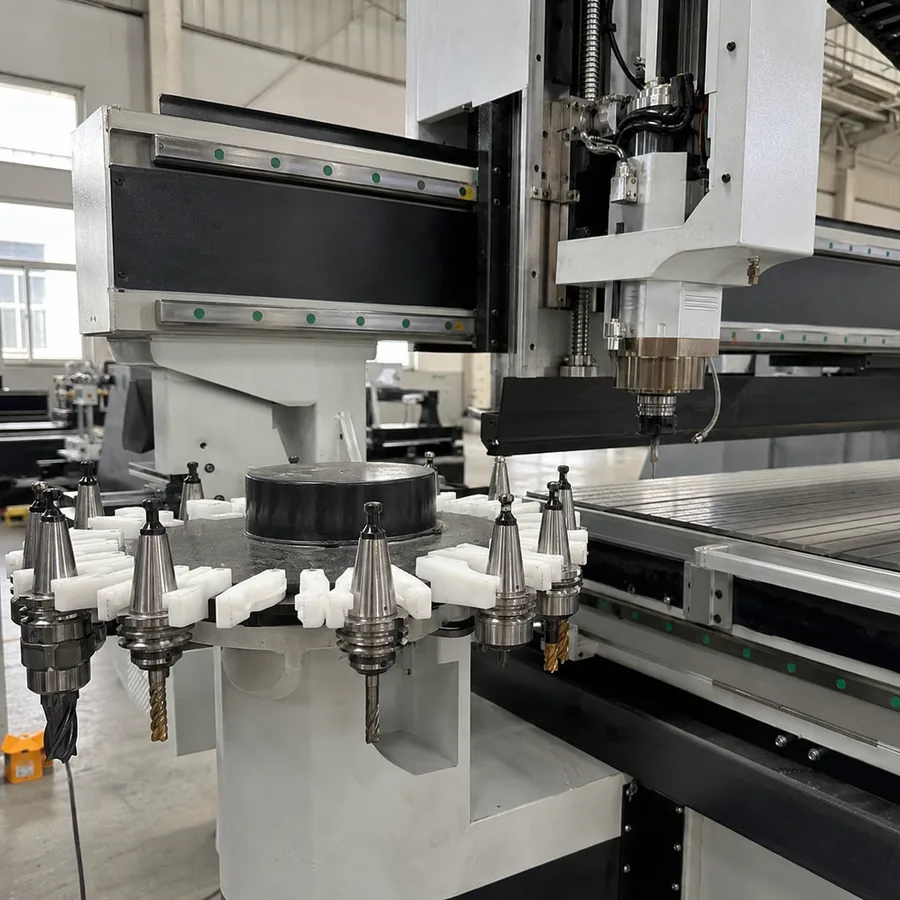
Both are valid industrial solutions. A linear magazine can offer a straightforward rack layout and is common on three-axis woodworking routers. A carousel can keep tools arranged around a rotating magazine and can support compact tool selection near the spindle on suitable machine designs. The better choice comes from tool count, tool dimensions, machine travel, magazine position, collision clearance, change sequence, and required options.
How many tool positions do you really need?
Start with every tool used in one representative program, then add positions for repeated sister tools, wear replacement, or a small number of recurring operations. Do not size the magazine for every cutter owned by the factory. Quick CNC’s confirmed live product pages currently include examples of an eight-tool linear ATC configuration and a twelve-tool linear ATC configuration; these are selection examples, not universal standards.
Make sure the controller, CAM, and postprocessor agree
The CAM tool numbers, postprocessor output, controller tool table, physical magazine positions, tool-length data, spindle commands, and safe change positions must agree. A successful single-tool cut does not prove that the complete automatic sequence is ready.
Do not forget the holders and air supply
Confirm the toolholder standard, collets, pull studs, permitted tool dimensions, holder cleaning, storage, balancing requirements, spare-holder plan, spindle clamping method, air pressure and flow, filtration, dryness, tank capacity, and alarm response for the selected configuration.
If Tool Changes Are Not the Bottleneck, ATC Will Not Fix It
ATC solves tool-change stops. If the real delay is somewhere else, spend the money on the part of the process that is actually waiting.
| What is slowing you down | What to look at instead | Why ATC alone will not solve it |
|---|---|---|
| Repeated full-sheet loading and unloading | Nesting CNC cell or automated handling | The machine can change tools but still waits for material movement |
| Large quantity of vertical holes | ATC router with suitable drill bank or drilling-focused equipment | Changing to individual drill bits may not match dedicated boring throughput |
| Side holes and six-face processing | PTP, side drilling, or six-sided drilling solution | Tool access and panel orientation define the process |
| Same small fixed group of tools repeated continuously | Compare multi-head or multi-spindle architecture with ATC | Prepared heads can suit a fixed repetitive sequence, while ATC provides broader flexibility |
| Rotary or angled geometry | Rotary-axis, swing-head, true four-axis, or five-axis review | ATC changes the cutter but not the cutter’s access angle |
| Parts moving during cutting | Workholding, spoilboard, vacuum-zone, fixture, and cutting-force review | Tool-change automation does not correct weak holding |
| Programs and drawings not ready | CAD/CAM, postprocessor, process-planning, and training work | A larger tool magazine cannot fix an unstable digital workflow |
Six ATC Buying Mistakes That Cost Money
Counting tools but ignoring how often they change
Five tools used once a month is a very different problem from four tools used every shift.
Expecting ATC to make the machine more accurate
ATC removes manual tool-change interruptions. Accuracy still depends on the machine, tooling, setup, material, program, and inspection.
Forgetting about air and holder care
Dirty holders, poor air preparation, wrong tool data, or bad clamping can stop an automatic cycle quickly.
Buying the biggest magazine just because you can
Unused positions cost money and add management. Buy enough positions for normal programs, repeated tools, and a sensible spare margin.
Calling every saved minute profit
Use contribution value and avoidable cost. If the rest of the line cannot use the saved time, the money does not appear automatically.
Testing one cutter and calling the machine ready
Run the real multi-tool sequence: tool calls, offsets, magazine positions, alarms, recovery, and a representative part.
A Bigger Tool Magazine Does Not Fix Slow Loading
Simple example — not a customer case
Imagine a panel shop choosing between a regular router and a large ATC model. The ATC looks more productive on paper, so the shop pays for the biggest magazine without timing the full process.
- What went wrong
- The shop chose the largest tool magazine without recording the normal tool sequence or the complete line cycle.
- What happened next
- Most tool positions stayed empty, while the router still waited for manual sheet loading and part removal. Output barely moved.
- Why it happened
- The decision treated tool capacity as total factory productivity and ignored material handling.
- What to change
- Time cutting, tool changes, loading, unloading, labeling, drilling, edge banding, and sorting. Then compare a right-sized ATC router with a nesting or handling solution.
- What this tells you
- Pay for ATC when tool changing is a measured part of the bottleneck. If loading and unloading dominate, fix the flow that keeps the machine fed and clears finished parts.
What Should You Send Us First?
You do not need a twelve-item project file before you contact us. One normal job is enough to start. Send what you already have, and we can narrow the machine down from there.
Material, thickness, largest size, and a drawing, photo, CAD file, or 3D model.
Cutting, drilling, grooving, pocketing, engraving, profiling, roughing, finishing, side work, or rotary work.
How many tools one typical program uses, how often the job repeats, and roughly how long manual changes take now.
Typical batch size, jobs or sheets per shift, and anything else that is currently slowing the process down.
If you already have software details, utilities, or a factory layout, send them too. They help later, but they are not required for the first conversation.

A Simple Way to Narrow the Machine Down
Start with the job, find the real bottleneck, then choose the machine category. That keeps the discussion tied to production instead of a list of features.
- Start with the job: material, working size, drawing, operations, tools, batch frequency, output target, and the finish or quality you need.
- Find what is actually slowing the work down: cutting, tool changing, operator attention, workholding, loading, drilling, software, dust extraction, or downstream flow.
- Compare the right machine types: regular router, ATC CNC router, multi-head router, nesting machine, PTP configuration, drilling equipment, or a wider furniture CNC solution.
- Match the full setup: working area, spindle, magazine, holders, table, controller, postprocessor, air, vacuum, dust extraction, safety, training, and service.
- Run the job you actually care about: use the intended file, tools, material, fixtures, and inspection method. A complete cycle tells you more than one headline specification.
Frequently asked questions
Is an ATC CNC router worth it for a small business?
Yes when the small business has repeated multi-tool work, operator interruption, and enough demand to convert saved time into output or schedule capacity. It is not automatically justified by company size. A small cabinet-door shop with recurring five-tool programs can benefit more than a larger factory doing mainly single-tool profiling.
How many tools justify an ATC CNC router?
There is no universal minimum. Review ATC when several tools repeat within normal programs and the manual changes create measurable delay. Count frequency and batch size as well as tool quantity. A stable four-tool sequence repeated every shift is more relevant than a rare job using eight tools.
Does an ATC CNC router cut faster?
ATC mainly reduces non-cutting interruption between tools. It does not automatically increase feed rate or material-removal capability. Cutting speed still depends on the spindle, tool, material, depth of cut, chip load, rigidity, workholding, extraction or cooling method, and programmed toolpath.
Does ATC improve CNC router accuracy?
ATC can support more controlled tool-length management and reduce manual change variation, but it is not proof of finished-part accuracy. Machine geometry, drives, spindle condition, holders, tooling, fixtures, material behavior, CAM strategy, setup, calibration, and inspection determine the result.
What is the difference between an ATC CNC router and a regular CNC router?
A regular router requires the operator to install the next cutter manually. An ATC router stores prepared tools and performs a programmed exchange. The two machines can still differ in working size, spindle, table, axis configuration, drilling functions, control, and automation, so ATC should not be the only comparison point.
Is a linear or carousel ATC better?
Neither is universally better. Choose from the required tool count, tool dimensions, magazine location, machine layout, change path, special heads, clearance, service access, and representative cycle. Confirm the exact magazine in the selected machine drawing and quotation.
What maintenance does an ATC CNC router add?
Add inspection and control for toolholders, collets, pull studs where applicable, magazine positions, sensors, pneumatics, spindle clamping, tool data, change positions, and recovery procedures. The exact schedule and method must follow the selected machine and component documentation.
When is a nesting machine or PTP router better than an ATC router?
A nesting solution is stronger when full-sheet optimization, labeling, loading, unloading, and panel flow define the project. A PTP or drilling-focused solution is stronger when flexible holding, dense boring, side access, or multi-face holes dominate. These machines can also include ATC; the main point is to select the complete process architecture.
What should I send before requesting an ATC CNC router quotation?
Send materials, thicknesses, largest and smallest parts, drawings, required operations, the tools used in a normal program, batch and output targets, current cycle and manual-change records, quality requirements, software and postprocessor details, utilities, factory layout, destination, budget range, and expected production start.
More Quick CNC Pages That May Help
- What Is an ATC CNC Router and How Does It Work? — ATC components, workflow, limits, and quotation inputs.
- How to Choose a CNC Router — machine-category selection by material, process, tool count, and bottleneck.
- How Much Does a CNC Router Cost? — total-budget categories and configuration-based price comparison.
- Quick CNC ATC CNC Router Category — confirmed current ATC product and configuration paths.
Exact machine details still depend on the model and the final quotation.
Send Us One Normal Job — We Can Start From There
Send one representative drawing, the usual tool list, batch frequency, and your current change or cycle time if you have it. We can use that to decide whether a regular router, ATC router, nesting machine, drilling-focused machine, or another setup is the better place to start.
Send Your Job Details
Frannie
Hello, I’m Frannie, a CNC machinery specialist with 15 years of experience in the woodworking CNC industry. I help furniture factories, cabinet makers, woodworking workshops, and production businesses choose CNC machines that match their production needs, factory size, budget, and efficiency goals.
My work focuses on solving real production problems, including replacing outdated equipment, improving machining efficiency, reducing labor costs, and upgrading to smarter CNC solutions. I also support customers with machine installation guidance, operation training, video support, and on-site training when needed, helping them use their machines more confidently and effectively.