Choosing the Right CNC Router Spindle
Start with the spindle your job needs. Then look at how that spindle is cooled.
An air-cooled CNC spindle is a good fit when you want a simpler setup with fewer extra cooling parts and no coolant to manage. Just make sure the spindle can get the clean airflow it needs.
A water-cooled CNC spindle makes sense when the spindle you need uses liquid cooling and your team is comfortable looking after the coolant, hoses, circulation, and cooling unit.
Do not treat water cooling as proof of higher accuracy or air cooling as proof of lower production capability.
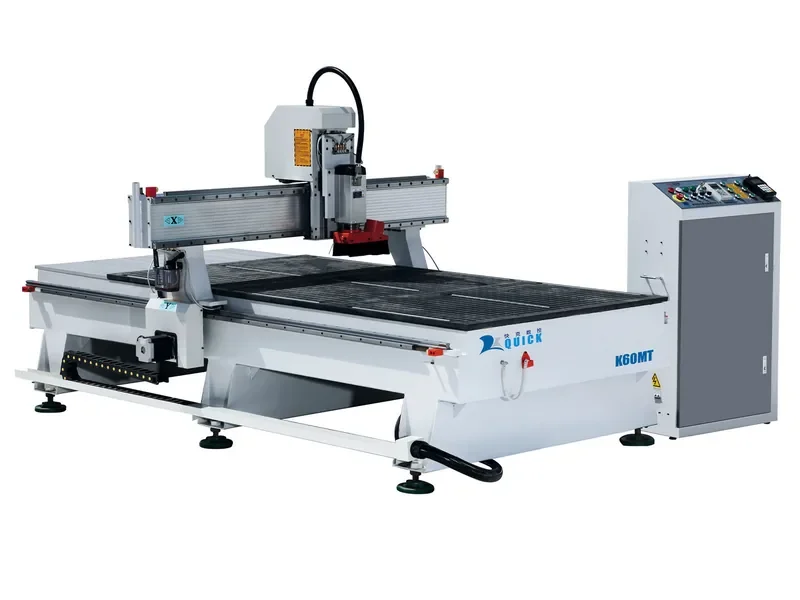
Quick CNC’s current UE-481 public specification lists a 9 kW ISO30 air-cooled spindle, a spindle speed of 24,000 rpm, and an X-Y-Z working area of 1220 × 2440 × 200 mm, approximately 48 × 96 × 7.9 in. Separately, HSD’s ES951 family includes both forced-air and liquid-cooled variants. These examples show why cooling method cannot be selected from one universal spindle-power cutoff.
A good cooling setup is simple: the spindle suits the job, your team can maintain it, and the machine can warn you when cooling is not right.
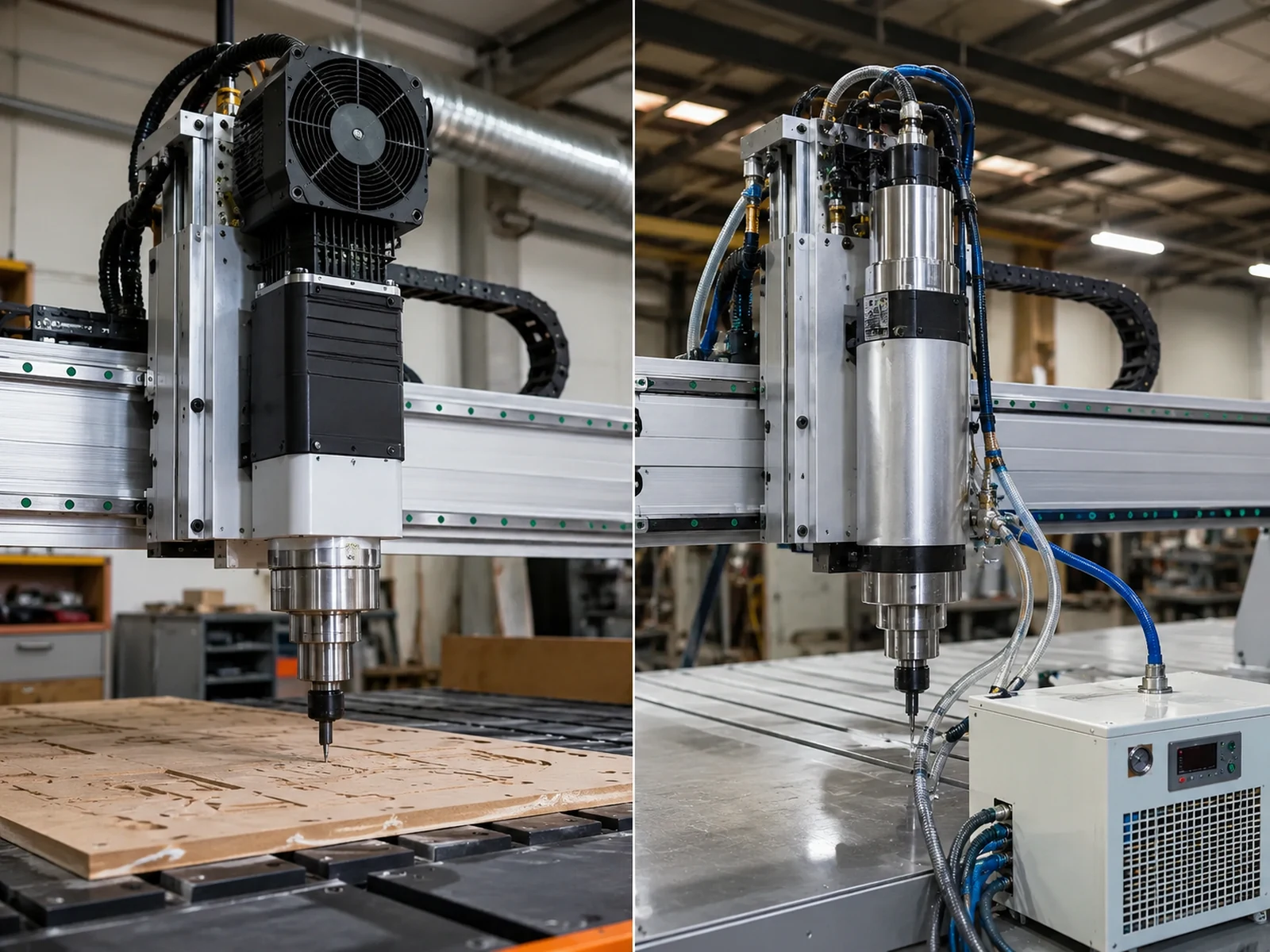
Air-Cooled or Water-Cooled Spindle — Which One Should You Choose?
There is no single winner for every workshop.
Air cooling is often the easier choice when you want a simpler setup with fewer external cooling parts.
Water cooling is the better fit when the spindle requires it and your team can keep the cooling loop in good condition.
The better question is not “Which one has more advantages?” Ask this instead:
Which cooling failure can this factory detect, maintain, and correct before it interrupts production or damages the spindle?
Air-Cooled vs Water-Cooled: What’s the Real Difference?
| Compare | Air-Cooled | Water-Cooled | What to Check |
|---|---|---|---|
| System layout | Fewer external cooling parts | Adds a liquid-cooling circuit | Check what is actually included |
| Main maintenance | Keep the fan and air path clean | Maintain coolant, cooling unit, hoses, and circulation | Make sure someone owns the routine checks |
| Freezing | No spindle coolant circuit | Requires approved coolant or drainage planning | Check transport and storage temperatures |
| Main failure | Restricted airflow or fan failure | Lost circulation, pump failure, blockage, leakage, or inadequate heat rejection | Check how the machine warns you and what it does next |
| Noise | Fan remains one spindle-noise source | Removes the spindle cooling fan on liquid-cooled models | Compare complete-machine noise |
| Installation | Requires clean inlet and exhaust clearance | Requires hose routing and cooling-unit space | Make sure there is room to install and service it |
| Production judgment | Comes from spindle data | Comes from spindle data | Compare the duty, RPM, torque, and tool interface |
How Do the Two Cooling Systems Work?
The way the spindle is cooled tells you what your team needs to check every day.
Air-Cooled Spindle
An air-cooled spindle uses fan-generated airflow to remove motor heat.
The fan may be mounted directly on the spindle shaft or powered independently. A shaft-mounted fan follows spindle rotation, while an independently powered fan can supply airflow separately from spindle speed. Colombo documents shaft-fan, powered-fan, compressed-air, and liquid-cooling architectures as distinct spindle designs.
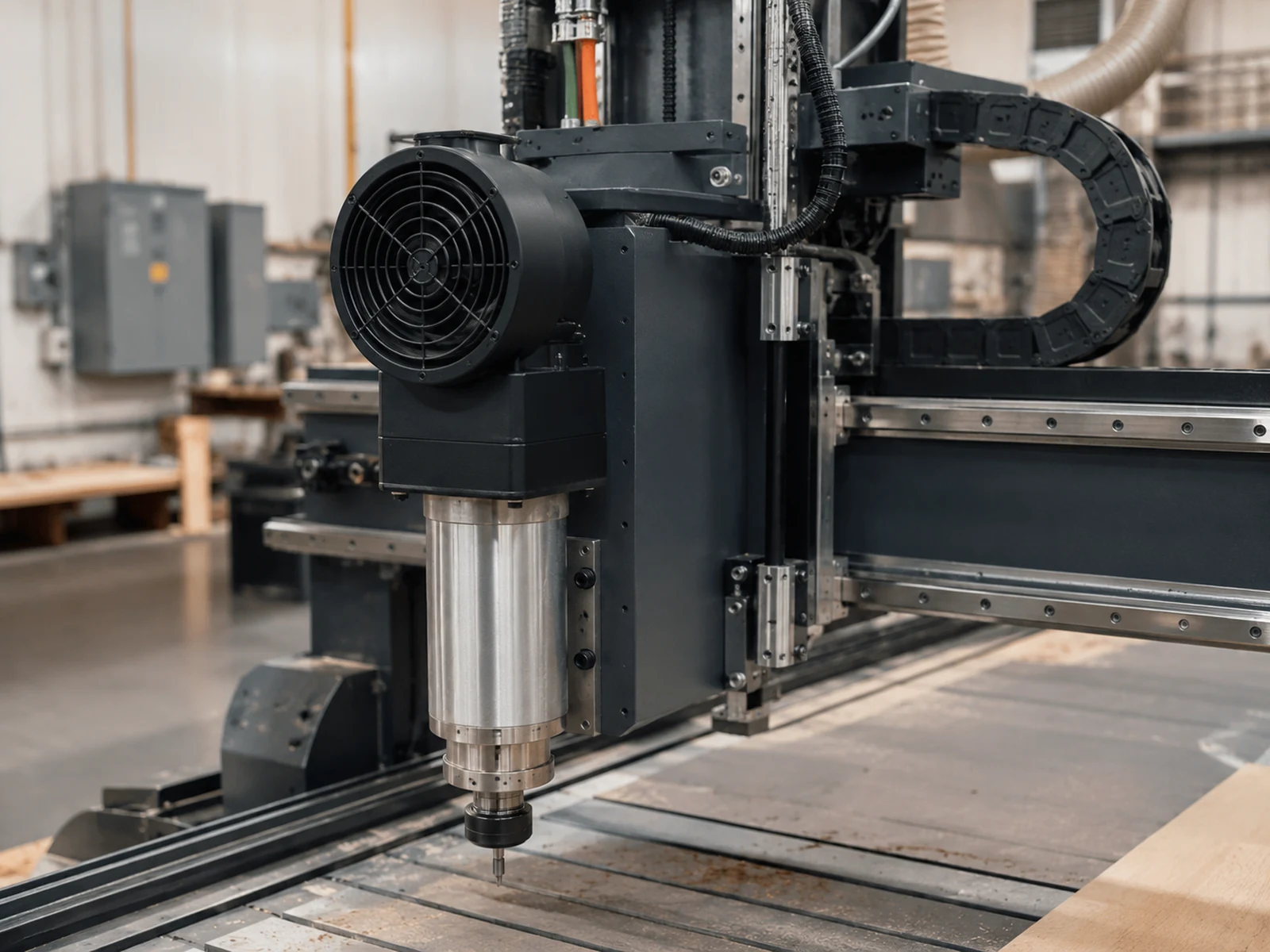
Before you order, make sure these points are clear:
- Fan architecture
- Fan power supply
- Air inlet and exhaust positions
- Required installation clearance
- Cleaning access
- Thermal-protection output
Air cooling remains practical only while the designed airflow is available. Colombo’s maintenance guidance specifically instructs users to keep spindle bodies, fans, and airways clean so the cooling system can function correctly.
Do not assume that the UE-481 uses either a shaft-driven or independently powered fan. The current public product specification identifies the spindle as air-cooled but does not identify its fan architecture.
Water-Cooled Spindle
A water-cooled spindle circulates coolant through passages in or around the spindle body and transfers the heat to an external cooling unit.
The complete package can include:
- Circulation pump
- Supply and return hoses
- Coolant
- Refrigerated chiller
- Water/air heat exchanger
- Temperature monitoring
- Low-flow detection or flow interlock
- Controller fault input
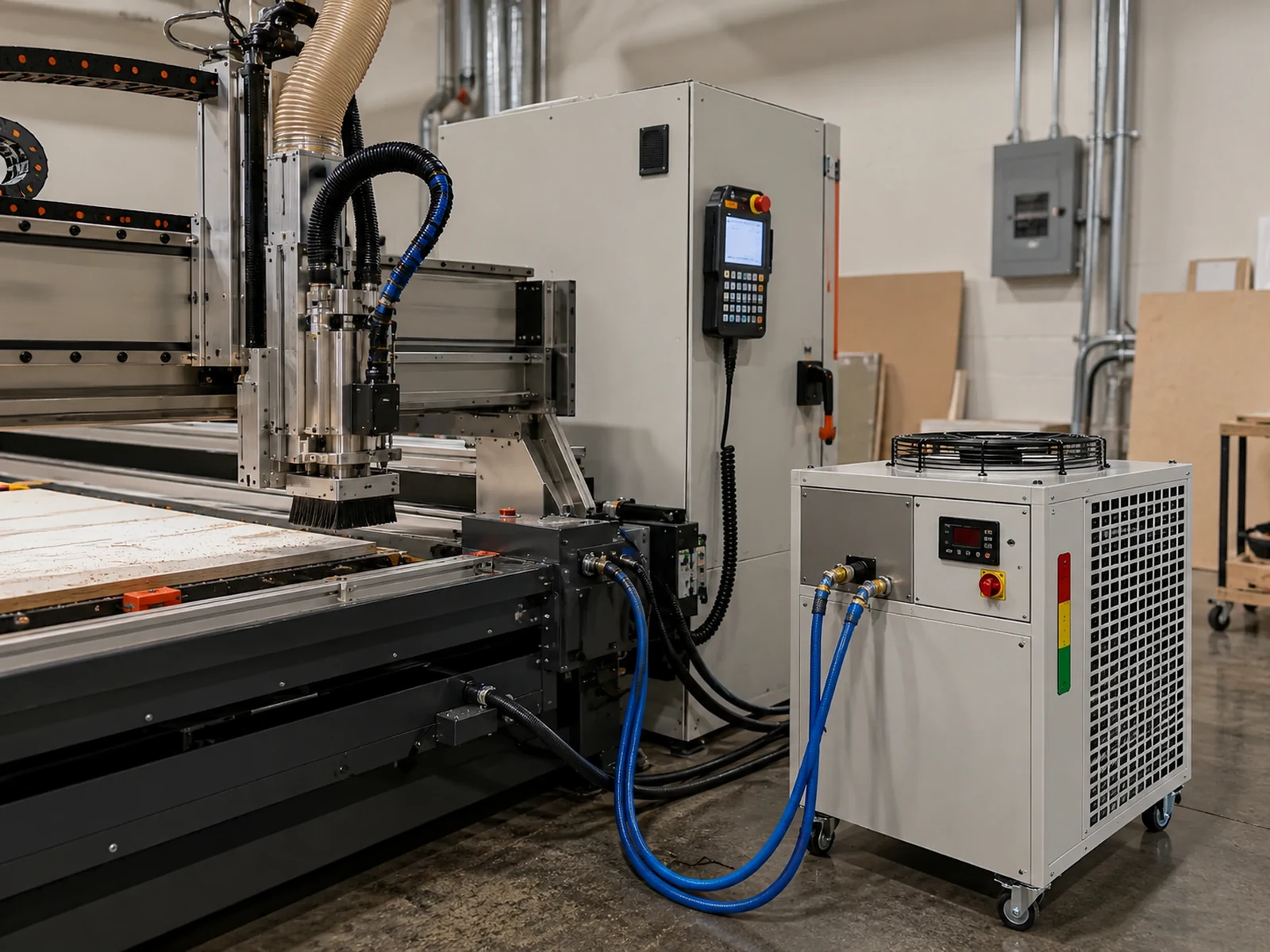
The required cooling device is not universal. HSD lists both a water refrigerator and a water/air heat exchanger among the accessories for its ES951 family. Its technical sheet also shows that cooling architecture varies among spindle versions within the same family.
Use only the coolant, flow, pressure, and operating-temperature requirements specified for the exact spindle and cooling unit. Do not copy a coolant mixture or flow value from another spindle model.
Cooling Has to Work With the Rest of the Machine
The cooling setup also has to work properly with:
- VFD settings
- Controller alarms
- Thermal protection
- Low-flow protection when included
- Cable and hose routing
- Dust extraction
- Maintenance access
- Tool-changing hardware
Even the right spindle can become the wrong setup if the cooling, alarms, hoses, wiring, or maintenance access are badly integrated.
Cooling Type Doesn’t Tell You How Good the Spindle Is
Cooling keeps spindle temperature under control. It does not tell you how strong, accurate, or suitable the spindle is for your job.
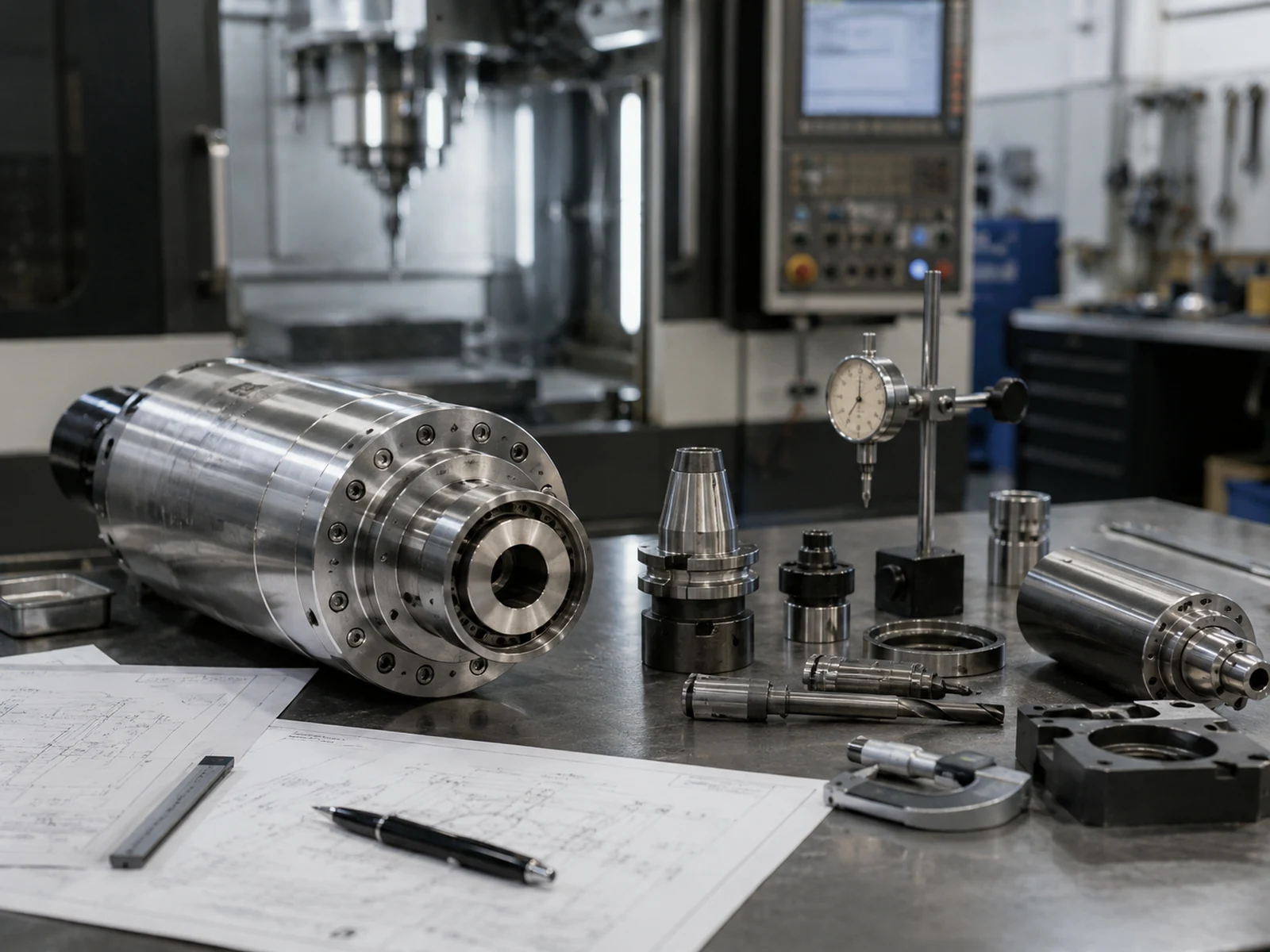
Power and Torque
Air cooling is not limited to low-power spindles, and water cooling is not automatically required above one fixed kW value.
The current UE-481 public specification lists a 9 kW ISO30 air-cooled spindle. HSD’s ES951 technical sheet independently lists forced-air versions at several power ratings and liquid-cooled versions at other power ratings. These are separate examples; they do not mean the UE-481 uses an HSD ES951 spindle.
If cutting load matters, look at the spindle’s power or torque curve at the RPM your tools actually use.
Runout and Finished-Part Accuracy
Water cooling does not automatically produce lower runout.
Check spindle runout with:
- A stated measurement position
- An agreed test bar or tool holder
- A defined spindle condition
- A suitable measuring instrument
Finished-part accuracy also depends on the machine frame and gantry structure, linear guides and drive system, calibration, tooling, tool deflection, workholding, cutting parameters, material movement, and inspection method.
Cooling can influence thermal management, but it does not independently establish finished-part accuracy.
Tool Interface and Duty Rating
Cooling type does not decide whether the spindle uses manual collet changes, automatic tool changing, ER collets, ISO tool holders, or HSK tool holders.
It also does not prove continuous-duty suitability. HSD’s ES951 technical sheet lists separate S1 and S6 ratings for its spindle versions. In standard motor-duty terminology, S1 describes continuous running duty at constant load long enough to reach thermal equilibrium.
For broader machine selection, review how the spindle fits the complete CNC router for woodworking configuration.
Don’t Read Z Travel as Material Thickness
Quick CNC lists the UE-481 X-Y-Z working area as 1220 × 2440 × 200 mm, approximately 48 × 96 × 7.9 in.
The 200 mm Z value is the listed Z-axis working travel. It is not a guarantee that the machine can cut a 200 mm-thick workpiece.
Usable workpiece thickness is reduced by the space required for:
- Tool holder
- Cutter projection
- Spoilboard
- Vacuum fixture or mechanical clamp
- Workholding plate
- Safe clearance above the part
- Required retract height
Usable workpiece thickness ≈ available spindle clearance − tool-holder and cutter requirement − fixture and spoilboard height − safety clearance
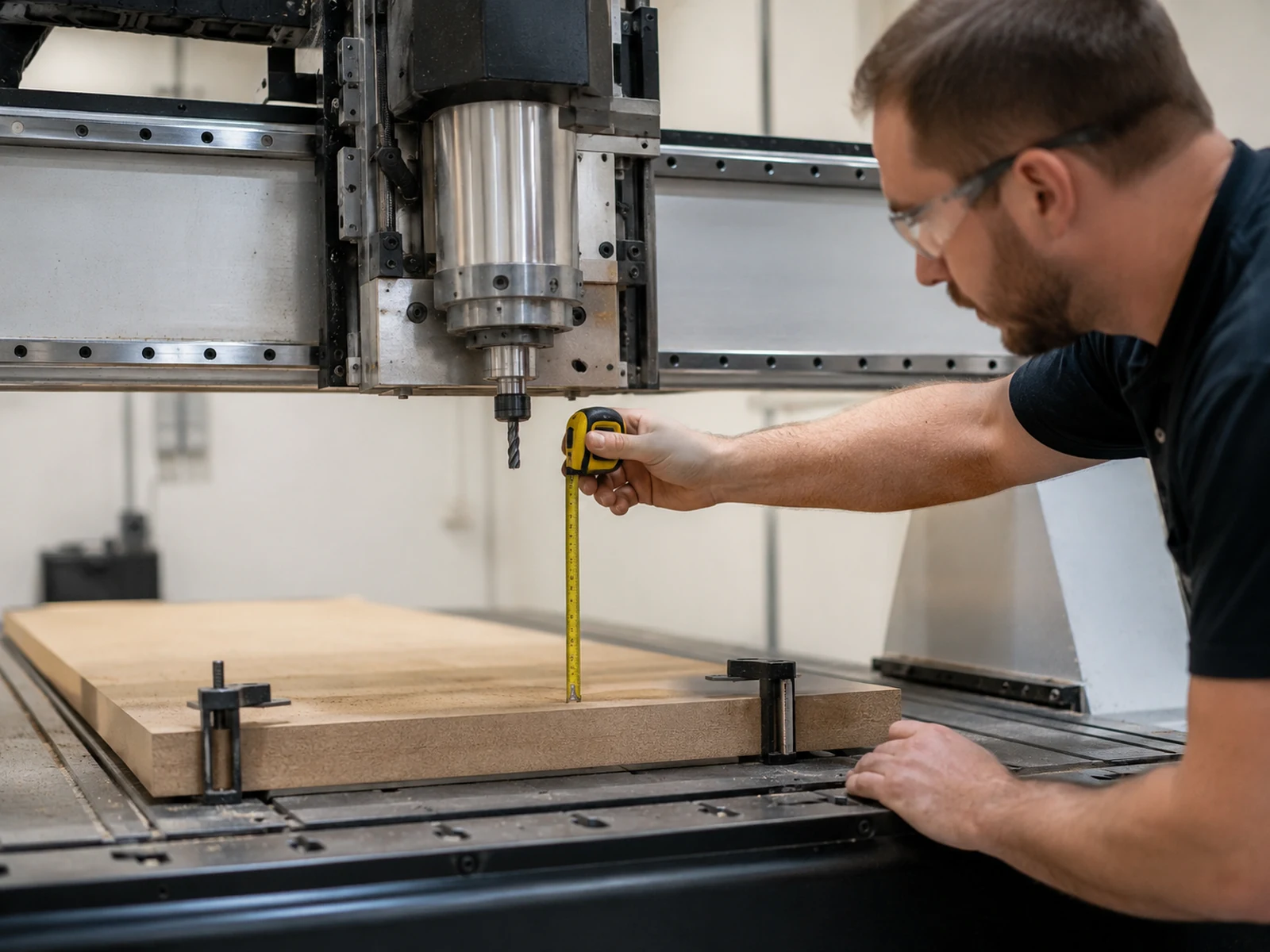
This is a layout check, not a universal machine formula.
Before ordering a machine for thick doors, stair parts, molds, foam blocks, or deep 3D work, provide:
- Maximum material thickness
- Fixture height
- Tool-holder type
- Longest required cutter
- Required cutting depth
- Clearance required above the part
Before you order, have us confirm the real spindle-to-table clearance and cutting envelope for the configuration you are considering.
Which Cooling System Fits Your Workshop?
Look at how you run the machine, the workshop environment, and who will maintain it. That usually makes the choice much clearer.

Which One Fits Your Workshop Better?
Process
Both cooling types can work well. First check whether the exact spindle gives you the RPM, torque, and tool interface your job needs.
Daily Workload
Look at the real cutting cycle and the spindle’s duty data. Do not choose from cooling type or kW alone.
Heat and Ventilation
Air cooling needs clean airflow around the spindle. Water cooling moves heat to another unit, and that unit still needs somewhere to release it.
Dust
Air-cooled spindles need airways that can be kept clean. Water cooling reduces reliance on workshop air for motor cooling, but it does not make the spindle dustproof.
Maintenance
With air cooling, someone needs to keep the fan and air path clean. With water cooling, someone needs to watch coolant, hoses, circulation, and the cooling unit.
Fault Protection
Ask what happens if cooling is lost. Thermal alarms matter for both systems, and liquid-cooled setups may also use flow monitoring when included.
Cold Weather
Air cooling avoids coolant-freezing risk. Liquid-cooled systems need approved coolant or a winterization plan for cold transport and storage.
Production Duty
“Eight hours a day” does not tell the whole story. A better picture is the longest cutting cycle, time under load, loading gaps, tool changes, normal RPM, cutter size, and number of shifts.
An air-cooled spindle can be specified for continuous operation when its technical data includes an appropriate S1 rating. That does not mean every air-cooled spindle can operate continuously at every load. Confirm the cutting load, RPM range, airflow, ambient conditions, and production cycle.
A liquid-cooled spindle also requires a suitable duty rating and correctly sized heat-rejection system. A stopped pump, restricted circuit, or inadequate cooling unit removes the cooling benefit.
Hot or Enclosed Workshops
An air-cooled spindle needs suitable ambient air and enough space around the inlet and exhaust.
A water-cooled spindle transfers heat to another device, but that device must release the heat into a suitable area. Installing the cooling unit inside a hot, unventilated enclosure does not solve the thermal problem.
MDF and Wood Dust
For heavy-MDF production, review the complete contamination-control plan. Air-cooled spindles require accessible, clean cooling passages. Water cooling reduces dependence on workshop air for motor heat removal, but it does not make the spindle dustproof.
Review spindle sealing, positive-pressure air when specified, tool-holder cleaning, machine enclosure, dust extraction, and fan or cooling-unit maintenance separately.
See Quick CNC’s CNC router applications when defining the material and process before spindle review.
Noise
Choose water cooling when reducing fan-related spindle noise is a defined requirement and the workshop can manage the added cooling circuit.
Do not describe a water-cooled CNC router as silent. The operator may still hear cutting, dust extraction, vacuum pumps, servo and motion systems, automatic tool changes, the circulation pump, and a refrigerated chiller or heat-exchanger fan.
If you want to compare noise properly, use the same spindle speed, tool, material, measurement distance, and auxiliary equipment.
Cold Storage and Shipping
Air cooling avoids coolant-freezing risk.
For a liquid-cooled system, make sure you have a written cold-weather procedure covering the approved coolant, drainage where allowed, pump and hose protection, cooling-unit protection, storage limits, and checks before restarting.
Use only coolant approved for the selected spindle and cooling unit. Exact chemistry, flow, and temperature requirements are model-specific.
What Happens If the Spindle Cooling Stops Working?
A cooling problem is much easier to deal with when the machine or operator catches it early.
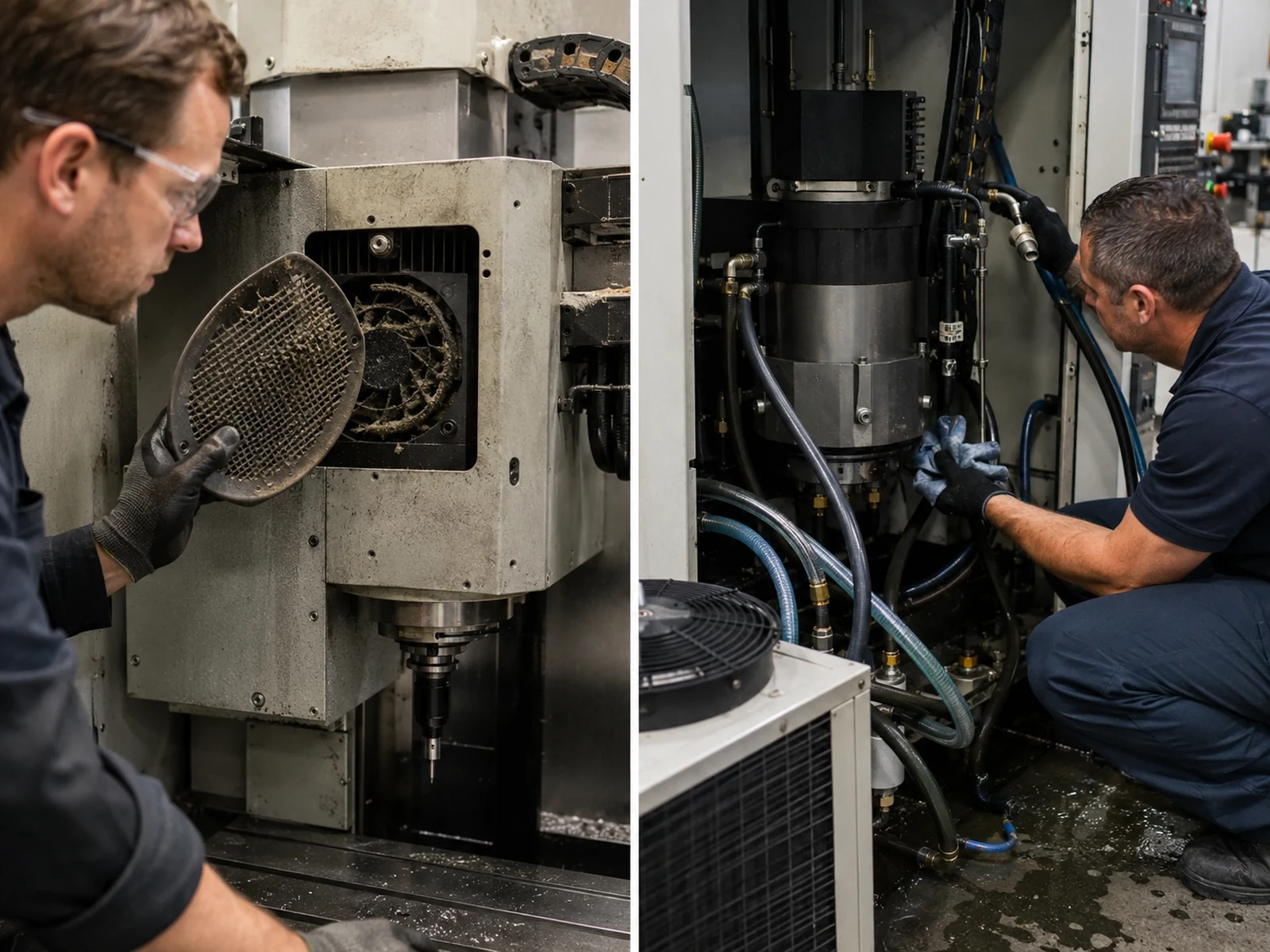
What Usually Goes Wrong?
Air Path Gets Blocked
Dust reduces airflow and spindle temperature starts to rise. Stop, clean the air path, and check that the fan is working normally.
Air-Cooling Fan Fails
A change in fan sound or loss of airflow is a warning. Stop the spindle and repair or replace the approved fan component before running again.
Coolant Stops Circulating
A stopped pump, blocked hose, or low coolant can raise spindle temperature quickly. Stop machining and inspect the cooling loop.
Coolant Leaks
Look for falling coolant level, air in the line, or visible leakage. Repair the leak and refill only with the approved coolant.
The Cooling Unit Cannot Remove Enough Heat
If coolant temperature keeps climbing, check the cooling-unit size, workshop temperature, ventilation, and heat-rejection path.
Coolant Freezes
Cold transport or storage can damage hoses, fittings, pumps, or cooling passages. Use the approved winterization procedure and inspect the whole loop before restarting.
The Cooling System Is Fine — But Who Is Checking It?
A spindle can have the right cooling setup and still cause trouble if nobody owns the daily checks.
With air cooling, a dusty air path or failing fan can go unnoticed. With water cooling, low coolant or lost circulation can do the same thing.
The fix is simple: make one person responsible for the check, keep the cooling path easy to reach, and confirm that the machine’s alarm or protection works the way the supplier says it does.
The better cooling setup is the one your workshop can keep an eye on consistently.
How Should You Compare Two CNC Router Quotes?
If a quotation only says “9 kW spindle,” you still do not know enough to compare it properly.
1. Find Out Exactly Which Spindle You Are Getting
Ask for the spindle brand and full model, rated power, RPM range, power or torque curve, duty data where available, tool interface, runout information, cooling method, and thermal protection.
Two quotations with the same kW value are not directly comparable when spindle brands, tool interfaces, duty ratings, or torque curves are different.
2. Check What Comes With the Cooling Setup
For an air-cooled spindle, make sure the quotation tells you:
- Fan architecture
- Fan power supply
- Air-clearance requirements
- Thermal-protection output
- Cleaning access
- Replacement-fan availability
For a liquid-cooled spindle, make sure the quotation tells you:
- Cooling-unit type and model
- Pump model where separate
- Coolant specification
- Required flow
- Operating-temperature range
- Hose and fitting scope
- Thermal protection
- Low-flow detection or flow interlock, when included
- Drainage and winterization instructions
Do not assume every liquid-cooled setup includes a flow switch. Ask: How is loss of coolant circulation detected, and what does the machine do after that fault?
3. Check the Machine Before You Accept It
| Check | What to Ask About | What to Check on the Machine |
|---|---|---|
| Spindle identity | Manufacturer and full model | Check that the nameplate matches the quote |
| Power and RPM | Rated data and curve | Check that the spindle covers the RPM range you actually use |
| Duty rating | S1/S6 or manufacturer duty data | Compare it with your longest real cutting cycle |
| Tool interface | ER, ISO, HSK, or specified system | Check that it matches your tooling and ATC setup |
| Z-axis envelope | Travel, spindle clearance, tooling, and fixture assumptions | Check the real workpiece thickness the machine can fit |
| Air cooling | Fan type, clearance, and protection | Make sure the fan runs normally and is easy to reach for service |
| Liquid cooling | Cooling unit, coolant, pump, hoses, and required circulation | Make sure coolant circulates normally and there are no leaks |
| Fault protection | Thermal output, optional flow detection, and programmed response | Check what alarm appears and how the machine responds using a safe agreed test |
| Runout | Value and measurement method | Measure runout with the agreed method |
| Warm-up | Spindle-manufacturer procedure | Make sure you receive the correct warm-up procedure |
| Cutting test | Material, tool, program, and criteria | Use the same material, tool, program, and test conditions you agreed on |
| Winterization | Transport and storage procedure | Make sure you have the cold-weather procedure before shipping or storage |
Do not create a real cooling failure just to test the machine, and never bypass an interlock. Use a safe test method and make sure the alarm and controller react the way they are supposed to.
Comparing Two Spindle Configurations?
Send us both quotes and the full spindle models. We can help you see whether the cooling setup, tool interface, duty data, and workshop requirements are actually comparable.
Send Us Both ConfigurationsWhat Should You Send Us So We Can Recommend the Right Setup?
You do not need to solve the whole configuration yourself. Give us enough information to understand the job, and we can look at the spindle, cooling, and the rest of the machine together.
What You Need to Cut
- Main product
- Material
- Common and maximum material thickness
- Typical and largest cutter diameter
- Cutting, engraving, drilling, grooving, or 3D processes
- Required cutting depth
- Tool-changing requirement
- Surface-quality or tolerance expectation
- Drawings or sample files where available
Part Size and Working Space
- Required X and Y working size
- Maximum workpiece thickness
- Fixture or spoilboard height
- Longest cutter
- Tool-holder type
- Required clearance above the part
- Deep-pocket or 3D-machining requirement
Do not use the listed Z travel alone to select a machine for thick material.
How You Run Production
- Longest loaded program
- Hours per shift
- Shifts per day
- Tool changes per job
- Product mix
- Production target
- Manual or automatic loading requirements
Your Workshop
- Minimum and maximum ambient temperature
- Dust and extraction conditions
- Ventilation
- Noise restrictions
- Freezing risk
- Available maintenance staff
- Local voltage and frequency
- Destination country
If You Already Have a Quote
- Machine model
- Spindle manufacturer and full model
- Spindle power
- Cooling method
- Tool interface
- S1/S6 duty data
- Controller and VFD
- Included cooling equipment
- Thermal and flow-protection description
- Competing quotation where relevant
For cabinet, wardrobe, door, and panel work, also compare whether the process needs a standard ATC router, nesting system, drill bank, PTP configuration, or another furniture CNC machine arrangement.
So, Which One Makes More Sense for You?
Choose the spindle for the job first. Then choose the cooling setup that fits it.
First check the power and torque where you actually run the tool, the duty rating, tool interface, ATC needs, runout information, machine fit, and real working space.
Then pick the cooling setup your workshop can actually look after day after day.
Go with air cooling when the simpler setup is more useful to you and the installation can keep the required airflow clean and open.
Go with water cooling when the spindle needs it and your team can manage coolant, circulation, heat removal, alarms, and cold-weather protection.
Pick the spindle that can do the job, make sure the machine has enough real working space, and use the cooling setup your team can keep running without making maintenance harder than it needs to be.
Questions We Hear All the Time
Can a 9 kW CNC spindle be air-cooled?
Yes. Quick CNC’s current UE-481 public specification lists a 9 kW ISO30 air-cooled spindle. So do not choose cooling type from the kW number alone. Look at the full spindle model, torque curve, duty data, RPM range, and how it is integrated into the machine.
Is a water-cooled spindle automatically more accurate?
No. Cooling helps control temperature, but it does not tell you how accurate the spindle or finished part will be. Check runout separately, then look at the tooling, machine structure, workholding, cutting parameters, and how the finished part is measured.
Which cooling type is better for an MDF workshop with heavy dust?
For a dusty MDF shop, look at how the whole machine deals with dust. Air cooling needs clean, accessible air passages. Water cooling uses less workshop air for motor cooling, but the spindle still needs proper sealing and good dust extraction.
Does every water-cooled CNC spindle need a chiller?
No. Some liquid-cooled spindles use a refrigerated chiller, while others can use a water/air heat exchanger or another approved cooling unit. Check what the exact spindle needs for coolant, flow, temperature, and heat removal. HSD lists both refrigerated and water/air heat-exchanger options for its ES951 family.
What happens if the water-cooling pump stops?
If the pump stops, coolant flow drops and spindle temperature can rise. Check what thermal protection is built in, whether flow monitoring is included, and what the machine actually does after the alarm—especially whether the spindle and machining cycle stop.
Can spindle coolant freeze during transport or storage?
Yes. If the machine will be shipped or stored in freezing conditions, the cooling loop needs the right coolant, drainage method, or winter plan. Use only coolant approved for the spindle and cooling unit, and check the whole circuit before starting the machine again.
Can an air-cooled spindle run all day?
Yes, if that spindle is actually rated for the duty. An S1 rating is one sign that continuous running is supported, but you still need to look at the real cutting load, RPM, airflow, workshop temperature, and production cycle.
Can I replace a water-cooled spindle with an air-cooled spindle later?
Do not treat it as a simple plug-and-play swap. Check the spindle size and weight, mounting, VFD settings, wiring, controller logic, tool interface, ATC compatibility, thermal protection, cooling parts, safety functions, and machine balance first.
References
The spindle examples in this article come from published Quick CNC and component-manufacturer information. Exact spindle, cooling, alarm, installation, and service requirements depend on the machine configuration you order.
- HSD ES951 technical information — cooling variants, S1/S6 data, and cooling-unit examples.
- Colombo technical guide — spindle cooling layouts and maintenance guidance.
- ABB Motor Guide — S1 continuous-running duty terminology.
Not Sure Which Spindle Setup Fits Your Machine?
Tell us what you are cutting, the material size and thickness, the main process, and how you expect the machine to run each day. We can start with the job and work back to the spindle and cooling setup.
Tell Us What You Need to Cut
Frannie
Hello, I’m Frannie, a CNC machinery specialist with 15 years of experience in the woodworking CNC industry. I help furniture factories, cabinet makers, woodworking workshops, and production businesses choose CNC machines that match their production needs, factory size, budget, and efficiency goals.
My work focuses on solving real production problems, including replacing outdated equipment, improving machining efficiency, reducing labor costs, and upgrading to smarter CNC solutions. I also support customers with machine installation guidance, operation training, video support, and on-site training when needed, helping them use their machines more confidently and effectively.