K45MT-DY 2/3-Spindle CNC Router for Woodworking
Keep two or three frequently used cutters ready for repeat work, so your operator can move from profiling to grooving or engraving with fewer manual cutter changes. We configure the spindle package, vacuum workholding, controller and dust setup around the parts you actually make.
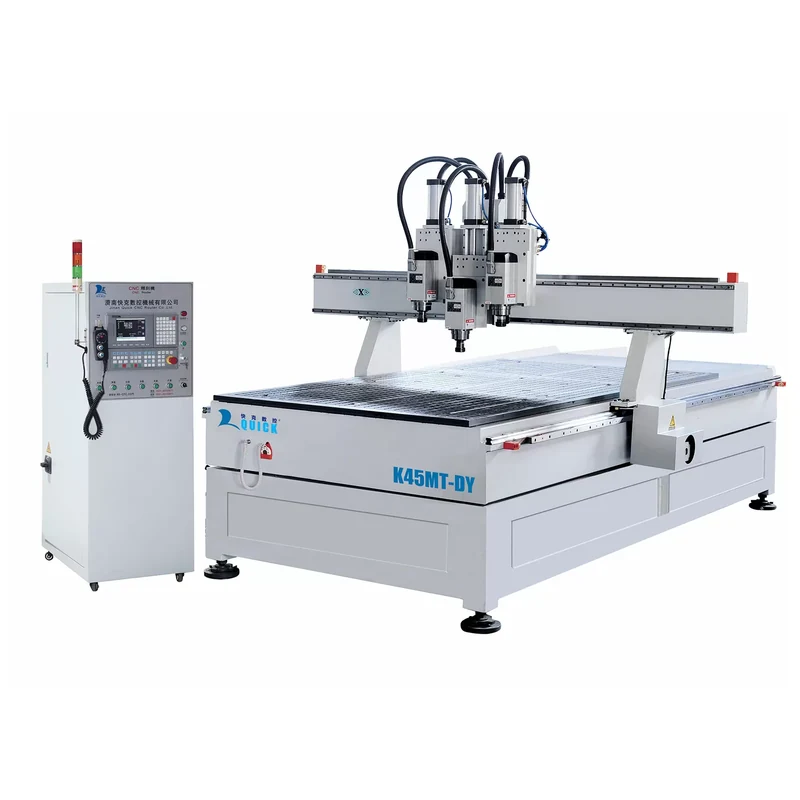
What Is the K45MT-DY Multi-Spindle CNC Router?
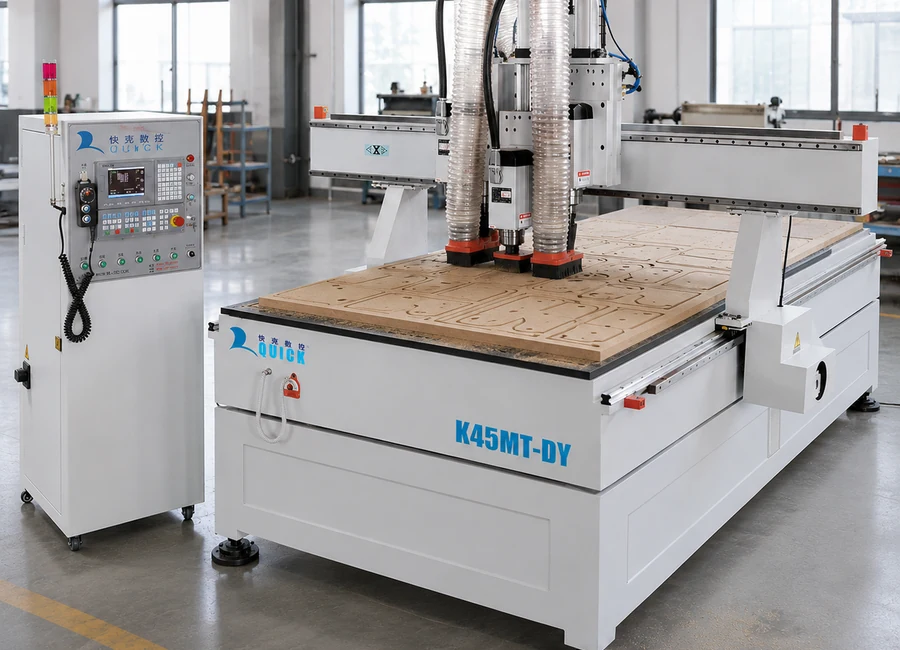
The K45MT-DY is a 2- or 3-spindle woodworking CNC router for repeat jobs that use a small, stable group of cutters. It is a practical fit for cabinet doors, furniture parts, MDF, plywood, grooving, profiling, engraving and repeat sheet cutting when you do not need a large ATC tool magazine.
Why Use Multiple Spindles Instead of Changing Tools by Hand?
Keep Common Cutters Ready
If your jobs keep coming back to the same two or three cutters, you can leave those tool positions prepared instead of setting them up again and again.
Reduce Operator Stops
A stable tool sequence can move through profiling, grooving or engraving with less manual cutter changing between operations.
Skip ATC Complexity When You Do Not Need It
If two or three tools cover most of the job, a multi-spindle layout can be a simpler production choice than buying a larger tool-magazine system.
Is the K45MT-DY Right for Your Work?
Best-Fit Buyers
- Furniture, cabinet and wood-door factories
- Panel-furniture and woodworking production shops
- Sign, acrylic and composite-material processors
- CNC service businesses and equipment distributors
- Owners, production managers, buyers and technical engineers
Typical Workpieces
Solid wood, MDF, plywood, particle board, melamine board, acrylic, PVC, plastics, foam and suitable composite sheets.
For aluminum-composite panels or selected soft-aluminum jobs, we first check the tooling, workholding, chip control and sample-cut plan.
Typical Operations
Cabinet and furniture-component routing, door patterns, drilling and grooving, engraving, sign making, nesting and repeat sheet cutting.
This machine makes the most sense when your programs keep returning to the same small group of cutters.
What a Multi-Spindle CNC Router Actually Does
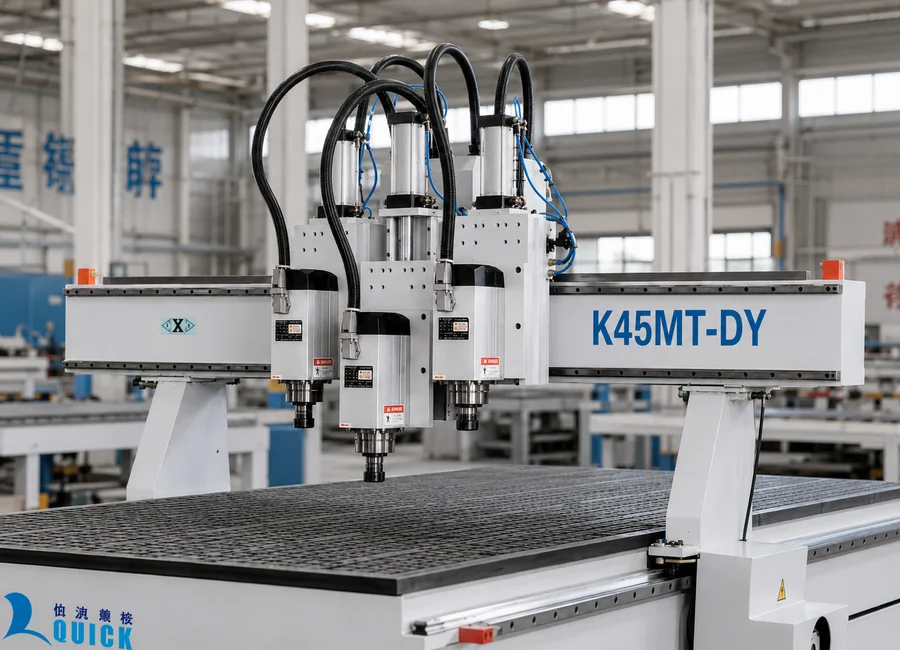
The K45MT-DY keeps multiple spindle positions prepared with selected cutters. For a repeat program, that could mean one cutter for profiling, another for grooving and a third for engraving.
Send us your tool list and program sequence and we can tell you whether the 2-spindle or 3-spindle version is the cleaner fit.
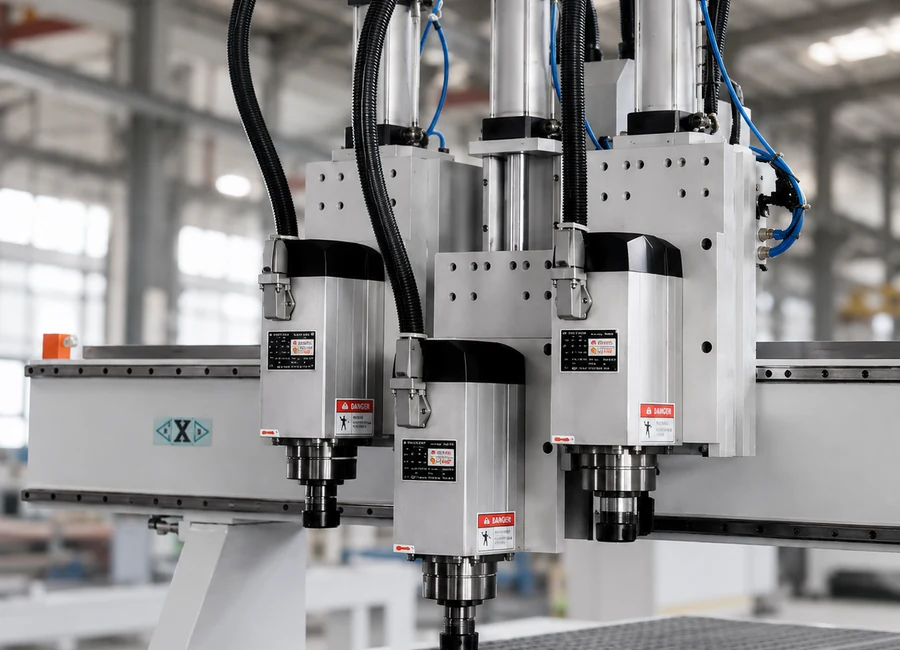
When This CNC Router Makes Sense, and When It Does Not
A strong fit when
- Your parts repeat two or three main cutters.
- You process 4 × 8 ft-class sheets or similar furniture components.
- You need routing, grooving, drilling or carving in batch production.
- You want vacuum workholding on a configurable woodworking platform.
Choose another platform when
- Your jobs need many tools and frequent automatic tool changes. An ATC CNC router is the better direction.
- You need four independently programmed cutting heads. Compare the K4 family.
- You need heavy metal milling or coolant-intensive machining.
- You want automatic loading and unloading as a standard production-line package.
2-Spindle vs 3-Spindle CNC Router: Which Setup Fits Your Tool Sequence?
Start with the tools your programs use most often. That usually makes the choice much easier than starting with a long option list.
| Production Need | 2-Spindle | 3-Spindle | ATC CNC Router |
|---|---|---|---|
| Two repeat cutters | Strong fit | Works | Usually more system than you need |
| Three repeat cutters | May still need a manual tool change | Strong fit | Works |
| Profiling + grooving | Strong fit | Strong fit | Strong fit |
| Profiling + grooving + engraving | Possible with an extra tool-change step | Strong fit | Strong fit |
| Large or frequently changing tool library | Not the best fit | Not the best fit | Best fit |
| Stable repeat production with a small tool group | Strong fit | Strong fit | Works, but may add unnecessary complexity |
Materials the K45MT-DY Can Process
Wood & Panel Materials
MDF, plywood, solid wood, particle board and melamine board are core woodworking materials for this machine family.
Plastics & Sheet Materials
Acrylic, PVC, plastics, foam and suitable composite sheets can also be matched with the right cutter, hold-down and cutting plan.
Selected Soft Aluminum
For suitable light soft-aluminum work, we check cutter geometry, spindle load, chip evacuation or lubrication, workholding and a sample test first. This is not a heavy-metal machining center.
K45MT-DY Multi-Spindle CNC Router Specifications
These are the current reference values for the model. We match the final machine configuration to your order, so the order documents remain the final build reference.
| Decision Area | Reference Value | What It Means for You |
|---|---|---|
| Working area | 1300 × 2500 × 200 mm (X × Y × Z travel) | The 200 mm figure is Z travel, not a promise that every 200 mm-thick part can be processed. |
| Spindle package | 2 or 3 × 6 kW air-cooled spindles | We match the lifting and control setup to the selected spindle package. |
| Rated spindle speed | 18,000 rpm | Actual cutting parameters still depend on the cutter, material and finish you want. |
| Drive system | Rack and pinion on X/Y; ball screw on Z | Final component brands and ratios are fixed in the selected configuration. |
| Rapid travel | 35,000 mm/min | This is the machine-rated reference value, not a promised production cycle time. |
| Maximum cutting speed | 25,000 mm/min | Real feed rate is set around the material, tool and cut quality target. |
| Positioning repeatability | 0.02 mm reference value | If this figure matters to your acceptance plan, we define the check method and conditions with the order. |
| Table / vacuum | Vacuum table; 7.5 kW pump listed | We match vacuum zoning, pump setup and auxiliary workholding to your sheet and part size. |
| Controller / drive | DSP A11 handheld control; Leadshine stepper listed | Servo and alternative controller packages can be configured when your application calls for them. |
| Power | 380 V, three phase, 50/60 Hz listed | We match voltage, phase and frequency to the destination before production is locked. |
| File / interface | G-code; USB 2.0 listed | Send us your files if you want us to check the postprocessor and workflow before ordering. |
Match the Machine Structure to the Parts You Actually Run
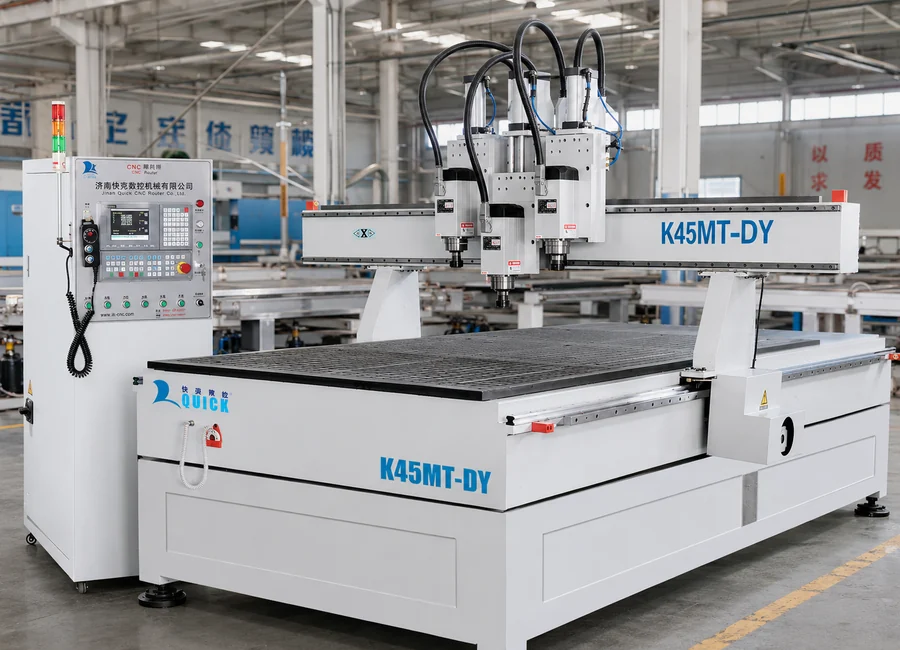
What this structure is built around
- Gantry routing across 1300 × 2500 mm-class sheet work.
- Rack-and-pinion X/Y motion and ball-screw Z motion on the listed configuration.
- Vacuum workholding for suitable flat panels, with auxiliary fixtures for smaller or porous parts.
- Multiple prepared spindle positions for repeat cutter sequences.
Before we lock the build, we look at your heaviest part, smallest part, tool projection, fixture height, dust load and destination electrical conditions. That gives you a machine spec tied to the job instead of a generic option sheet.
How We Configure Your 2- or 3-Spindle CNC Router
2-Spindle Package
Best when your repeat jobs mainly alternate between two cutters, such as profiling plus grooving or engraving.
3-Spindle Package
Best when a stable three-tool process keeps coming back in your programs and you want the third cutter ready.
Motion & Control
The reference setup lists DSP A11 and stepper drives. We can configure servo, controller and electrical alternatives when the job calls for them.
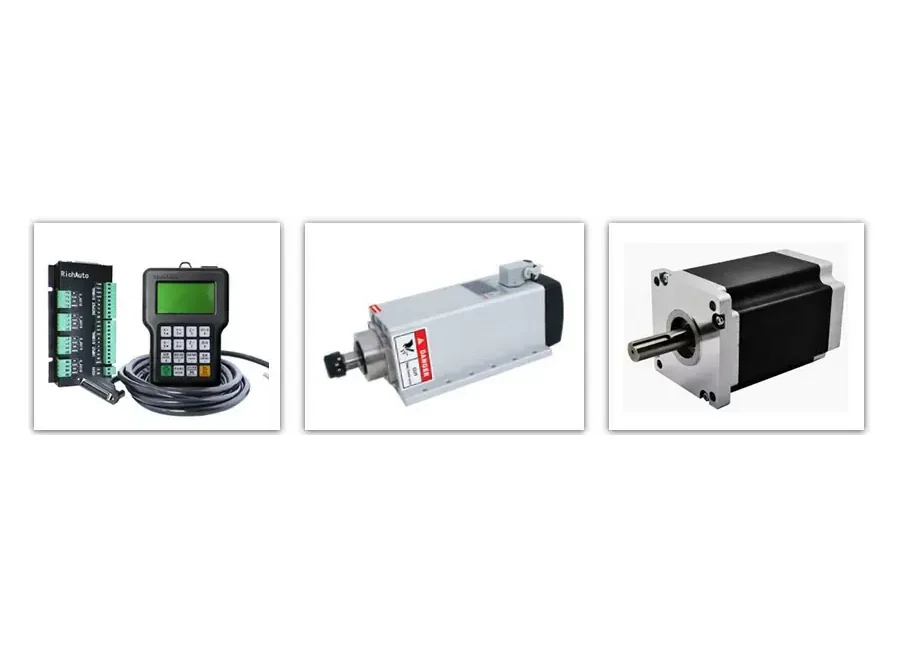
What we lock down before production
- Spindle count, power, brand, collet and cooling method
- Head-lifting and control logic
- Stepper or servo package
- Controller, postprocessor and file-transfer workflow
- Vacuum pump, table zoning and auxiliary clamps
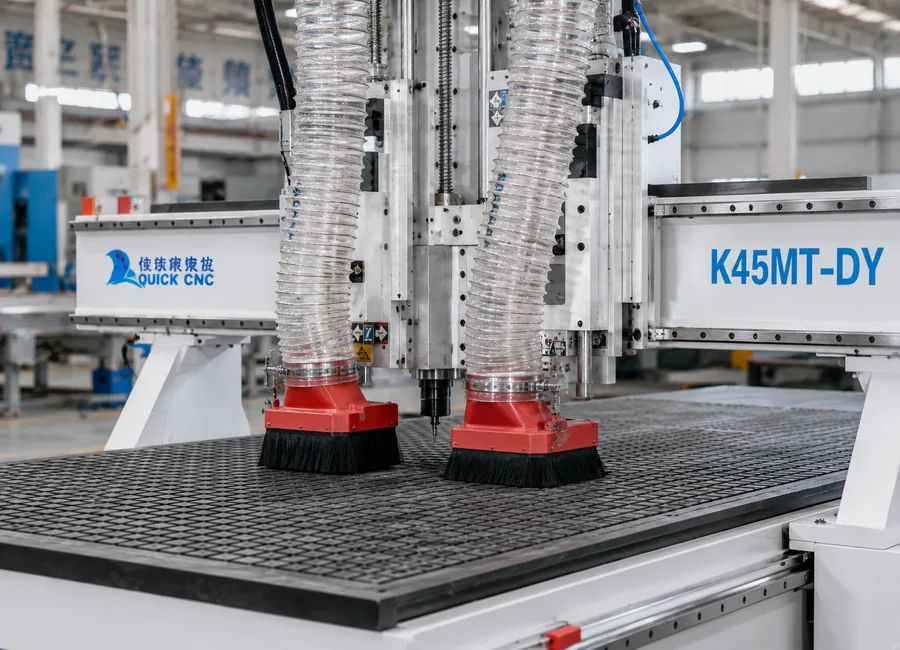
- Dust collection and extraction interface
- Voltage, phase, frequency and destination documentation
Choose Options That Solve a Real Production Problem
Working Size
Need a larger format? We first check your panel size, loading method and available floor space.
Spindle / Drive
HSD spindle and servo options can be considered when they make sense for your process.
Rotary Work
A rotary-axis option can be checked for suitable cylindrical parts once we know the diameter, length and fixture space.
Dust & Workholding
We match dust collection, vacuum zoning and fixtures to material porosity and part size.
Tooling, Workholding and Sample Cutting Decide the Real Result
What we need from you
- Material type, density, coating and sheet dimensions
- Part size, nesting layout and smallest remaining bridge
- Cut depth, pass strategy, edge-finish and chip requirements
- Tool diameter, flute geometry, collet and tool projection
- Vacuum leakage risk, fixture requirements and dust extraction
This video shows the machine family. For your project, sample results still come from the agreed tooling, material, workholding and test conditions.
About soft aluminum
For suitable light soft-aluminum work, we first define the cutter, spindle load, chip evacuation or lubrication, workholding and sample-test plan. If the job is heavy metal milling, this is simply the wrong machine architecture.
How We Turn Your Buying Requirements into a Pre-Shipment Check
Check the Configuration
We verify the model, working area, spindle package, controller, drives, vacuum, dust interface and destination power.
Run the Machine and Sample Plan
The acceptance plan can cover homing, motion, spindle operation, vacuum holding, program execution and agreed sample-cut items.
Record What Matters
We agree in advance which photos, videos, checklists, measurements or documents you need before the machine is released for shipment.
For certificates and destination documents: tell us what your market or project requires before the order is locked. That way the required document scope is clear from the start.
When to Choose K45MT-DY and When to Compare Another Quick CNC Model
K45MT-DY 2/3-Spindle Router
Choose it when two or three prepared cutters cover the repeat process and you do not need a large tool magazine.
K45MT-DT Double-Spindle
Compare this model when your process is centered on two heads and its defined head arrangement.
View the double-spindle modelK4 Multi-Head CNC Router
Compare the K4 when four independently selected tools are a better match for your cabinet-production sequence.
View the K4 multi-head modelHow We Would Configure This Machine for Cabinet-Door Work
This is an engineering example, not a claimed customer case.
What the shop is making
The work repeatedly uses profiling, grooving and decorative engraving on MDF and plywood parts. Most programs use the same two or three cutters, while part sizes and nesting layouts change.
How we would choose the setup
We would compare the 2- and 3-spindle sequence first, then work through vacuum zoning, dust extraction, cutter reach, controller workflow and a representative sample file. The recommendation comes from the real tool list and sample criteria, not a made-up productivity multiplier.
What Happens After You Send Us Your Parts and Tool List
1. Review the Job
We start with your drawings, materials, tool list, edge-quality target and production sequence.
2. Lock the Configuration
Spindles, control, workholding, dust setup and electrical package are written into the order documents.
3. Agree the Checks
We define the machine, functional and sample checks that matter for your order.
4. Prepare for Shipment
Packing, documents, installation scope and the after-sales route are checked before shipment.
K45MT-DY Lead Time, Packing and Warranty
MOQ
No minimum order quantity.
Lead Time
Standard production lead time is 45 days after the order and final machine configuration are confirmed.
Packing & Logistics
The machine is prepared with export packing and is generally transported by container.
Payment & Warranty
Payment terms follow the final quotation. The standard machine warranty period is one year.
Sort Out Installation and Support Before the Machine Ships
Pre-Installation
We check floor space, unloading path, power, grounding, vacuum, compressed air, dust extraction and network or software requirements with you.
Commissioning & Training
Remote or on-site support, travel responsibility, language and training content are agreed in the commercial scope.
After-Sales Route
Quick CNC provides technical support and spare-parts coordination around the supplied machine configuration and service agreement.
View Quick CNC service informationK45MT-DY Multi-Spindle CNC Router Questions
What is the difference between a multi-spindle CNC router and an ATC CNC router?
A multi-spindle router keeps a small number of cutters prepared in separate spindle positions. An ATC router uses a tool-changing system and tool magazine, so it is a better fit when your jobs need a larger or frequently changing tool library.
Is the K45MT-DY an ATC CNC router?
No. The K45MT-DY is a 2- or 3-spindle router that keeps a limited group of cutters ready for repeat work. If you need a large automatic tool library, compare an ATC model instead.
Should I choose two or three spindles?
Start with your normal tool sequence. If most jobs use two repeat cutters, the 2-spindle setup is usually the cleaner choice. If three repeat cutters keep appearing in the program, the 3-spindle setup gives you that extra prepared tool position. Send us your tool list and sample file and we can compare both setups.
Is a 3-spindle CNC router a good fit for cabinet doors?
It can be a strong fit when your cabinet-door programs repeatedly use three cutters, such as profiling, grooving and engraving. The actual choice still comes back to your tool sequence and sample requirements.
Can the K45MT-DY cut MDF and plywood?
Yes. MDF and plywood are listed among the typical woodworking materials for this machine, along with solid wood, particle board and melamine board.
Can it cut aluminum?
Selected light soft-aluminum work may be possible with the right cutter, chip-control plan and secure workholding, followed by a sample test. This model is not positioned as a heavy-metal machining center.
Can the working size or controller be customized?
Larger working formats, alternative controllers, servo packages, spindle options, rotary work and dust-control setups can be discussed around your actual application.
What should be tested before shipment?
We can define configuration checks, machine functions, representative program execution, vacuum holding and agreed sample or measurement records before the machine is released for shipment.
What is included in the price?
That depends on the spindle package, controller, drives, vacuum system, dust interface, electrical standard, accessories, documentation, packing and service scope. We list the included items clearly in the quotation.
Send Your Drawing and Tool List. We Will Help You Pick the Right Spindle Setup.
Send us your part drawing or sample photo, material, sheet size, usual tool sequence and destination power. We will use that information to recommend the 2- or 3-spindle setup, workholding, controller and supporting configuration.