K4 · Four-Spindle Cabinet Production
K4 Multi-Head CNC Router for Cabinet Production
Keep four commonly used tools ready on four independent spindles and move through repeated cutting, grooving and drilling operations with fewer manual tool-change stops. The K4 is built for cabinet, door and furniture-component production that uses a stable multi-tool process every day.
Send the drawing, material, normal tools used in one program and target output per shift. Quick CNC can configure the four-spindle tool plan around the real production sequence.
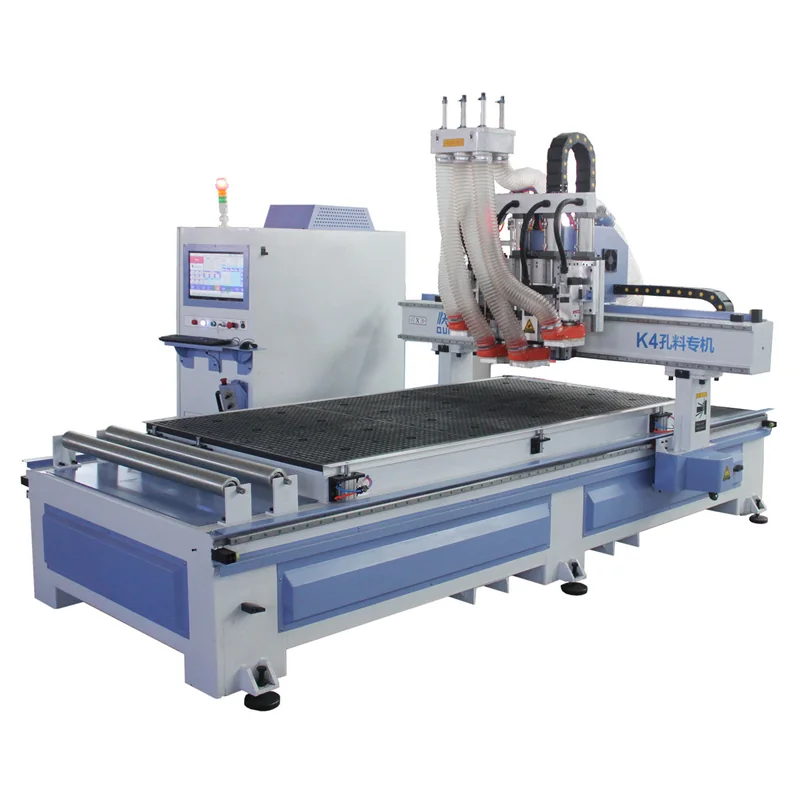
Where the K4 Fits Best in Furniture Production
The strongest fit is repetitive panel and furniture work where the same small group of tools appears again and again. Instead of stopping to change cutters manually, each spindle can stay prepared for a different operation.
Primary work
Cabinet panels, wardrobe parts, doors, shelves, furniture components, repeated grooves, profile cutting and drilling-hole work.
Primary materials
MDF, plywood, particle board, melamine board and solid wood are the main materials for the cabinet and furniture role.
Secondary sheet materials
Acrylic, PVC, plastics, aluminum composite panel, foam and suitable composites can be matched with the correct cutter, hold-down and dust or chip strategy.
Suitable soft aluminum work
Light routing in suitable soft aluminum requires the alloy, thickness, tool, chip removal, holding method and cutting parameters to be matched to the actual part before regular production.

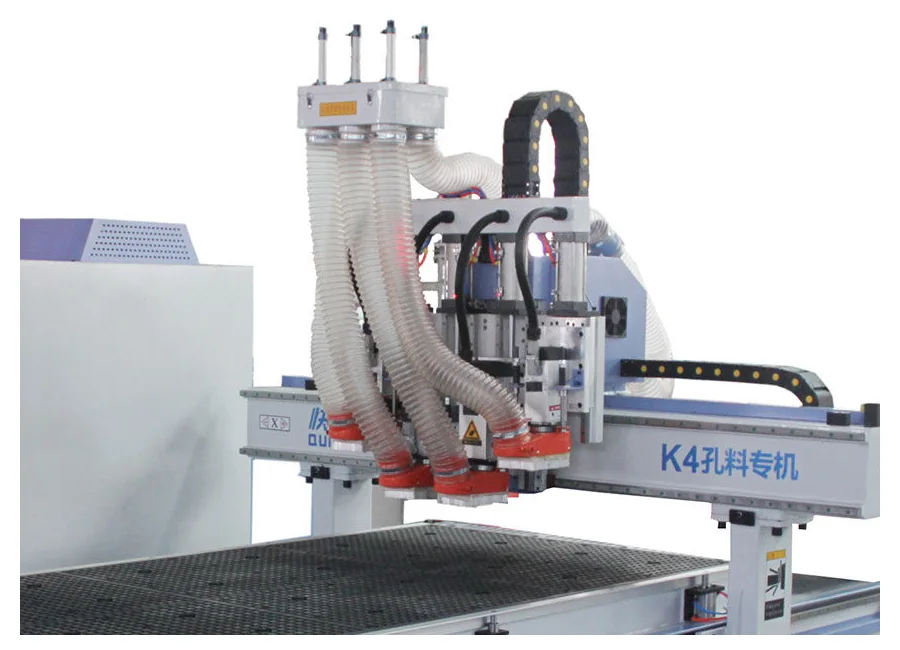
Four Prepared Spindles Turn Tool Changes into a Production Sequence
The K4 does not use a tool magazine. Four independent inverters control four spindles, allowing the program to call the prepared spindle needed for the next operation. The machine configuration uses two spindles for cutting and grooving and two for drilling-hole work.
The exact cutter assignment follows the part drawing. The production advantage is strongest when most jobs reuse the same three or four operations.
Choose K4 When the Process Matches — Not Just Because It Has Four Spindles
K4 is a strong fit when
- One normal program repeatedly uses three or four tools.
- Cabinet or door parts combine cutting, grooving and drilling.
- Manual cutter changes interrupt a repeat production cycle.
- A 4×8-class working area covers the normal panels and parts.
- The production mix is stable enough to keep the spindle assignments consistent.
Choose another machine direction when
- One program regularly needs more than four tools — an ATC router is normally more flexible.
- Dense horizontal or multi-face furniture holes dominate — a drilling or six-side drilling machine is usually the better route.
- Automatic loading, unloading, labeling and sheet flow are the main goal — move to a nesting cell or production line.
- Most jobs use one cutter only — a single-spindle router may be simpler.
K4 Multi-Head CNC Router Specifications
| Item | K4 Specification | Production Meaning |
|---|---|---|
| Model | K4 | Four-spindle multi-head CNC router. |
| Working area | 1220 × 2440 × 200 mm | 4×8-class panel and furniture-component work. |
| Machine size | 2400 × 3200 × 1900 mm | Use this footprint when planning installation space and service access. |
| Repositioning resolution | 0.02 mm | Motion-system specification; finished-part results also depend on tooling, material, hold-down, program and machine condition. |
| X/Y movement | Rack and pinion, gear drive | Long-axis motion for panel routing. |
| Z movement | Ball screw drive | Vertical spindle positioning. |
| Linear guide | 25 mm square guide | Supports guided axis motion on the machine structure. |
| Maximum speed | 45,000 mm/min | Machine travel specification, not a finished-part output figure. |
| Maximum cutting speed | 35,000 mm/min | Actual cutting speed depends on material, cutter, depth and finish requirement. |
| Spindle 1 | 6 kW HSD, 18,000 rpm | High-power routing position for suitable cutting or grooving work. |
| Spindle 2 | 6 kW spindle, 18,000 rpm | Second high-power routing position. |
| Spindles 3 & 4 | 2.2 kW each, 18,000 rpm | Used in the K4 tool plan for drilling-hole work. |
| Drive motors | Yaskawa servo, 850 W | Servo motion system for repeat axis positioning. |
| Controller | Syntec | Controls the multi-spindle machining sequence. |
| Table | Vacuum table with 7.5 kW pump | Panel hold-down for cutting, grooving and drilling. |
| Electrical specification | AC 380 V, 50–60 Hz, 3-phase | Send the destination and factory power before production so the electrical plan is set correctly. |
| Command / interface | G code / USB 2.0 | Program transfer and CNC execution. |
| Software | Alphacam listed with the machine | Post-processor and program setup should match the actual production files. |
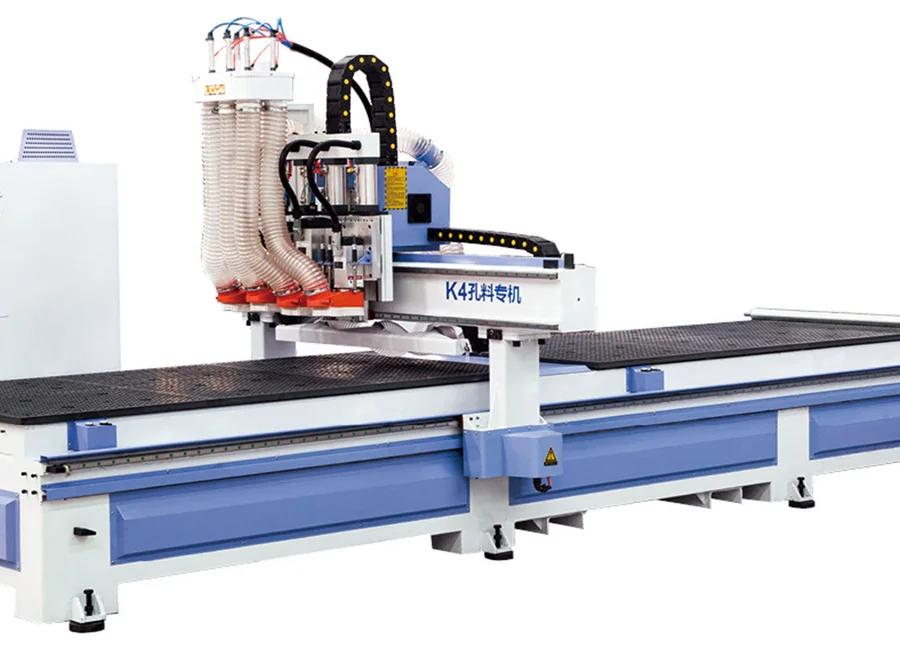
Machine Structure Built Around Repeated Panel Work
The K4 combines a heavy-duty bed with rack-and-pinion X/Y motion, Z-axis ball screw drive, 25 mm square guides and Yaskawa servo motors. The vacuum table and 7.5 kW pump hold sheet and panel work while the four-spindle head moves through the programmed sequence.
Stable motion platform
The bed, linear guides and drive system support repeated cutting, grooving and drilling across the working area.
Panel hold-down
Vacuum performance depends on the spoilboard, zones, sheet porosity, part size and sealing condition. Small parts or porous stock may need a different holding plan.
Configure the Four Spindles Around the Jobs You Run Most
Tool assignment
Build the four positions around the most common cutting, grooving, profiling and drilling operations instead of an occasional special job.
Double-station option
A double-station configuration is available when the production layout benefits from separate loading and machining positions. The final layout should follow part size, operator flow and floor space.
Electrical and extraction
Factory voltage, frequency, phase, dust collection and compressed-air requirements should be included in the machine plan before production.
Customization Starts with the Part, Not an Option List
Send the part that controls daily output and the process that causes the most interruption. The machine configuration can then be built around the material, part size, cutter sequence, drilling requirements, hold-down, software path and factory conditions.
Plan the Cutting, Grooving and Drilling Sequence Before the Machine Is Built
Example cabinet-panel tool plan
| Operation | Typical Tool Direction |
|---|---|
| Panel profiling | Compression or spiral cutter selected for the panel and edge finish. |
| Grooves / slots | Straight or compression cutter sized for the groove width and depth. |
| Repeated holes | Drilling tool assigned to one of the drilling spindles. |
| Second drill / recurring route | Use the fourth spindle for the next operation that repeats often enough to justify a prepared tool. |
Tool type, diameter, feed, speed and depth are set from the material, drawing and finish requirement.
Watch the K4 Multi-Head CNC Router
How Quick CNC Prepares the Machine Before Shipment
Quick CNC production includes component, assembly, electrical, running and packing checks. For a K4 project, the useful machine run should focus on the ordered spindle sequence, axis motion, Syntec operation, vacuum hold-down and the real cutting, grooving or drilling tasks that matter to your factory.
Send a representative panel drawing and material when machining result or cycle sequence matters. We can prepare the spindle sequence and machine run around a practical part from your production.
K4 vs Single-Spindle, ATC, Nesting and Six-Side Drilling
| Production Need | Better Starting Direction | Why |
|---|---|---|
| Mostly one cutter, occasional manual changes | Single-spindle CNC router | Simpler machine when the program does not need a fixed multi-tool sequence. |
| Three or four repeated tools in cabinet, door or furniture jobs | K4 multi-head CNC router | Prepared spindles reduce repeated manual tool-change stops. |
| Many tools across changing programs | ATC CNC router | A tool magazine gives more tool capacity and program flexibility. |
| Full-sheet cutting with loading, unloading and labeling | Nesting cell or furniture production line | Automation, material flow and labeling become the main production requirement. |
| Dense side, edge and multi-face furniture holes | CNC drilling / six-side drilling | Dedicated drilling architecture is better suited to multi-face hole patterns. |
Representative Cabinet Panel: Where Four Prepared Tools Save the Most Interruption
Consider a cabinet side panel that needs profile cutting, a back-panel groove and two recurring hole operations. On a single-spindle router, the operator may stop the process to change cutters several times. On the K4, the four tools can remain prepared on separate spindles and the program moves through the required sequence.
The actual production gain depends on the number of operations, tool changes, hole count, material, loading time and part mix. Send the normal part and shift target to estimate the process around your factory.
From Your Part Drawing to a Production-Ready K4 Configuration
Part and process
Start with the representative cabinet, door or furniture part and list every cutting, grooving, drilling and shaping operation.
Tool and holding plan
Match the four spindle positions to the most repeated tools, then check vacuum hold-down, smallest parts and sheet porosity.
Factory integration
Set the controller/software path, electrical supply, extraction, target output, service access and shipping destination before production.
Send These Inputs for a Useful K4 Quotation
- Main product and one representative drawing
- Material and thickness
- Largest sheet or part
- Smallest finished part
- Required cutting, grooving, drilling and routing operations
- Tools used in one normal program
- Hole directions and recurring drill sizes
- Target output per shift
- Factory voltage, dust collection and available air supply
- Destination country and required delivery timing
Order, Production Lead Time, Packing and Logistics
Configured machine quotation
The quotation is built around the spindle/tool plan, required options, destination electrical setup and service requirements rather than a generic machine list.
Approximately 45 days
Standard production lead time is approximately 45 days after the order and machine configuration are confirmed. Ocean freight time is separate.
Export packing
The machine is prepared for export shipment and is normally transported by container. Packing and shipping details are coordinated with the destination.
Installation, One-Year Warranty and After-Sales Support
Our service team supports installation guidance, operator training, troubleshooting and spare-parts coordination. For the K4, operator handover should cover Syntec operation, spindle assignment, tool setting, vacuum-table use, lubrication, dust extraction and routine maintenance.
Standard warranty: one year. Service arrangements are set according to the machine configuration and destination.
Multi-Head CNC Router FAQ
How is K4 different from an ATC CNC router?
K4 keeps four tools on four separate spindles and switches between those prepared spindles. An ATC router uses a tool magazine and is normally more flexible when one program needs more than four tools.
Do all four spindles cut at the same time?
No. K4 is configured around sequential spindle switching for different operations. It should not be confused with multi-head machines that run several heads simultaneously on repeated identical parts.
Is 1220 × 2440 mm suitable for cabinet panels?
It covers common 4×8-class panel work. Send the largest normal panel, smallest finished part and any fixture or edge-clearance requirement so the usable process can be planned correctly.
Can K4 drill cabinet holes?
Yes. The K4 tool plan uses two of the four spindles for drilling-hole work. Send the hole map, directions, diameters and depths so the drilling method can be matched to the part.
Does 0.02 mm mean 0.02 mm finished-part tolerance?
No. The 0.02 mm figure is repositioning resolution. Finished-part results depend on the cutter, calibration, workholding, material, program, thermal condition and measurement method.
How can production output be estimated?
Use one normal part. Count loading, cutting paths, grooves, holes, spindle calls and unloading, then compare the calculated process with the required pieces per shift. Send the drawing and output target so the process can be planned around your production mix.
Can K4 process acrylic, PVC or soft aluminum?
Acrylic, PVC, plastics and suitable composites can be handled with the correct cutter and holding plan. Suitable soft-aluminum work needs material-specific tooling, chip control, hold-down and cutting parameters.
What software and controller does K4 use?
The machine uses Syntec control, G code and USB 2.0; Alphacam is listed with the K4. Send your current CAD/CAM setup so the post-processor and file-transfer method can be matched before production.
Start with the Cabinet or Furniture Part You Run Most Often
Send the drawing, material, four most common operations and output target. Quick CNC can configure the K4 tool assignment, vacuum hold-down direction, software path, factory requirements and quotation around the production job that matters every day.
Send the Part and Production Target