4 Axis Wood CNC Router with ATC for Angled and Curved Parts
Machine cabinet doors, shaped furniture components and decorative wood parts with a 9.6 kW HSD spindle that swivels through ±90° and an 8-position automatic tool changer.
UA-481 is built for production where a fixed vertical spindle creates extra setups. The 1220 × 2440 mm table handles 4×8-class work, while the swiveling spindle gives the cutter access to selected angled faces, side features and curved surfaces. Automatic tool changing keeps cutting, grooving, drilling and carving operations in one programmed sequence.
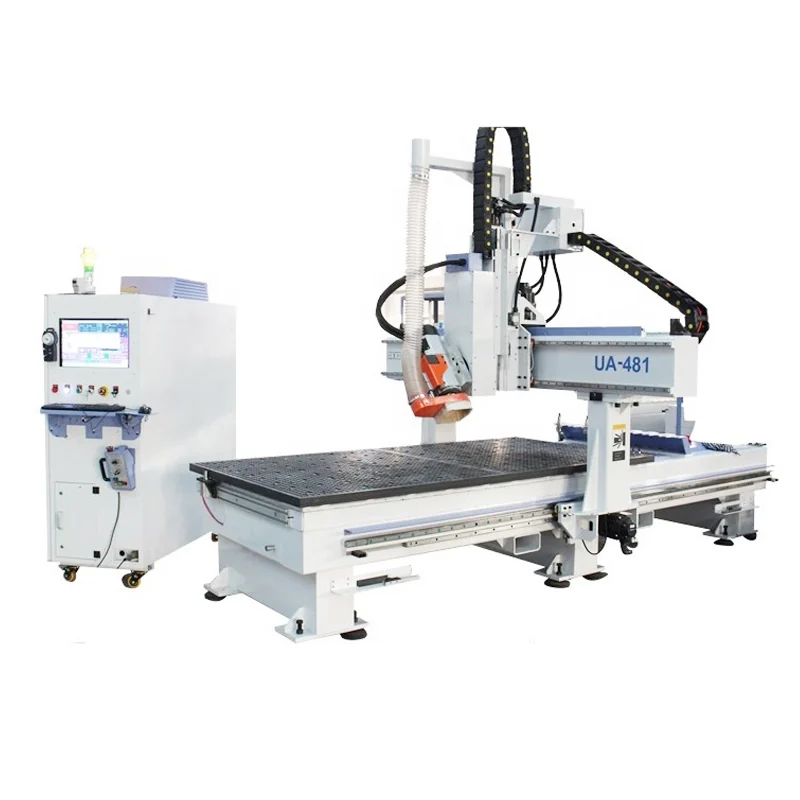
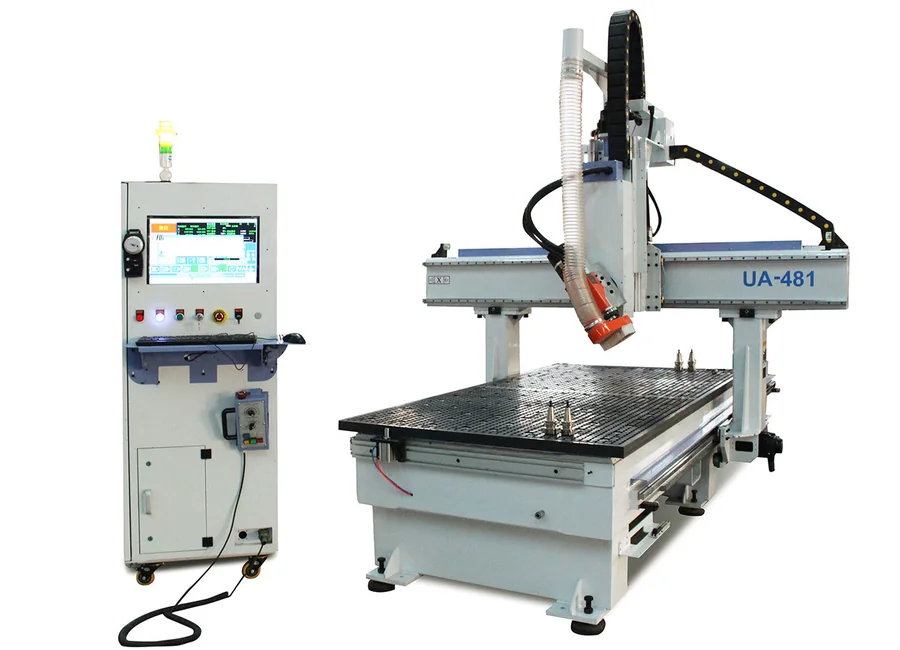
Choose UA-481 when the part needs more than top-face routing
The strongest applications are cabinet doors, custom furniture components, shaped solid-wood parts, carved panels, interior decoration and other work that combines standard routing with angled or curved-surface access.
Solid wood, MDF, plywood, particle board and melamine-faced panels are the main material group. Acrylic, PVC, plastics, aluminum composite panels, foam and suitable composites can also be processed with material-specific tooling and workholding. Soft aluminum should be limited to suitable light-routing jobs with controlled chip evacuation and secure fixturing.
Keep angled machining and tool changes inside one production sequence
A fixed vertical spindle often means extra fixtures, manual repositioning or a second machine when a workpiece needs a side groove, angled edge, inclined hole position or curved-surface tool access.
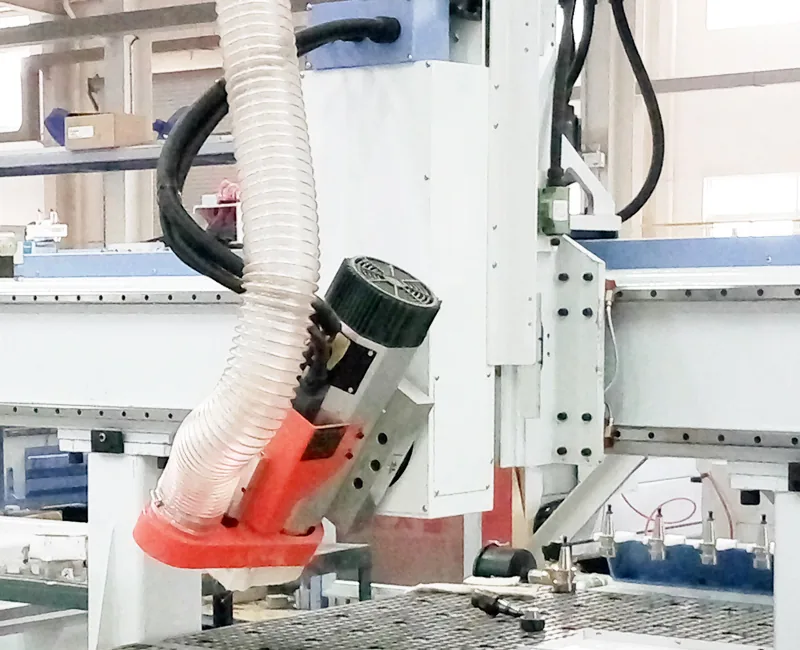
±90° spindle access
The HSD spindle can tilt to reach selected angled surfaces and side features without turning every operation into a manual setup.
8 automatic tools
Cutting, carving, grooving and drilling tools can be called by the program instead of stopping for repeated manual changes.
4×8-class work area
The 1220 × 2440 mm working envelope keeps the machine relevant to cabinet doors and larger furniture components.
Is this 4 axis ATC router right for your production?
Strong fit
- Cabinet doors that combine carving, profiling, grooves and selected side or angled features.
- Shaped furniture components that need the cutter to approach from more than one angle.
- Curved decorative wood parts, reliefs and custom interior components.
- Programs that use several tools and would otherwise stop for manual tool changes.
- Production where reducing repositioning is more valuable than using the simplest flatbed router.
Choose another machine when
- Full-sheet nesting and top-face cutting dominate the workload; use a 3-axis ATC or nesting CNC route.
- Dense connector holes are the bottleneck; add a boring unit or use a PTP / six-side drilling solution.
- Cylindrical workpieces must rotate continuously; a separate rotary-axis configuration is required.
- The job requires two continuously changing tool-orientation axes; move to a 5-axis machine.
- Steel, hard metals or stone are the main materials.
UA-481 configuration
| Item | UA-481 | What it means in production |
|---|---|---|
| Working area | 1220 × 2440 × 200 mm | 4×8-class X/Y envelope with 200 mm Z travel; fixture and cutter clearance reduce usable part height. |
| Spindle | 9.6 kW HSD air-cooled ATC spindle | High-power woodworking spindle for multi-tool cutting, carving, grooving and drilling sequences. |
| Spindle working angle | ±90° | Provides angled tool access beyond a fixed vertical spindle. |
| Tool magazine | 8-position linear ATC | Covers multi-operation programs without repeated manual tool changes. |
| Controller | Syntec | Runs the prepared G-code and coordinates the machine motion and tool-change sequence. |
| Servo system | Yaskawa servo motors and drives | Industrial servo motion for the machine axes. |
| Worktable | Double-layer vacuum table | Fast hold-down for suitable flat sheets and large parts; shaped or porous parts may need fixtures or clamps. |
| Reducer | Shimpo | Part of the spindle-angle drive architecture. |
| X/Y linear guides | 30 mm square linear guides | Supports the heavy moving structure across the full table. |
| Z-axis drive | TBI ball screw | Provides controlled vertical motion. |
| Inverter | 11 kW Fulling | Matched to the spindle drive system. |
| Maximum rapid movement | 80 m/min | Machine movement limit; it is not the cutting feed for every material or tool. |
| Listed maximum cutting feed | 50 m/min | Actual feed is set from material, cutter, toolpath, finish and workholding. |
| Included systems | Tool sensor, automatic lubrication, dust hood, 5.5 kW vacuum pump, tool shanks, positioning pins | Supports setup, lubrication, extraction connection and sheet positioning. |
| Program format | G-code | CAM and postprocessor need to match the Syntec control and the intended spindle-angle strategy. |
| Electrical supply shown for this configuration | 3-phase 380 V, 50 Hz | Tell us the destination factory voltage and frequency so the electrical package can be matched before production. |
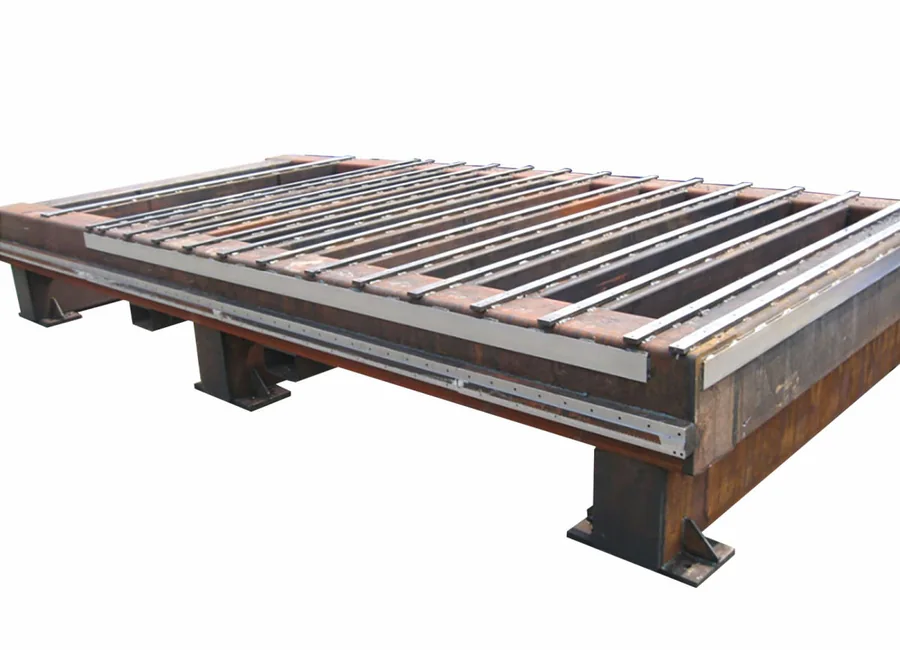
The spindle angle only works well when the machine underneath it is rigid
UA-481 uses a heavy welded frame, 30 mm linear guides, Yaskawa servo motion, a TBI Z-axis ball screw and a Shimpo reducer around the spindle-angle mechanism. These components support the extra mass and changing cutting direction created by a swiveling spindle.
The double-layer vacuum table is efficient for large flat parts. For shaped, porous, narrow or heavily profiled components, we can discuss mechanical fixtures, stops or dedicated workholding so the part remains secure when cutting forces change direction.
Add equipment only when it removes a real bottleneck
Linear or carousel ATC
The 8-position linear magazine fits many door and furniture programs. Consider a carousel arrangement when the recurring tool list is larger or the process benefits from another magazine layout.
Boring unit
Add a boring system when repeated hole patterns are too dense for spindle drilling to remain efficient. It is unnecessary for carving-focused work with only occasional holes.
Dust collection
Match extraction to MDF and wood dust volume, duct length and hood connection. Dust control is part of the production cell, not an afterthought.
Custom working size
Increase the working envelope only when the largest recurring raw part or fixture actually requires it.
Rotary device
Add a rotary device for cylindrical or indexed parts. It is a separate requirement from the UA-481 swiveling spindle.
Loading and unloading
Automation is worthwhile when repetitive sheet handling is already limiting output and the surrounding process can keep up.
Build the machine around the part geometry, not around an option list
Quick CNC can adjust the working size, tool-magazine arrangement, boring capability, dust-collection interface, workholding, rotary equipment, loading method and destination electrical package. The correct combination depends on the recurring part, not the maximum number of available options.
Start with the part
Send the drawing or 3D model and identify the faces that are difficult to reach today.
Map the operations
List cutting, profiling, carving, grooving, drilling and angled features in the real sequence.
Match the machine
We connect spindle angle, ATC capacity, workholding and optional systems to that process.
Use the right cutter and holding method for each machining task
| Machining task | Typical cutter direction | Why it fits |
|---|---|---|
| MDF profile cutting | Compression bit | Helps control chipping on the top and bottom faces of laminated or veneered panels. |
| Solid-wood profiling | Carbide spiral bit | Supports stable chip evacuation and clean profile cutting when feed, grain and cutter geometry are matched. |
| Relief and curved surfaces | Ball-nose cutter | Used for roughing or finishing shaped 3D surfaces with suitable step-over. |
| V-grooves and decorative details | V-groove cutter | Useful for lettering, chamfers and decorative grooves. |
| Side holes or grooves | Matched drill or straight cutter | The swiveling spindle can approach selected side features without manually laying the part on another face. |
Vacuum holding is efficient for large flat parts. Small, porous, warped or deeply profiled workpieces may need mechanical fixtures, tabs or dedicated locating. For a new material or complex angled feature, send a sample drawing so we can discuss a test cut before batch production.
Check the machine from frame preparation through cutting and packing
Quick CNC's factory process covers frame inspection, component inspection, assembly checks, electrical testing, running tests, sample cutting and packing inspection. For UA-481, the spindle-angle motion, ATC sequence, table holding and main machine functions are checked as part of preparing the ordered configuration for shipment.
When your project needs a material sample, send the material, drawing and finish requirement before production is completed so a suitable cutting test can be arranged.
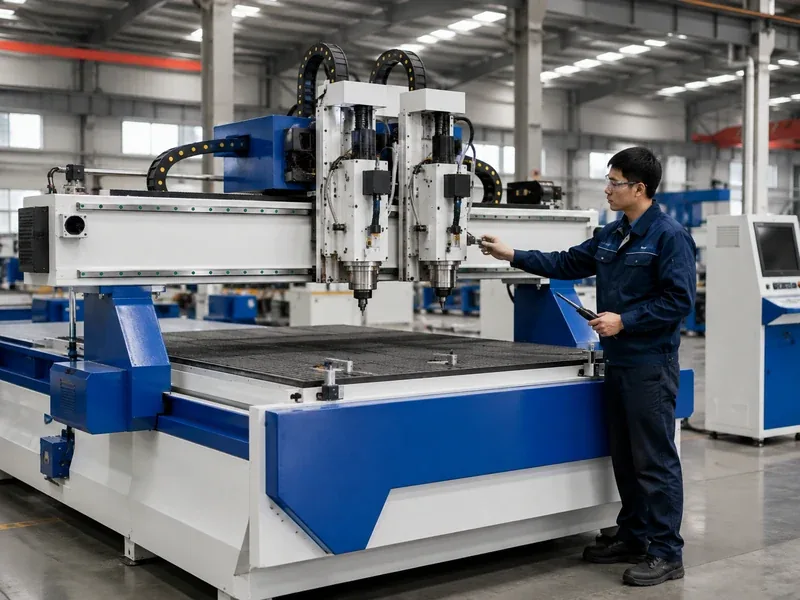
Choose the lowest machine complexity that completes the real part
| Production requirement | Better machine direction | Reason |
|---|---|---|
| Flat cutting, grooving and drilling from the top face | 3-axis ATC CNC router | Automatic tools without the cost and programming complexity of a swiveling spindle. |
| Flat operations plus selected angled edges, side grooves, side drilling or curved-surface access | UA-481 4 axis ATC | Combines ±90° spindle access with 8 automatic tools on a 4×8-class table. |
| Dense cabinet connector drilling | PTP / six-side drilling solution | Dedicated drilling architecture is better suited to repeated hole patterns. |
| Complex parts requiring two continuously changing tool-orientation axes | 5-axis CNC router | Provides additional tool orientation beyond a single swiveling axis. |
US custom door production: fewer repositioning steps
A custom door manufacturer in the United States previously used separate machines for front carving, side drilling and slotting. Frequent workpiece repositioning added labor and made it harder to keep the complete process consistent from one operation to the next.
After introducing the Quick CNC 4 Axis Wood CNC Router with ATC, the factory combined relief carving, side drilling, grooving and profile cutting into one machining route. The ±90° spindle reduced repeated repositioning and the ATC reduced manual interruptions. The customer reported one fewer manual processing step and approximately 25% higher overall production efficiency.
Machine building, application support and service from one supplier
Quick CNC has manufactured CNC equipment since 2006. Our production covers frame preparation, mechanical assembly, electrical installation, machine testing and export packing, while our application team helps connect the machine configuration to your material, toolpath and workholding requirements.
Application engineering
We discuss part geometry, cutters, fixture requirements and the operations that justify a swiveling spindle.
Machine production
Frame, motion components, electrical systems and auxiliary equipment are assembled around the ordered configuration.
After-sales support
Installation guidance, operator training, troubleshooting, maintenance advice and spare-parts support continue after delivery.
Four items are enough to start the UA-481 discussion
You do not need a complete technical specification before contacting us. Start with the part and the process problem.
Part drawing
2D drawing, 3D model or clear photos of the recurring workpiece.
Material
Material type, thickness and any surface finish that must be protected.
Maximum size
Largest raw workpiece and smallest finished part that must be held securely.
Difficult features
Show the angled face, side hole, groove or curved surface that currently requires another setup.
Plan the machine order around configuration and destination
Quick CNC machine orders do not use a fixed MOQ. Production lead time is normally about 45 days, with the exact schedule depending on the final UA-481 configuration and current production plan.
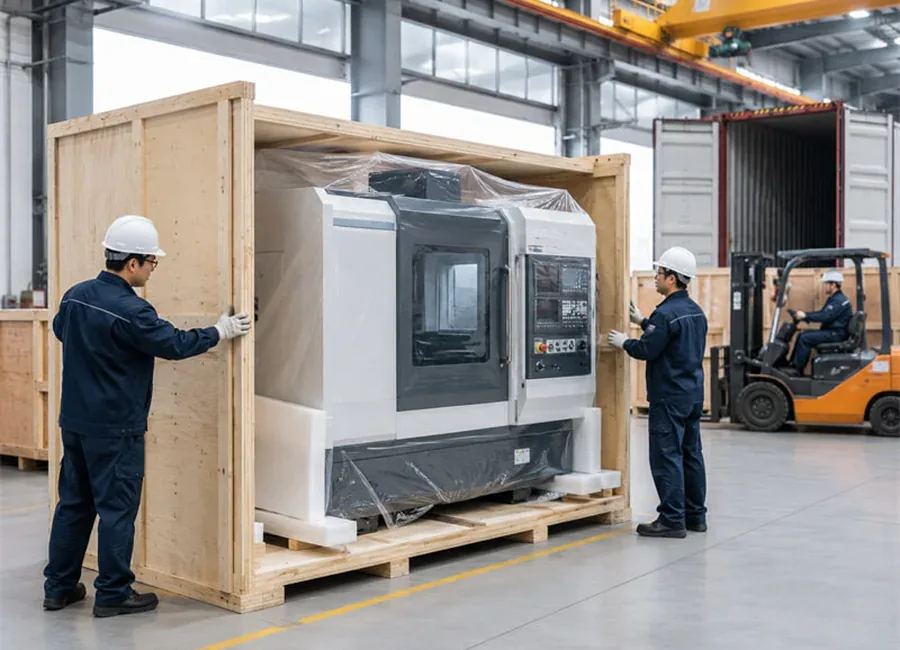
Machines are prepared for international container shipment. Export packing, machine securing and the final packing list are completed before dispatch. Tell us the destination country and factory voltage early so the shipment and electrical package can be prepared together.
Support the machine from startup through daily production
One-year warranty
The standard Quick CNC machine warranty is one year. The signed sales agreement defines the final coverage for the supplied configuration.
Startup and training
Installation guidance, commissioning support and operator training can be provided remotely or on site according to the project.
Technical support
Our service team supports troubleshooting, maintenance guidance, spare-parts coordination and process questions after delivery.
Questions that decide whether UA-481 is the right machine
What is different about the UA-481 compared with a standard 3-axis ATC router?
The UA-481 adds a swiveling HSD spindle with a ±90° working angle. That gives the cutter angled access for selected side features, curved surfaces and shaped wood parts while the 8-position ATC handles multi-tool programs.
Is the UA-481 a rotary-axis machine for columns and balusters?
No. Its defining fourth-axis function is the swiveling spindle. A separate rotary device is an option for cylindrical or indexed workpieces, and it should be selected only when the part geometry requires workpiece rotation.
When is a 3-axis ATC router the better choice?
Choose a 3-axis ATC router when production is mainly flat sheet cutting, pocketing, drilling and engraving from the top face. The UA-481 earns its extra complexity when angled spindle access removes real repositioning or separate machining steps.
Can the UA-481 machine cabinet doors and shaped furniture parts?
Yes. Cabinet doors, curved decorative components and shaped furniture parts are core woodworking uses, especially when a part combines top-face machining with angled edges, grooves, holes or relief work.
What materials can the UA-481 process?
The main material group is solid wood and wood-based panels such as MDF and plywood. Acrylic, PVC, plastics, aluminum composite panels, foam and suitable composites can also be configured with the right cutters and workholding. Soft aluminum is limited to suitable light-routing work.
How many tools can the UA-481 change automatically?
The listed UA-481 configuration uses an 8-position linear automatic tool changer. A different magazine arrangement can be discussed when the real tool list requires it.
What should we send for a machining recommendation?
Send the part drawing or 3D model, material and thickness, maximum part size, and the features that currently require repositioning or another machine. Those items are enough to start the machine and tooling discussion.
What support is available after delivery?
Quick CNC provides installation guidance, operator training, remote troubleshooting, maintenance advice and spare-parts support. On-site service can also be arranged when required.
Send the part that is difficult to machine from one direction
If repeated flipping, side machining or manual tool changes are slowing a door or furniture part, send the drawing and show us where the current process breaks down. We will match the spindle angle, tool list, workholding and optional systems to that real job.
Best starting information:
- Part drawing or 3D model
- Material and thickness
- Maximum workpiece size
- Angled, side or curved features