Linear vs Carousel ATC
Linear vs Carousel ATC Tool Changer for CNC Routers
If your jobs use a stable set of tools and you mainly want to stop changing tools by hand, linear ATC is usually the practical place to start. Carousel ATC becomes more interesting when tool changes repeat often enough that the full tool-change cycle is taking useful production time.
Start with your program, not the magazine. Count the tools in one normal job, how often they change, and whether tool changing is really the bottleneck. That tells you more than comparing 8, 12 or 16 tool positions on a brochure.
Start With the Job You Actually Run
Do not start with the magazine. Start with the parts you make every day: how many tools a normal program uses, how often the machine changes them, and whether the real bottleneck is tool changing or something else such as drilling, loading, unloading or material handling.
Once that is clear, the ATC layout is much easier to choose.
Start Here
If your tool set is predictable and you mainly want automatic tool changing without adding unnecessary complexity, linear ATC is a solid choice.
It makes more sense when tool changes happen often enough that the saved non-cutting time matters across the shift.
If a normal job only uses four or five tools, paying for a much larger magazine may not change your production at all.
Machine structure, spindle, holders, tool setting, workholding and the cutting program still matter much more.

Is This Comparison for Your Shop?
This comparison is useful for cabinets, wardrobes, doors, furniture parts, signs, acrylic panels, mixed woodworking jobs and panel processing.
This is not aimed at desktop hobby routers, manual tool changing, metal machining centers, laser cutting, plasma cutting or knife-cutting systems.
Linear and Carousel ATC: What Is Actually Different?
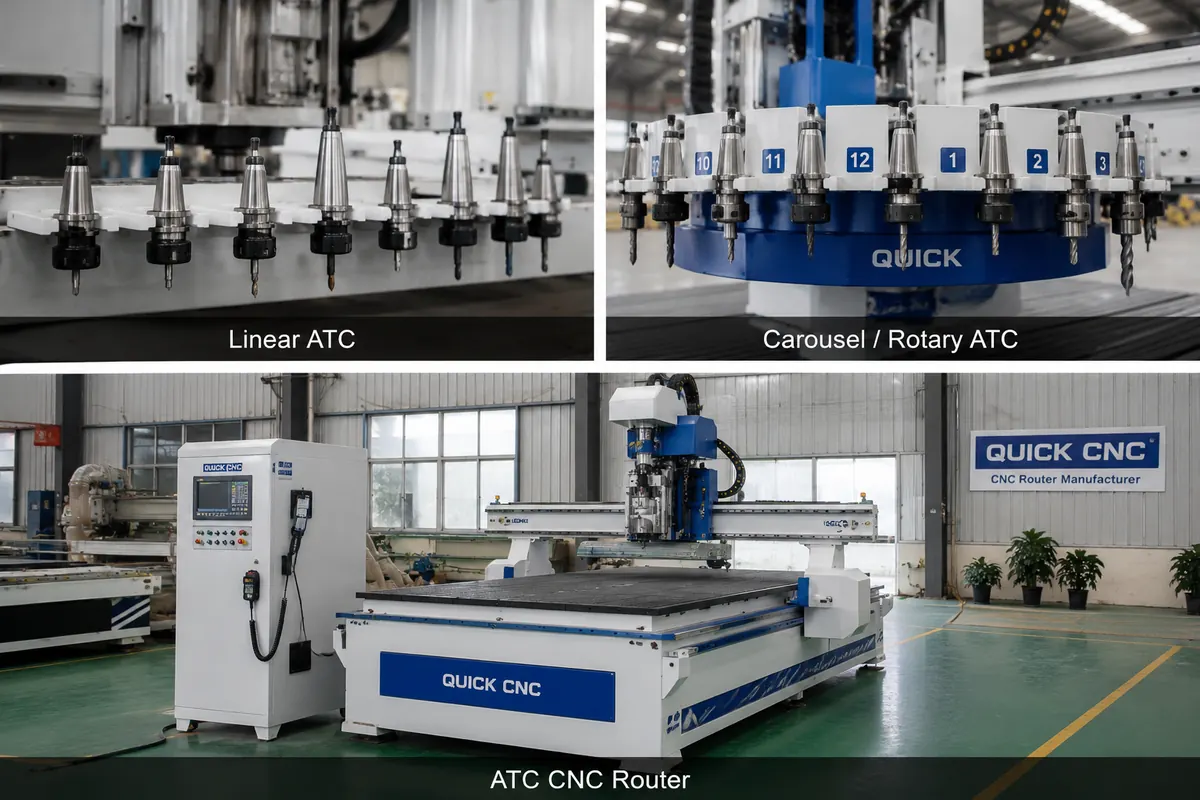
A linear tool changer keeps the holders in a straight rack. The spindle travels to the correct pocket, drops off the current holder and picks up the next one.
A carousel tool changer keeps the holders around a rotating disc. The magazine turns the correct tool into the exchange position.
So do not choose by shape alone. The useful question is simple: which layout matches your tool list and daily production with the least extra complexity?
Linear vs Carousel ATC: Side by Side
| What You Are Comparing | Linear ATC | Carousel ATC | What Matters in Practice |
|---|---|---|---|
| Tool layout | Straight row of holders. | Rotating circular magazine. | The shape itself does not tell you which machine will make more parts. |
| Best fit | Cabinet, furniture, door, sign and general woodworking jobs with a stable tool list. | Jobs where tool changes happen often enough that non-cutting time becomes important. | Look at one normal program, not a brochure demo. |
| Tool capacity | Commonly used with moderate tool counts, depending on the machine. | Can make compact access to more positions easier on the right machine design. | Count the tools you really use, then leave room for backup and finishing tools. |
| Tool-change movement | The spindle normally travels to the rack. | The magazine rotates to present the tool. | Compare the complete tool-change cycle, not one movement in isolation. |
| Floor and loading space | Works well when the rack does not interfere with loading or long parts. | Can keep tools close to the spindle, but some designs need more service space or add weight to the moving structure. | Think about the machine, dust collector, vacuum pump, loading path and operator access together. |
| Maintenance | Usually straightforward when the rack is easy to reach and clean. | Needs good protection around the rotating magazine, sensors and moving parts. | Choose a layout your team can clean, inspect and reset without making daily work harder. |
| Cost | Often the better-value route when automatic tool changing is needed but the job mix is not extremely tool-change heavy. | Can cost more because of the extra magazine mechanism and machine integration. | Only pay more if it solves a real production problem. |
| Cutting accuracy | Not automatically better or worse. | Not automatically better or worse. | Look at machine structure, spindle, holder repeatability, calibration and tool setting. |
How I Would Choose It for a Real Shop
If most programs use only a few tools and changes are limited, do not start by shopping for the biggest magazine.
For a lot of furniture, cabinet, door and sign work, linear ATC gives you automatic changing without adding unnecessary complexity.
If tools are called again and again through every shift, a carousel layout may reduce non-cutting time on some machine designs. The actual gain still depends on magazine position, safe moves, controller logic and the tool-change sequence.
If the real issue is side drilling, loading, labeling or material handling, changing the magazine will not fix it.
Spindle, holder, controller, tool sensor, air supply and postprocessor need to match the job just as much as the magazine does.
Not Sure Which ATC Layout Fits Your Jobs?
Send us one typical drawing or program, your tool list, material and daily output target. We can tell you whether linear ATC is already enough or whether carousel ATC is likely to save useful time.
Send a Typical JobHow the Choice Changes by Job
If the work is mainly cutting, grooving and normal routing, linear ATC is often enough. If drilling, labeling and material handling are the bigger issues, look at the nesting and drilling setup before paying more for the magazine.
When one door program runs several profile, carving and finishing tools, ATC makes sense quickly. Linear is fine for many jobs; carousel becomes more interesting when those tool changes repeat all day.
If you switch between engraving, V-carving, polishing and profile tools often, ATC can save a lot of stopping. The number of changes matters more than the material name.
For a shop doing many different jobs, keep the machine flexible and avoid over-specifying it. Linear ATC is often the easier balance between flexibility, cost and maintenance.
If you are already moving into rotary-axis or more complex multi-process work, compare the full 4-axis / rotary ATC machine instead of treating the magazine as a separate accessory.
For a broad market, standard 4×8, 3-axis, linear ATC and nesting configurations are easier to match to common furniture, cabinet, door and sign jobs.
Will Carousel ATC Actually Save You Time?
Sometimes yes. Sometimes almost nothing. If tool changes repeat many times on every part, a carousel layout may reduce non-cutting time on the right machine. The real gain depends on magazine position, safe moves, controller logic and the complete tool-change sequence.
Count the tool changes in a normal part, not a demo file.
Tool-change time difference × changes per part × parts per shift.
If it does not improve output, staffing or delivery, the simpler layout may be the better buy.
Which Machine Should You Look At?
Once you know the job, the machine choice gets much simpler.
Start with the CNC Router range. If tool changes are limited, a standard machine may already do the job.
Move to the ATC CNC Router range. Linear ATC is the practical first step for many furniture, cabinet, door and sign jobs.
Look at the 12 Tool Linear ATC CNC Router UE-481 as a reference for a linear magazine layout.
See the UC-481 with rotary ATC and compare it against the actual tool-change frequency in your program.
Look at Furniture CNC Machine options together with drilling, edge banding, loading and material flow.
Read the 3-axis vs 4-axis vs 5-axis CNC Router guide first. Axis count can change the machine choice more than the magazine style.
Four Mistakes That Cost Money
You pay more, but daily output does not change because the normal job only uses a few tools.
What to do instead: size the magazine around the tools you use every day.
You end up focusing on the wrong thing while spindle, holder, calibration and workholding have a much bigger effect on the finished part.
What to do instead: compare the whole machine and tool-setting system.
The machine fits on paper, but the tool rack, dust hose or service area gets in the way of normal material handling.
What to do instead: lay out the machine, dust collector, pump and operator space before ordering.
Tool holders, collets, air preparation, vacuum, dust collection, software and training get left out of the real project cost.
What to do instead: compare the complete production-ready setup.
A Common Over-Spec Example
A cabinet shop runs repeat panel work with five tools in a normal program. Tool changing is not the bottleneck; loading sheets and drilling take more time. Choosing carousel ATC because it sounds faster adds cost without solving the part of the process that is actually slow.
Better approach: compare linear ATC first, then spend the extra budget on drilling or material handling if those are the real bottlenecks.
Before You Order, Check These Things
The magazine is only one part of the ATC system. These are the items worth confirming on the exact machine before you order.
| Check | Why It Matters | What You Need to Confirm |
|---|---|---|
| ATC spindle | Spindle type affects cutting ability, cooling, holder interface and tool compatibility. | Brand, power, cooling type, speed range and holder interface for the machine you are ordering. |
| Tool holder | ISO30 and HSK-F63 are different systems. This matters even more if you already keep holders or tooling in the shop. | Holder interface, included holder quantity, spare holders and collet range. |
| Cutter and collet sizes | The machine has to hold the cutters you actually use for cutting, drilling, engraving or profiling. | Shank sizes, tool diameters, profile cutter clearance and the collets you need. |
| Controller | The controller handles the tool table, ATC logic and postprocessor connection. | Controller model, language, postprocessor, tool-table setup and operator routine. |
| Tool sensor | Automatic changing and tool-length measurement are related, but they are not the same thing. | How tool length is measured, how offsets are stored and whether the sensor is included in the chosen configuration. |
| Compressed air | The ATC spindle normally needs stable, clean compressed air for tool release, taper cleaning and related pneumatic functions. Magazine movement depends on the machine design. | Required pressure, air treatment, compressor scope and any pneumatic functions used on the selected machine. |
| Magazine protection | Dust and chips around tool pockets and sensors can cause trouble over time. | Cover design, cleaning access and the maintenance points operators need to reach. |
| Machine layout | The tool magazine must not get in the way of loading sheets, long parts, the dust hose or normal service access. | Full footprint, magazine position, loading direction and the space needed around the machine. |
Send Us One Typical Job
Material, part size, the tools used in one normal program and your daily output target are enough to start. From there, we can narrow down whether linear ATC, carousel ATC or a different machine setup makes more sense.
Send Your RequirementsLinear vs Carousel ATC FAQ
Is carousel ATC always faster than linear ATC?
No. It may reduce tool-access time on some machine layouts, but the full cycle still depends on magazine position, safe moves, controller logic and the tool-change program.
Is linear ATC enough for cabinet production?
Often, yes. If automatic tool changing is useful but the program does not call tools constantly, linear ATC can already be a practical setup.
When should I stay with a normal 3-axis CNC router?
If the work is mainly flat cutting, 2D profiling, simple drilling or basic signage and tool changes are rare, a standard 3-axis router may already cover the job.
What spindle and holder should I check?
Check spindle power, cooling type and the holder interface on the exact machine. If you already use ISO30, HSK-F63 or a specific collet system, tell us before configuration.
Does an ATC CNC router need compressed air?
The ATC spindle normally needs stable, clean compressed air for tool release and related pneumatic functions. The exact pressure, air treatment and magazine actuation depend on the selected machine design.
Can ATC replace a drill bank or a nesting line?
No. ATC changes routing tools automatically. Drilling, labeling, loading, unloading and edge banding are separate parts of the production process.
What should I send if I am not sure which one to choose?
Send your material, part size, one typical drawing or CAM file, the tools used in that job and your output target. That is enough to start narrowing the machine down.
References and Related Reading

Frannie
Hello, I’m Frannie, a CNC machinery specialist with 15 years of experience in the woodworking CNC industry. I help furniture factories, cabinet makers, woodworking workshops, and production businesses choose CNC machines that match their production needs, factory size, budget, and efficiency goals.
My work focuses on solving real production problems, including replacing outdated equipment, improving machining efficiency, reducing labor costs, and upgrading to smarter CNC solutions. I also support customers with machine installation guidance, operation training, video support, and on-site training when needed, helping them use their machines more confidently and effectively.