
For curved furniture parts, angled faces, door components and other jobs that need more tool access than a standard vertical 3-axis router can provide.
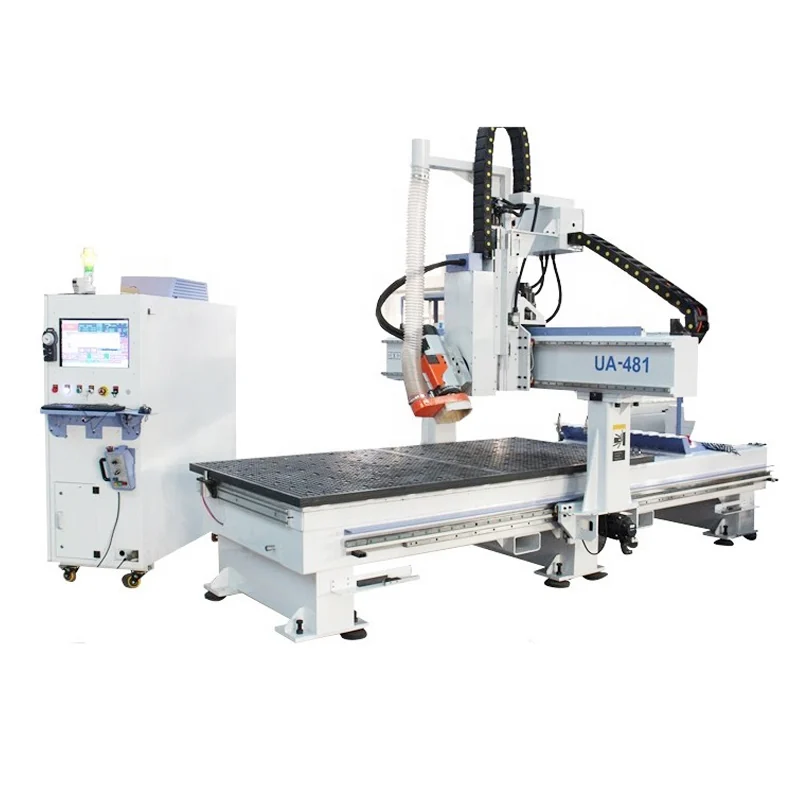
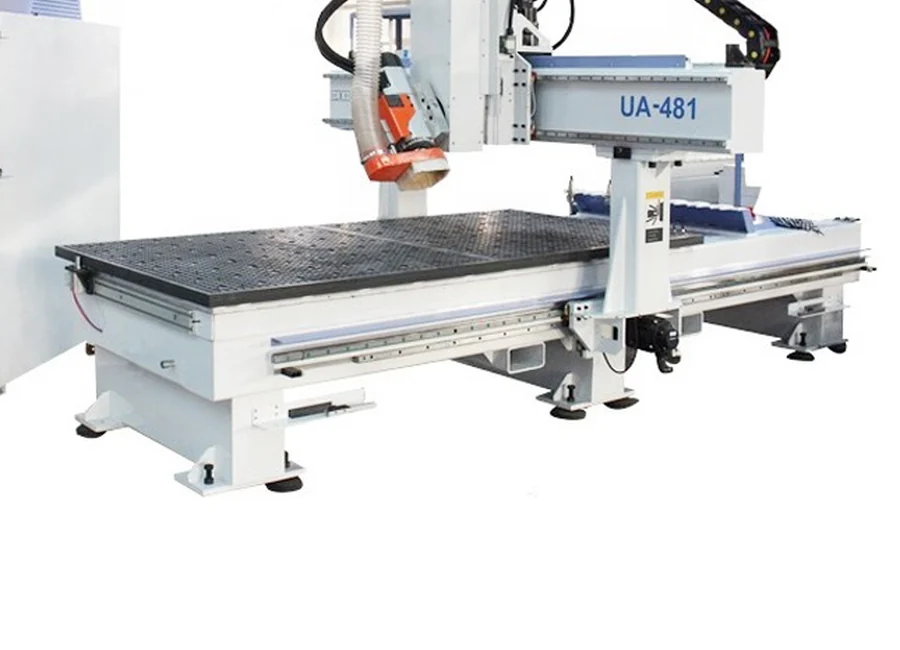
The UA-481 is a swing-head 4 axis ATC CNC router. Its 9.6 kW HSD spindle tilts through a listed ±90° range, giving the cutter access to angled faces and curved surfaces that are awkward for a fixed vertical spindle. The reference machine uses a 1220 × 2440 × 200 mm working area, an 8-position linear automatic tool changer, Syntec control and Yaskawa servo motors.
This is not a rotary-axis-only setup. A rotary device is an optional project configuration for cylindrical work.
Curved or angled machining is a regular part of production, not a once-a-month special job.
Your work is mainly flat sheet nesting, vertical drilling and standard profile cutting.
A 3D model, largest part size, material, angled or curved surfaces and your output target. That tells us far more than a generic “send price” message.
A ±90° spindle is useful because it can reduce the number of times you have to stop, refixture or manually angle a part. The value is not “one more axis” on a brochure. The value is keeping more machining inside the CNC process.
| With a fixed vertical spindle | With the UA-481 swing head |
|---|---|
| Angled faces may need a special fixture or another setup. | The spindle can approach suitable angled faces directly within its ±90° swing range. |
| Curved or sloped geometry can force extra repositioning. | More tool access can be handled in the programmed process when the geometry and clearance fit the machine. |
| Several tools may mean manual tool changes on a basic router. | The 8-position linear ATC supports multi-tool carving, cutting, drilling and milling sequences. |
| Setup variation grows as operators move the part between operations. | Keeping more work on one CNC setup can improve process consistency. |
| Specification | UA-481 Reference Configuration |
|---|---|
| Model | UA-481 4 Axis |
| 4-axis architecture | ±90° swing-head ATC spindle; rotary device is an engineering option rather than the primary 4-axis arrangement |
| Working area | 1220 × 2440 × 200 mm |
| Spindle | 9.6 kW Italy HSD air-cooled ATC spindle |
| Spindle swing range | Listed as ±90°, 180° total range |
| Spindle speed | 24,000 rpm |
| Tool magazine | 8-position linear automatic tool changer |
| Drive motors | Japan Yaskawa servo motors |
| Controller | Syntec control system |
| Table | Double-layer vacuum table |
| Reducer | Shimpo reducer |
| X/Y guidance | 30 mm Taiwan square linear guides |
| Z transmission | TBI ball screw |
| Inverter | 11 kW Fulling inverter |
| Machine rated maximum rapid speed | 80,000 mm/min |
| Machine rated maximum cutting feed | 50,000 mm/min |
| Command | G-code |
| Software workflow | ArtCAM / AlphaCAM compatible process |
| Standard electrical | 3-phase 380 V, 50 Hz |
| Machine dimensions / weight | Shown in the final configuration drawing for the selected build |
Do not read 50,000 mm/min as a guaranteed production cutting speed. Real feed, finish and output depend on the material, cutter, depth of cut, toolpath, workholding and extraction. For angled work, the part geometry and spindle clearance matter just as much as the headline speed.
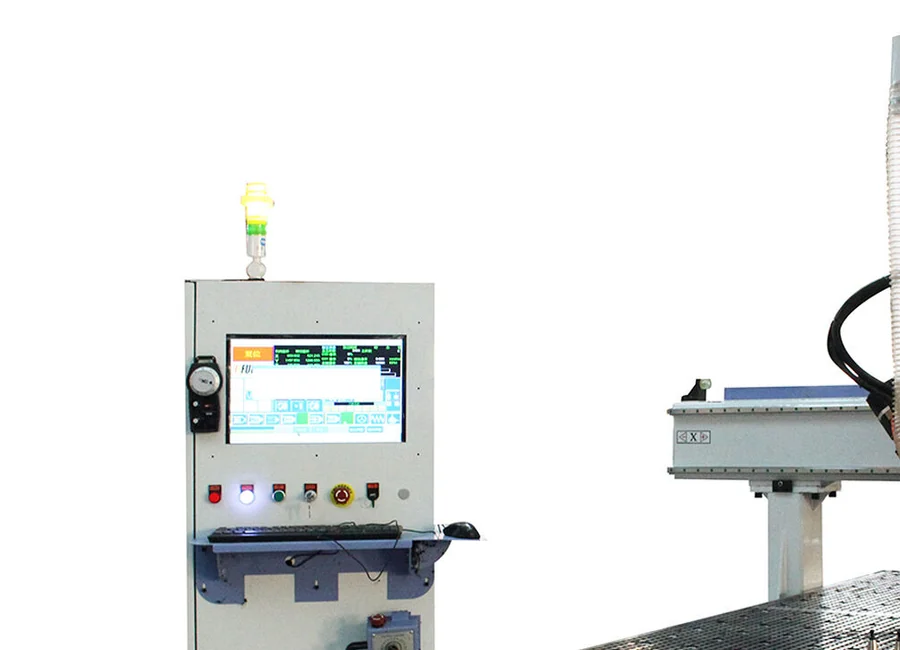
The reference machine uses a heavy welded frame, aging and tempering treatment and five-side machining of the base surfaces. The point is simple: once the spindle starts working at an angle, machine geometry and rigidity matter even more.
We match the tooling, holder setup, workholding, extraction and electrical package to the part instead of handing you a long option list and hoping something on it solves the job.
The HSD spindle is listed with a ±90° swing range and 24,000 rpm maximum speed. That gives the cutter access to sloped and curved surfaces while keeping automatic tool changing in the same machine platform.
The useful question is not “Can the head tilt?” It is “Can the cutter reach my surface without hitting the part, fixture or table?” That is why a 3D model matters on this machine.
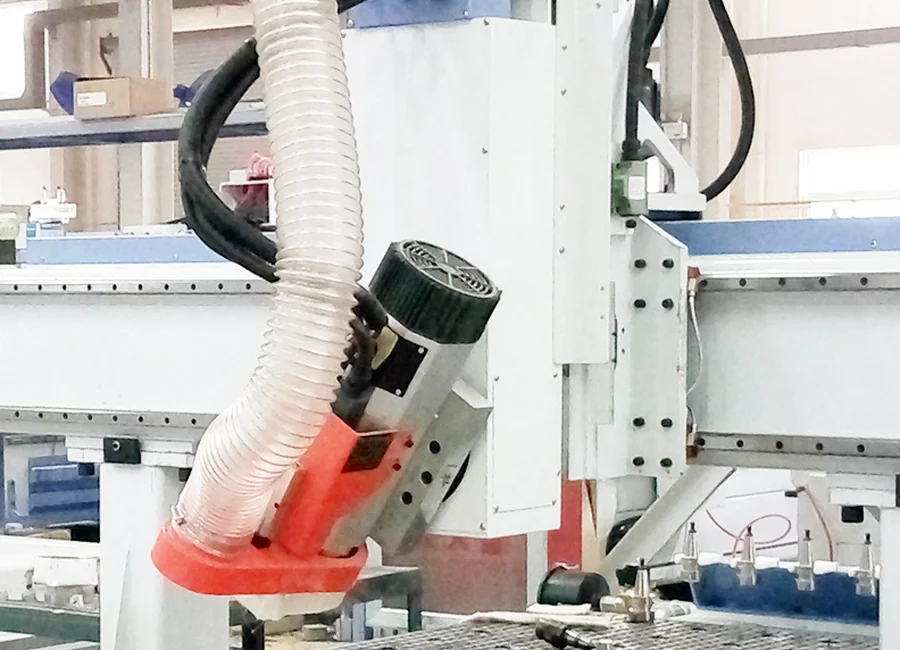
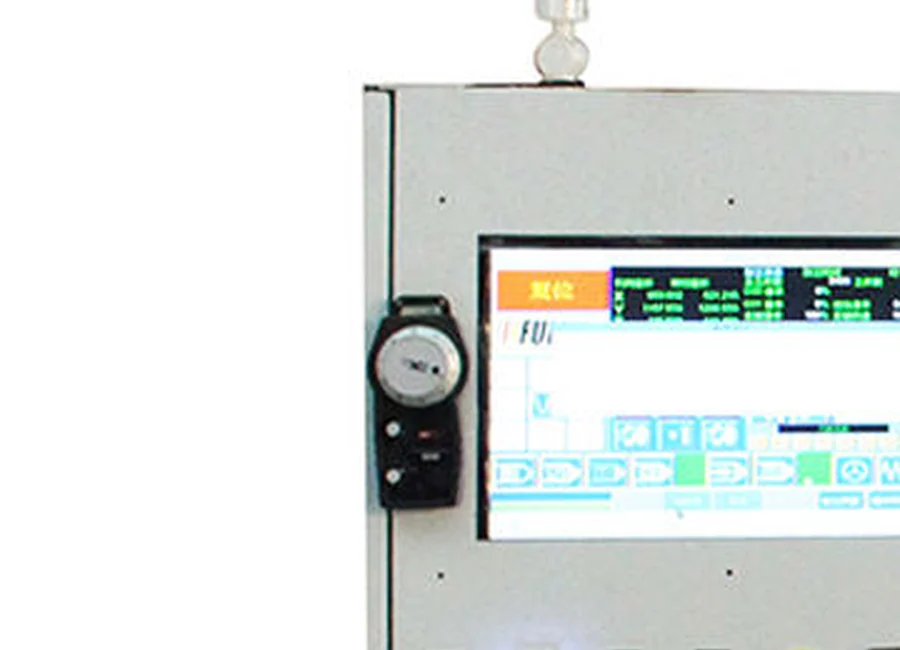
Tool count, part geometry, takt time, factory layout and operator workflow decide which options are worth paying for. More options are not automatically a better machine.
For a swing-head machine, the 3D model tells us far more than a flat dimension sheet. We use it to review cutter access, spindle-angle clearance, workholding and the order of operations.
Quick CNC’s company-wide QC framework includes CMM inspection, laser interferometer testing, Ballbar testing and 24–72-hour continuous-operation testing. The ordered machine follows the test scope agreed for that build.
For the UA-481 project, ask for the evidence that matters to your order: current-machine photos, tool-change video, functional checks, sample machining when included, packing information and the applicable documentation package.
Choose it when production is mainly flat panels, nesting, vertical drilling and standard profiling. There is no point paying for swing-head capability you rarely use.
View the 3-axis ATC CNC routerChoose it when curved or angled surfaces appear often enough that repeated manual repositioning becomes part of the production problem.
Review UA-481 specificationsMove to a true 5-axis platform when the geometry needs broader multi-direction tool access than a swing-head 4-axis router can provide.
View the 5-axis wood CNC routerWe can review the current-model video, your drawing and an agreed sample test to check tool access, workholding, process order and finish expectations before the configuration is finalized.
Plan a UA-481 Sample TestJinan Quick-Fulltek CNC Machinery Co., Ltd. has manufactured CNC machinery since 2006. Quick CNC supports projects with 25 designers and 20 after-sales engineers, covering configuration review, production, inspection, packing and service support.
You do not need to write a long RFQ. Send the 3D model and the basics above. We can work through the rest from there.
Quick CNC has no minimum order quantity for this machine, so a single-machine project is fine.
Standard production lead time is approximately 45 days after the order and machine configuration are confirmed. Freight time is separate.
The standard machine warranty is one year from receipt. Remote guidance, online training, maintenance support and paid on-site service are available.
Final packing, logistics, warranty exclusions, travel costs and service responsibilities follow the signed order agreement.
The reference UA-481 uses a ±90° swing-head ATC spindle as its main 4-axis arrangement. A rotary device is listed separately as an engineering option for cylindrical work.
The supplied UA-481 specification confirms the ±90° swing-head structure, but it does not state the interpolation mode. If simultaneous 4-axis motion is required for your CAM process, include that requirement with the 3D model so the controller and process configuration can be matched before order.
A standard 3-axis router keeps the spindle vertical. The UA-481 adds a ±90° swing-head spindle, giving the cutter access to suitable angled and curved surfaces while retaining automatic tool changing.
The primary fit is solid wood and wood-based panels such as MDF, plywood, particle board and melamine board. Acrylic, PVC, plastics, aluminum composite panel, soft aluminum, foam and other composites need suitable tooling, workholding and process controls.
Send the 3D model. We review where the spindle needs to tilt, whether the cutter can reach the surface and whether the part, fixture or table creates a clearance problem.
Yes, custom working areas can be discussed after we review the largest part, fixture space, factory layout and transport limits.
Send the destination country, available voltage, phase and frequency. The reference machine is listed as three-phase 380 V at 50 Hz.
Quick CNC accepts one-machine projects. Standard production lead time is approximately 45 days after order and configuration confirmation, excluding freight. The standard machine warranty is one year from receipt.
Send your 3D model, material, part size, angled or curved surfaces, output target and destination electrical data. We will use those inputs to recommend the machine options, tooling, workholding and sample plan for the quotation.
Tell us your material, working size and production needs. Our engineers will recommend a suitable CNC machine for your business.