UC-481 Carousel ATC CNC Router for Multi-Tool Woodworking Production
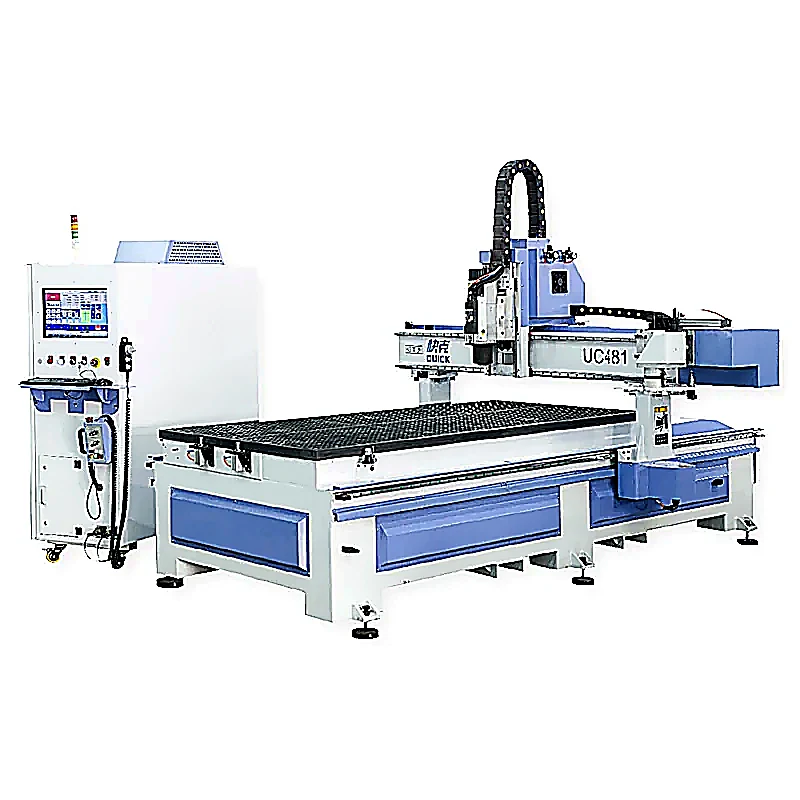
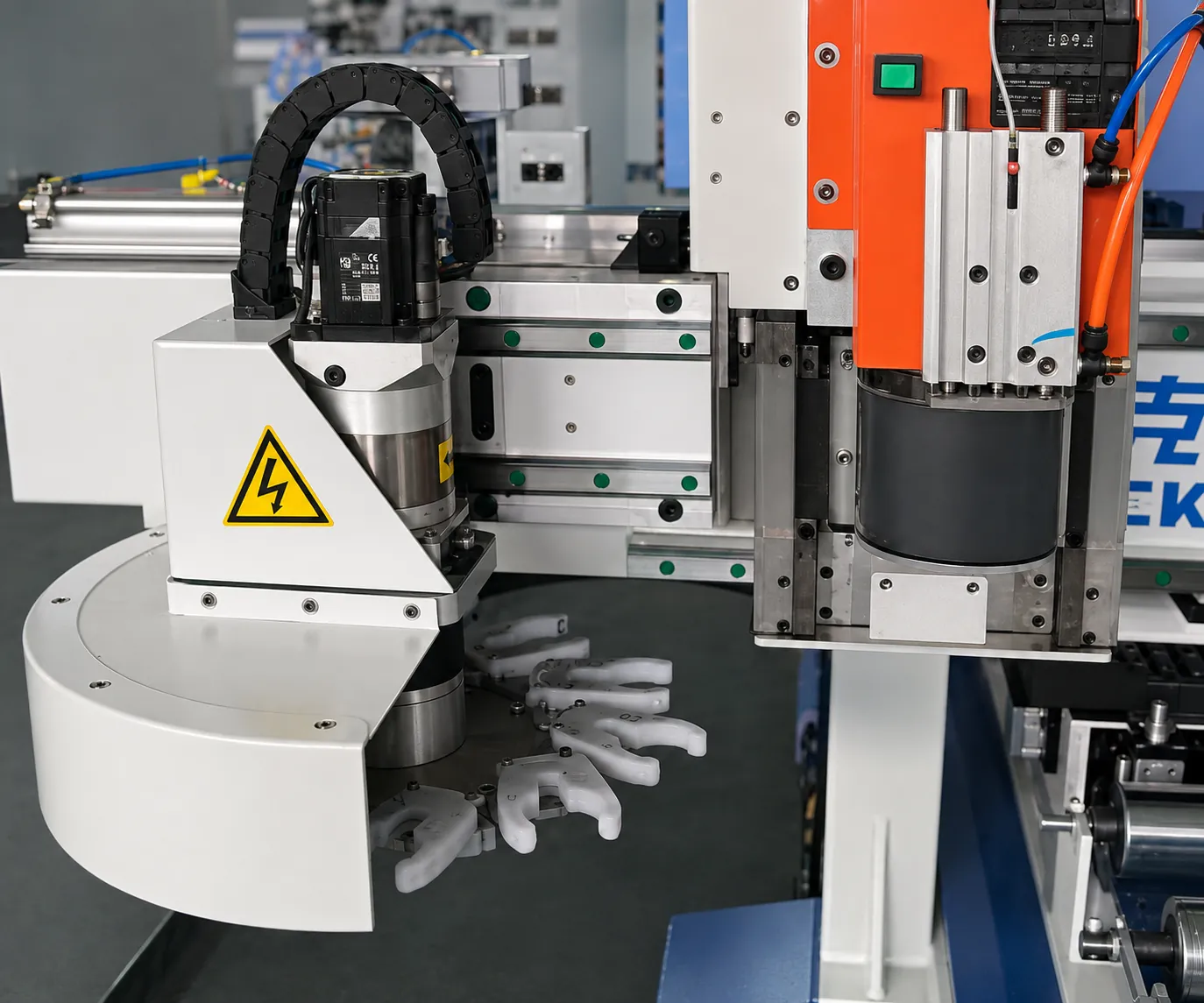
Keep multi-tool furniture parts moving without stopping the router for every cutter change. The UC-481 is built for jobs where one programmed part may need profile cutting, grooves, pockets, vertical drilling, engraving or other routing operations with several tools. Its 10-tool rotary carousel lets the Syntec-controlled program call preloaded cutters automatically instead of relying on repeated manual tool changes between operations.
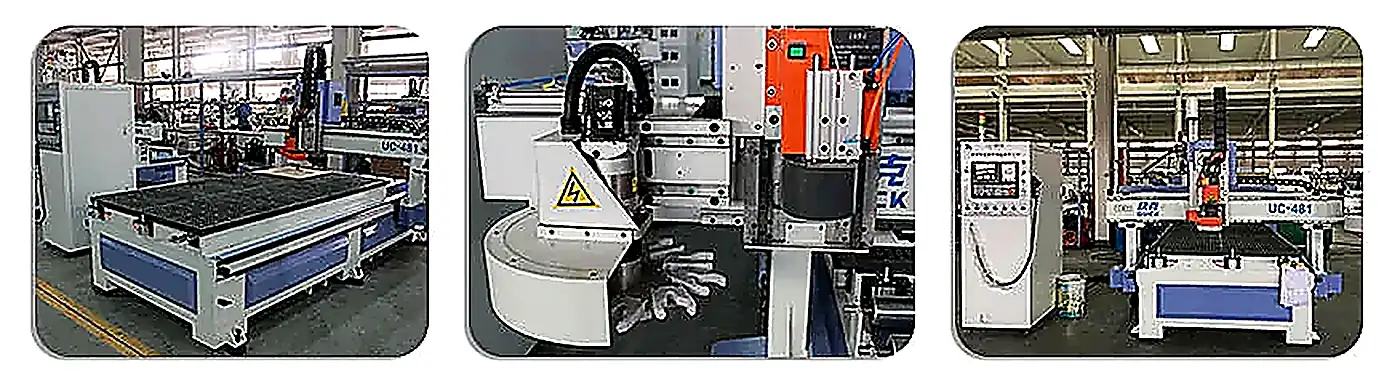
With a 1220 × 2440 × 200 mm working area, 9 kW HSD air-cooled spindle, vacuum table and locating pins, the UC-481 is a practical fit for cabinet panels, furniture components, door parts and other sheet or routed components that use a recurring multi-tool process.
Start with five details: material, maximum part or sheet size, main operations, expected batch/shift requirement and destination country. Quick CNC will first confirm whether the UC-481 fits the job; if another machine architecture is more suitable, we will recommend that direction instead.
Where the UC-481 Creates the Most Production Value
We position the UC-481 first for furniture, cabinet, door and woodworking production where the same part family repeatedly moves through several routing tools. That is where automatic tool changing can remove a real interruption from the process instead of being an option that rarely gets used.
| Production situation | Fit | Why |
|---|---|---|
| Cabinet and furniture parts using several cutters in one program | Strong fit | The 10-tool carousel keeps a recurring tool set ready for programmed changes. |
| Door components, profiles, grooves, pockets and decorative routing | Strong fit | Multiple routing operations can be sequenced without stopping for every manual tool change. |
| Full-sheet MDF, plywood, particle board and melamine processing | Strong fit | The 1220 × 2440 mm working area and vacuum table suit common sheet-processing jobs. |
| Acrylic, PVC, plastics, foam and compatible composites | Process check | Tooling, chip control, heat and workholding must match the material. |
| Aluminum composite panel or soft aluminum | Process check | We review alloy, thickness, cutter, holding, chip removal and lubrication/cooling before recommending the process. |
For this page, furniture and woodworking remain the main production story. Signage, plastics and compatible non-ferrous applications are secondary capabilities and are configured around the actual material and finish requirement.
What Changes on Your Shop Floor
The value of the UC-481 is not simply that it carries ten tools. The value appears when a part actually needs several of them and the machine can move through the programmed sequence without waiting for an operator to stop, change the cutter and restart the job.
On a manual-tool-change router
- Run the first operation.
- Stop when the next cutter is required.
- Change and check the tool.
- Restart the next operation.
- Repeat whenever the program needs another cutter.
With the UC-481
- Prepare the required cutters in the carousel.
- Load and locate the panel or component.
- Run the programmed operation sequence.
- The controller calls the required preloaded tool.
- Unload after the programmed routing sequence is complete.
When ATC is worth paying for: when tool changes happen often enough to interrupt your normal production cycle. If most of your jobs use one cutter, or only change tools occasionally, we would rather recommend a simpler configuration than add complexity that does not improve the process.
Choose the UC-481 for the Right Job — and Avoid It for the Wrong One
A production machine should be selected from the part and operation list, not from the number of options on the quotation.
| Your production requirement | UC-481 decision | What we would do |
|---|---|---|
| Several routing tools are used repeatedly on cabinet, furniture or door parts | Recommended direction | Map the tool list and program sequence to the 10-tool carousel. |
| Mostly full-sheet routing, profiling, grooving, pocketing and limited vertical drilling | Recommended direction | Confirm sheet size, smallest part, vacuum strategy and cutters. |
| Small or porous nested parts after full cut-through | Needs workholding check | Review vacuum zones, spoilboard, machining order and auxiliary holding methods. |
| Dense connector-hole patterns, extensive side drilling or drilling-dominant work | Compare another architecture | Evaluate drill-bank, PTP or six-sided drilling equipment. |
| Side-face machining, rotary workpiece machining or multi-axis tool orientation | Use another architecture | Evaluate 4-axis or 5-axis routing according to the geometry. |
| Steel, stainless steel, hardened metal or heavy metal removal | Not the intended machine | Select equipment designed for that metal-cutting requirement. |
UC-481 Reference Specifications
| Item | Reference specification |
|---|---|
| Model | UC-481 |
| Working area | 1220 × 2440 × 200 mm |
| Machine dimensions | 2200 × 3800 × 2300 mm |
| Repositioning resolution | 0.02 mm |
| X/Y transmission | Rack and pinion |
| Z transmission | Ball screw, Taiwan reference |
| Linear guide | 25 mm square guide, Taiwan reference |
| Maximum rapid speed | 50,000 mm/min |
| Maximum cutting speed | 35,000 mm/min |
| Spindle | 9 kW HSD air-cooled spindle, Italy reference |
| Spindle speed | 24,000 rpm |
| Tool changer | Rotary / carousel ATC |
| Tool positions | 10 |
| Inverter | 11 kW Fulling |
| Servo | Yaskawa 850 W |
| Controller | Syntec 6MB reference |
| Workholding | Vacuum table with 7.5 kW vacuum pump |
| Locating | Pop-up pins: X × 2, Y × 3 |
| Power reference | AC 380 V, 50–60 Hz, 3 phase |
| Program/input | G-code; USB 2.0 |
| Software reference | Alphacam |
How to Read the Specifications Before You Compare Quotes
| Reference item | What it means in production | What we confirm for your job |
|---|---|---|
| 10-tool rotary carousel | Keeps a ten-position tool set available for automatic program calls. | Your normal cutter list and how many tools one part family actually needs. |
| 9 kW HSD air-cooled spindle | Provides the spindle platform for production woodworking and compatible routed materials. | Material, cutter, depth per pass, edge/finish target and planned cycle. |
| 0.02 mm repositioning resolution | A machine reference for programmed repositioning; finished-part tolerance is a separate acceptance question. | If tolerance is critical, define the measured features, material, workholding and sample method before order. |
| 50,000 mm/min rapid / 35,000 mm/min maximum cutting speed | Machine capability figures, not universal production feeds. | Actual feed and spindle settings are selected from cutter diameter, flute count, chip load, depth, material and finish requirement. |
| Vacuum table + 7.5 kW pump | A natural workholding direction for sheets and larger panels. | Smallest part, board porosity, spoilboard, vacuum zones and cut-through strategy. |
| AC 380 V, 50–60 Hz, 3 phase | The reference electrical build. | Destination power supply and final electrical configuration before production. |
Final software/post-processor details and any custom working-size request are confirmed against the production file before order.
How the Hardware Supports the Production Process
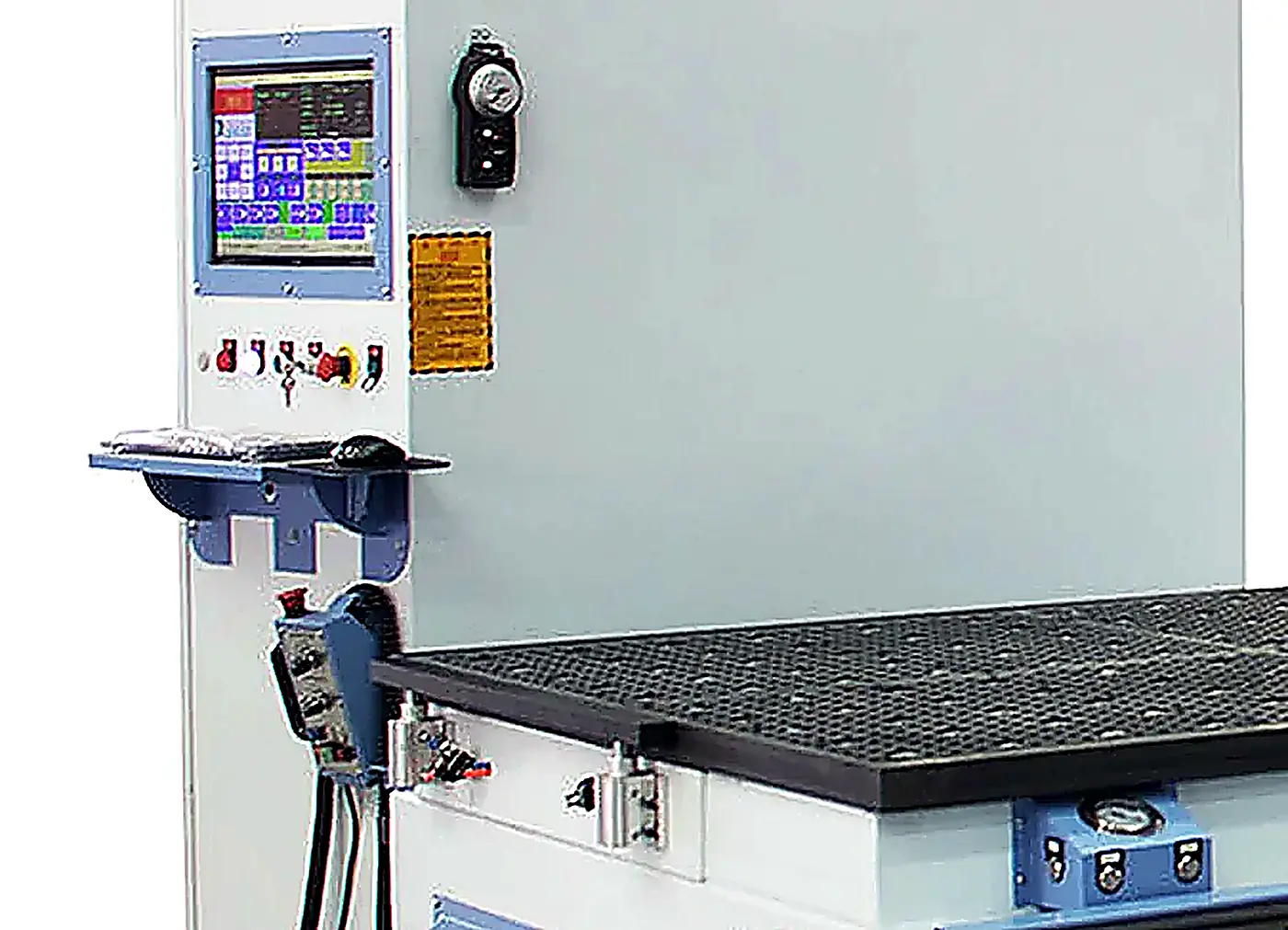
Component names matter only when they support the job you need to run. The UC-481 reference build combines an all-steel gantry, rack-and-pinion transmission on X/Y, ball screw on Z, 9 kW HSD spindle, Yaskawa 850 W servo system and Syntec control around the multi-tool routing process.
| Machine element | Production role | What to check in your factory |
|---|---|---|
| Frame and all-steel gantry | Provide the structural platform for repeated machine movement and routing loads. | Available floor space, loading direction and maintenance clearance. |
| X/Y rack-and-pinion + Z ball screw | Handle axis travel across the 1220 × 2440 × 200 mm working envelope. | Your largest part, thickness and required access around the workpiece. |
| 9 kW HSD spindle | Performs cutting, grooving, pocketing, drilling and engraving operations called by the program. | Actual material/tooling combination and finish requirement. |
| Yaskawa servo + Syntec control | Drive the axes and coordinate programmed motion and tool-changing commands. | Post processor, operator process and required program functions. |
| Automatic lubrication + dust hood | Support routine machine care and connection to suitable extraction. | Site dust extraction, maintenance access and service routine. |
The listed machine dimensions are not the complete installation footprint. Reserve additional clearance for the control cabinet, vacuum pump, dust extraction, loading/unloading, maintenance and operator access.
Choose the Configuration by the Job, Not the Option List
Why choose the 10-tool carousel on the UC-481?
Choose it when your normal production uses a recurring set of several cutters and you want those tools prepared for automatic program calls. The decision should come from the actual tool list, not from assuming a carousel is automatically “better” than every other magazine layout.
| Production pattern | Direction | Reason |
|---|---|---|
| Repeated multi-tool programs that fit within a ten-position prepared tool set | UC-481 carousel ATC | Matches the machine's 10-tool rotary magazine and automated tool-change process. |
| A different magazine layout or tool-count requirement is preferred | Compare linear ATC | We compare the actual cutter list, machine layout and production sequence before choosing the magazine type. |
| Jobs mainly use one cutter and tool changes are rare | Simpler router may be enough | ATC adds less production value when there are few tool-change interruptions to remove. |
Vacuum workholding and locating pins
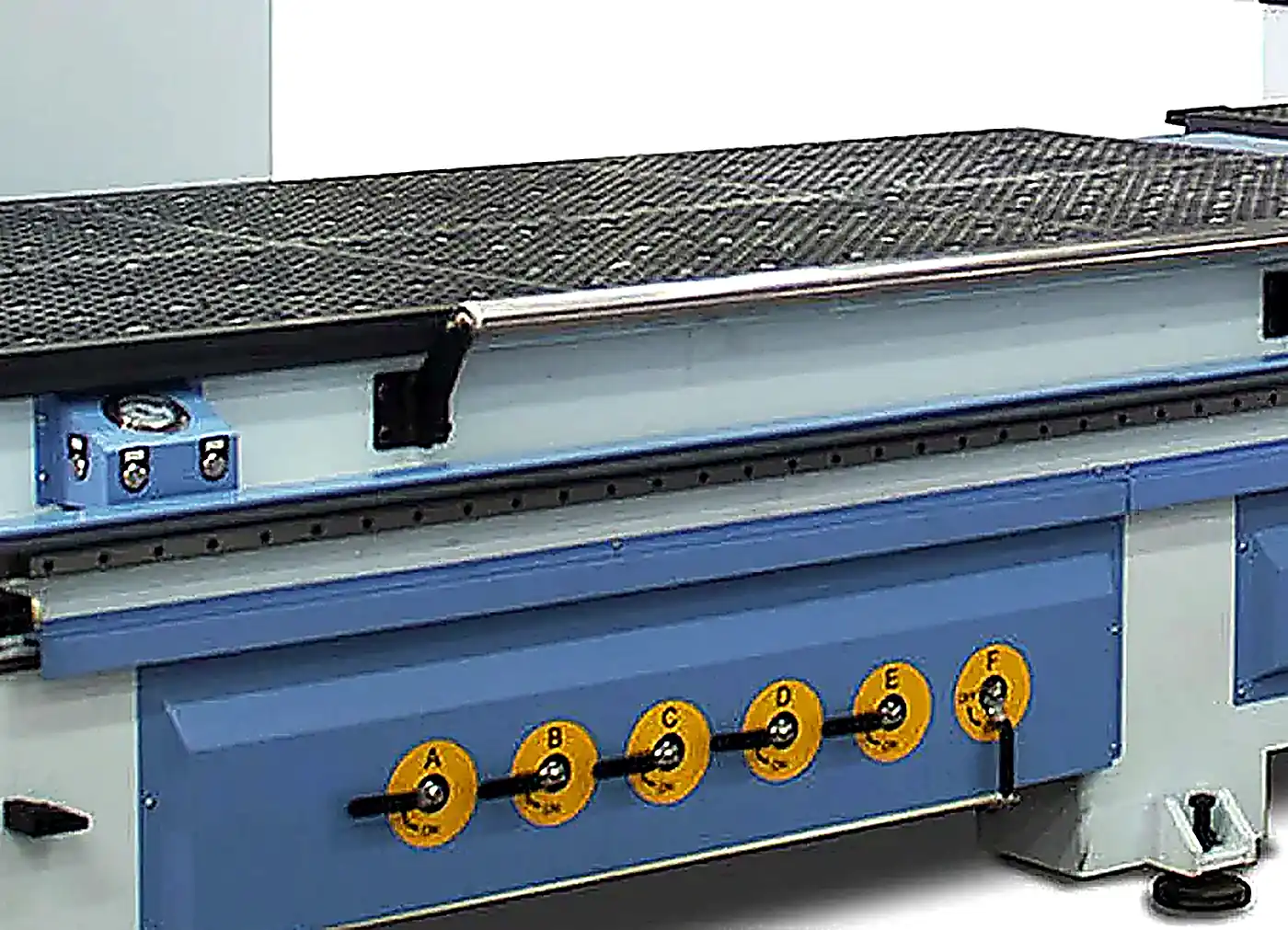
The vacuum table is well suited to full sheets and larger panels, while pop-up pins help establish panel location. For small nested parts or porous board, send the smallest part and nesting layout so we can plan spoilboard condition, vacuum zones, machining order, tabs/onion skin or auxiliary holding where necessary.
Drilling requirements
The spindle can change to drilling tools for vertical drilling within a routed program. If the hole map is dense, includes extensive side holes or drilling dominates the cycle, we will compare a drill-bank, PTP or six-sided solution before recommending the UC-481.
Electrical and CAM integration
The reference machine is listed with AC 380 V, 50–60 Hz, three-phase power and Alphacam. We confirm destination power, final electrical build, CAM process and post processor before production.
Configure the Machine Around the Parts You Produce
We start from the production file rather than adding options first. The main inputs are the part size, material, operations, tool list, holding requirement, expected output and factory utilities.
From these inputs, Quick CNC can match working size, spindle/tooling direction, workholding, electrical standard, software integration and other project-specific items. Options that do not improve the actual process do not need to be added.
Tooling, Workholding and Sample Testing
Tool choice should follow the material and operation. We use the drawing and required edge/finish result to propose the first tooling direction, then confirm it against the real process.
| Typical task | Tooling direction | What must be confirmed |
|---|---|---|
| Laminated MDF / melamine panel cutting | Compression tooling is commonly considered when both faces need controlled edges. | Board grade, thickness, cut-through strategy and required edge quality. |
| Solid wood profiles and general sheet routing | Carbide spiral tooling is commonly used. | Material, grain, depth, chip evacuation and finish. |
| V-grooves, relief and decorative work | V-bits, ball-nose or profile tools are selected from the geometry. | Smallest detail, surface finish and tool reach. |
| Acrylic / plastics | Use cutters and parameters that control heat and evacuate chips. | Plastic type, thickness, edge finish and holding. |
| Soft aluminum | Suitable carbide tooling with secure holding and controlled chip removal. | Alloy, thickness, lubrication/cooling approach, tolerance and batch requirement. |
When a sample matters: if edge quality, small-part holding, tolerance or a difficult material is important to the purchase decision, send the drawing and material requirement before order. We can set the sample conditions around the material, tooling, holding and machining result you need to check.
What to Confirm Before Your UC-481 Ships
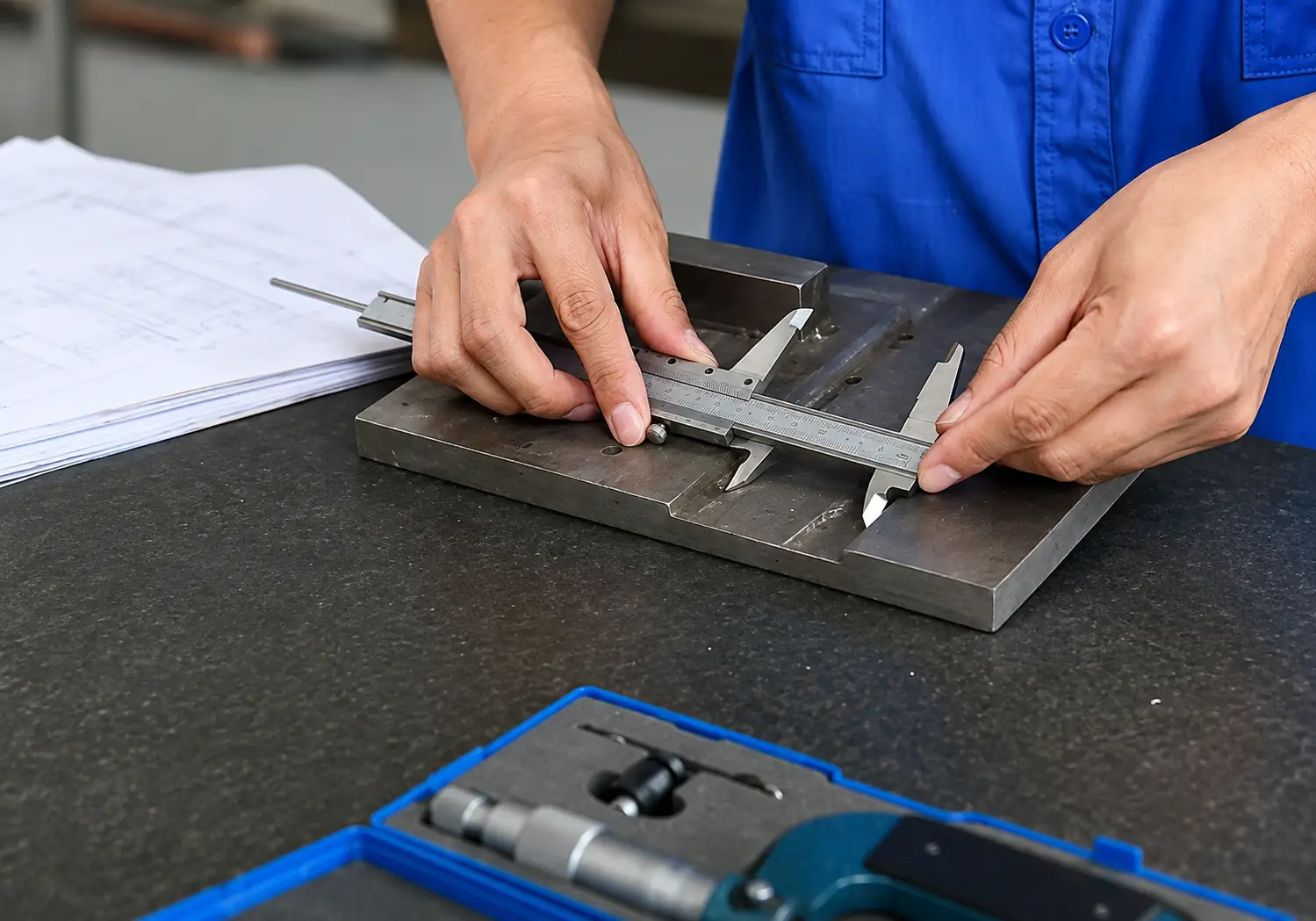
Quick CNC's factory QC framework covers frame and component checks, assembly inspection, electrical testing, running tests and final packing inspection. For a UC-481 order, the useful acceptance plan is the one tied to the machine you actually bought and the functions you expect it to perform.
UC-481 acceptance points to define in the order
| Area | Acceptance focus | How we handle it |
|---|---|---|
| Carousel ATC | Tool-change movement and programmed tool calls | Confirm the applicable functional check and required record before production. |
| Spindle | Running function of the installed 9 kW HSD spindle | Include the installed spindle in the machine running check. |
| Axes / control | Axis movement, homing and program/control functions | Match the check to the installed Syntec-controlled machine configuration. |
| Vacuum table / locating pins | Workholding-system and locating functions | Confirm the applicable function check; defined holding performance requires an agreed test condition. |
| Sample part | Agreed dimensions, edge/finish or process result | Use a project-specific sample plan when it is part of the order. |
| Packing | Final machine condition and export packing | Complete final packing inspection before shipment. |
Company-wide measurement capabilities include CMM inspection, laser interferometer testing, Ballbar testing and continuous-operation testing. If your project requires a specific measurement method or report, tell us before the order is finalized so the applicable scope can be confirmed rather than assumed.
Which Quick CNC Architecture Fits the Job?
We do not use “higher configuration” as the selection rule. The machine type should follow the dominant operation.
| Dominant production need | Machine direction | Why |
|---|---|---|
| Top-face routing with several cutters used repeatedly | UC-481 carousel ATC | Matches multi-tool routing with a 10-position rotary magazine. |
| ATC routing but a different magazine layout/tool-count plan | Linear ATC router | Compare the actual tool list and preferred magazine arrangement. |
| Dense cabinet drilling / connector-hole work | Drill-bank, PTP or six-sided drilling | Dedicated drilling architecture can match drilling-dominant work more directly. |
| Rotary workpiece, side-face machining or additional tool orientation | 4-axis / 5-axis router | The geometry requires an axis architecture the 3-axis UC-481 does not provide. |
Send the part geometry and operation list first. Quick CNC can compare these directions before preparing the quotation so you are not paying for the wrong type of machine.
Typical Cabinet Part: How a Multi-Tool Program Can Run
Take a cabinet side panel or furniture component that requires several different operations. A practical tool sequence could look like this:
| Program step | Typical operation | Tool direction | Why ATC matters |
|---|---|---|---|
| 1 | Profile / sheet cutting | Compression or spiral cutter as required | The first cutter is already prepared in the magazine. |
| 2 | Grooves / dados | Grooving or straight/spiral cutter | The program can call the next preloaded tool. |
| 3 | Pockets / recesses | End mill selected for the geometry | No manual cutter swap is required between programmed operations. |
| 4 | Vertical drilled features | Appropriate drilling tool in the spindle | Limited drilling can be included in the routed sequence when the hole pattern suits spindle drilling. |
| 5 | Engraving / profile detail | V-bit, ball-nose or profile tool as required | A finishing/detail tool can be called as another programmed step. |
Not every part needs all five operations. The point is to compare your real tool sequence with the carousel capacity and count how many manual stops the automatic tool-changing process can remove. That complete cycle is more useful for machine selection than comparing spindle power alone.
From Production Requirement to Final Machine Check
The order should move from the part requirement to the machine build and then to the final machine check. This keeps the conversation focused on the result you need instead of treating the UC-481 as a fixed list of components.
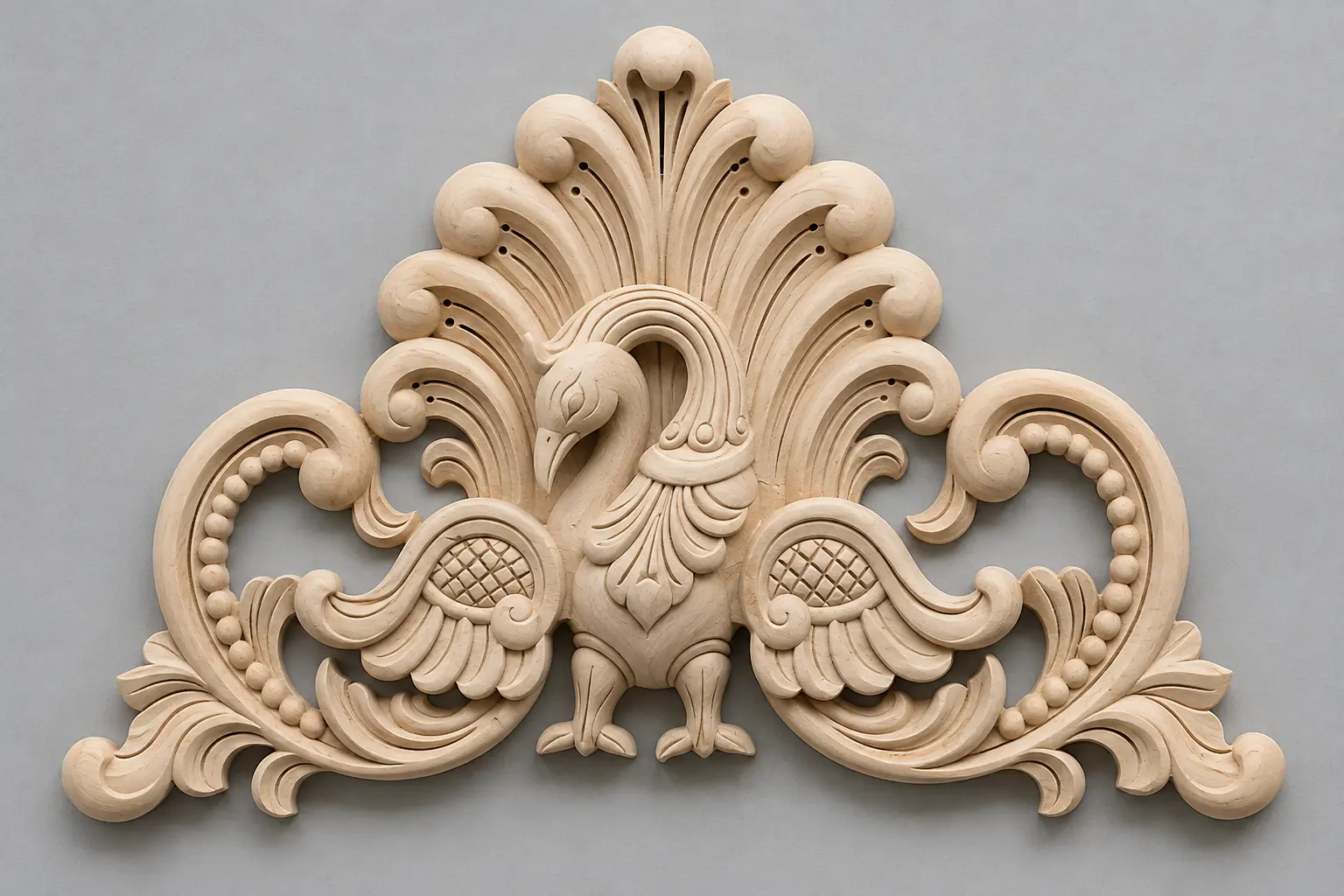
For small nested parts, decorative surfaces, defined tolerances, difficult plastics or soft aluminum, send the drawing early. These jobs depend more heavily on tooling, holding and process setup, so they should be addressed before the machine configuration is finalized.
Start With Five Inputs — Not a Long Specification Sheet
You do not need to prepare a complete technical package before the first contact. Send these five items and we can make the first machine-fit judgment:
- Material: for example MDF, plywood, melamine board, solid wood, acrylic or another material.
- Maximum part or sheet size and thickness.
- Main operations: cutting, grooving, pocketing, drilling, engraving or other routed features.
- Expected batch size or shift requirement.
- Destination country.
If you already have a drawing or CAD file, send it. After we confirm the machine direction, our engineers can ask for the details that matter to configuration: smallest nested part, tool list, tolerance/finish requirement, CAM/post processor, power supply, dust extraction, compressed air where relevant and loading/unloading method.
MOQ, Lead Time, Packing and Logistics
| Commercial item | UC-481 planning reference |
|---|---|
| MOQ | No minimum order quantity. |
| Production lead time | Approximately 45 days after deposit and configuration confirmation, subject to the signed order. |
| Packing | Export packing for machine shipment. |
| Transport | Normally shipped by container; freight, destination charges and project-specific logistics are confirmed in the quotation. |
Before the order is signed, we recommend locking the machine configuration, destination electrical requirement, shipping scope and any sample/acceptance requirement together so the commercial quotation matches the production plan.
Installation, Warranty and After-Sales Support
Buying the machine is only one step; the handover also needs the factory site to be ready. Before shipment, we confirm the applicable project requirements for site power, workshop space, dust extraction, vacuum-system location, unloading access and other utilities required by the final configuration.
Quick CNC supports installation guidance, training, troubleshooting and spare-parts coordination according to the confirmed project scope. The standard warranty is one year from receipt of the machine, subject to the signed contract and exclusions.
For a smoother start-up: send your factory power standard and a simple floor/layout plan before shipment if machine placement, extraction routing or utility access needs coordination.
FAQ
Is the UC-481 a 4-axis CNC router because it has a rotary ATC?
No. “Rotary ATC” describes the rotating carousel that stores tools. It does not mean the workpiece has a rotary axis. The UC-481 on this page is a 3-axis router with an automatic tool-changing carousel.
How many tools does the UC-481 carousel hold?
The reference UC-481 configuration uses a 10-tool rotary magazine. The useful question is whether your normal program needs enough recurring tools for those ten prepared positions to remove manual tool-change stops.
When should I choose carousel ATC instead of a simpler router?
Choose carousel ATC when multi-tool programs are common and tool changes regularly interrupt the cycle. If most jobs use one cutter or tool changes are rare, a simpler router may be the more economical direction.
Can it process MDF, plywood and melamine panels?
Yes. These are core application materials for the UC-481. Cutter selection, panel grade, spoilboard condition, vacuum zoning, feed/speed settings and part size still determine edge quality and hold-down.
Can the UC-481 handle drilling for cabinet parts?
It can use spindle-mounted drilling tools for vertical drilled features within a routed program. If the job has dense connector holes, extensive side drilling or drilling-dominant cycle time, send the hole map so we can compare a drill-bank, PTP or six-sided solution.
Does 0.02 mm mean the finished part is guaranteed to hold 0.02 mm tolerance?
No. The 0.02 mm figure is a machine repositioning reference. If finished-part tolerance is critical, define the material, measured features, workholding and acceptance method so a relevant sample/test plan can be agreed.
Is the vacuum table enough for every nested part?
Not automatically. Small parts, porous boards and full cut-through reduce effective holding area. Send the smallest part and nesting layout so vacuum zones, spoilboard, machining order and auxiliary holding can be planned.
What should I send for the first quotation discussion?
Start with five items: material, maximum part or sheet size and thickness, main operations, expected batch or shift requirement, and destination country. A drawing or CAD file is helpful when available.
Send One Part Drawing — We Will Tell You Whether the UC-481 Fits
The UC-481 is a strong direction when a furniture, cabinet, door or routed component uses several cutters and automatic tool changing removes real stops from the process. You do not need to select every option first.
Send the material, part size, main operations, expected production requirement and destination country. Quick CNC will map the tool sequence and workholding requirement, confirm whether the UC-481 is the right architecture, and then prepare the configuration and quotation around the actual job.