
The UE-481 is built for factories where one panel or component moves through several routing operations and operators lose time to manual tool changes. Its 12-position linear ATC keeps the planned cutter set ready so the program can move from cutting to grooving, selected vertical drilling, engraving and profiling without stopping for manual tool replacement.
The standard UE-481 combines a 1220 × 2440 × 200 mm working area, 9 kW air-cooled ISO30 spindle, 24,000 rpm spindle speed, Taiwan Syntec control, servo drive and a vacuum table with 7.5 kW pump. It is a practical fit for cabinet, furniture, door and mixed-job woodworking production that repeatedly uses several tools in one program.
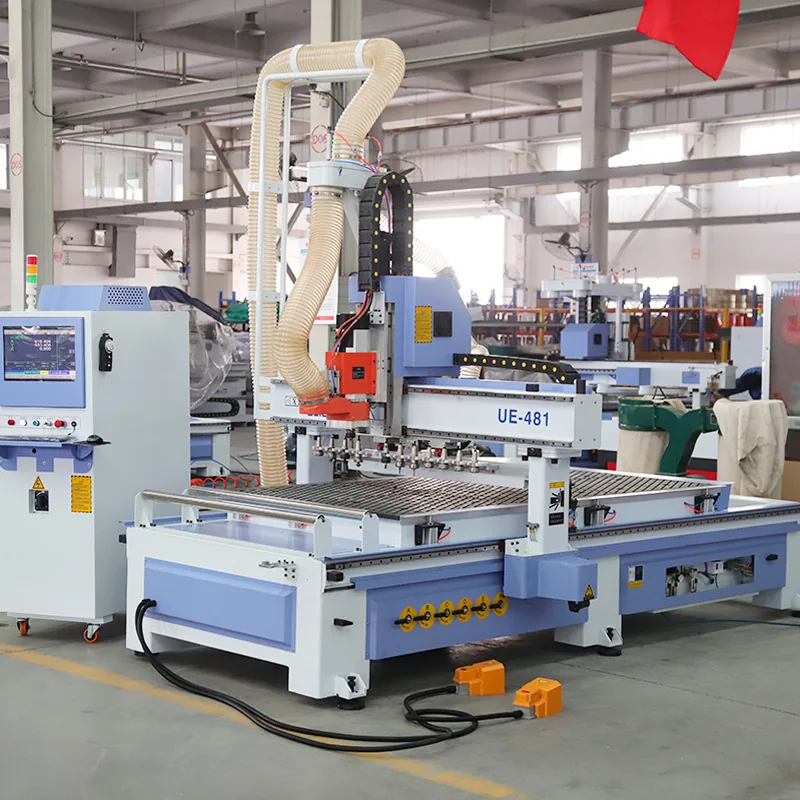
For flat parts machined from the top, the UE-481 can combine several router operations in one programmed sequence. Typical work includes cabinet and furniture-panel cutting, grooves and slots, internal cut-outs, door profiles, decorative routing, engraving, relief work and selected vertical holes made with suitable router or drilling tools.
The value of the 12-position magazine is not the number itself. It is the manual interruption it removes when one normal program needs several tools. A typical cabinet, door or furniture component can call different cutters in sequence while the prepared tools remain in the magazine.
| Program step | Typical tool role | Why the ATC matters |
|---|---|---|
| Sheet or part breakdown | Compression or application-matched cutting tool | The program starts with the main cutting tool already prepared. |
| Grooves and slots | Grooving / slotting tool | No operator stop is needed just to install the groove cutter. |
| Internal cut-outs and smaller features | Smaller-diameter routing tool | The program can switch tool size without manual replacement. |
| Selected vertical holes | Suitable drill or router tool | Occasional top-face holes can stay inside the same routing sequence. |
| Profiles, V-grooves or decorative details | Profile, V-bit or engraving tool | Different detail tools can be called automatically when the drawing requires them. |
| Finishing pass | Finishing or detail tool | A separate finishing tool can remain ready instead of replacing the roughing tool manually. |
If a normal job uses only one or two tools and tool changes happen between batches, 12 positions will not create the same production value. In that case, a smaller ATC configuration may reduce cost without reducing output.
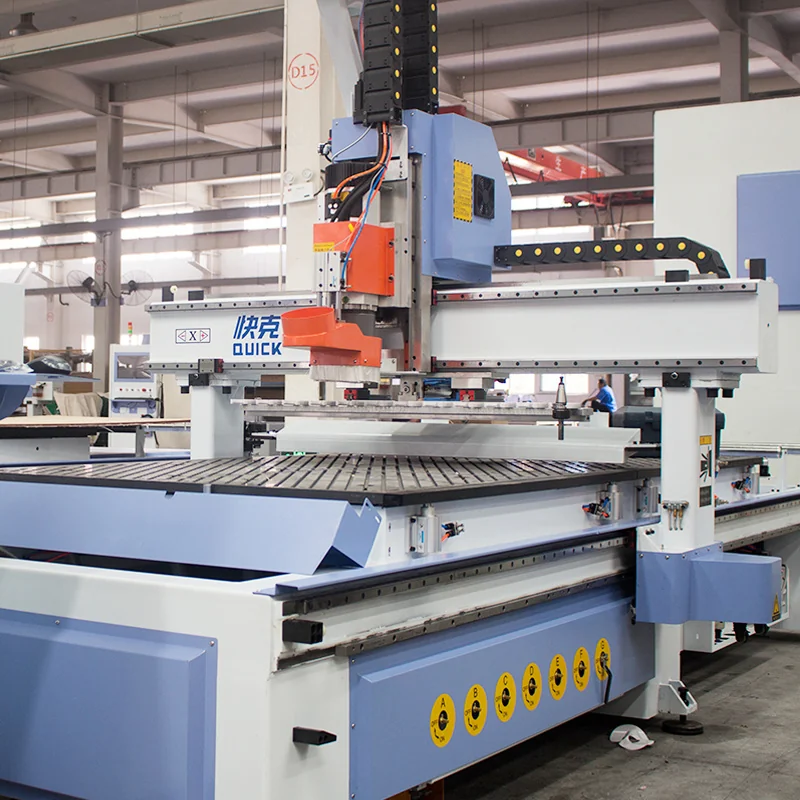
| Item | Standard UE-481 |
|---|---|
| Model | UE-481 |
| Machine Type | Linear ATC CNC Router |
| Working Area | 1220 × 2440 × 200 mm |
| Tool Magazine | 12-tool linear ATC |
| Spindle | 9 kW air-cooled, ISO30 |
| Spindle Speed | 24,000 rpm |
| Controller | Taiwan Syntec |
| Drive | Servo motor |
| Linear Guide | Linear Φ25 square guide |
| Workholding | Vacuum table |
| Vacuum Pump | 7.5 kW |
| Inverter | 11 kW Fuling |
| Machine Size | 3850 × 2270 × 2220 mm |
Pre-load the cutters used in a normal multi-step job so the control can call the next tool without waiting for manual replacement. The correct tool count comes from the real program, not from brochure comparison.
The ATC spindle is matched to automatic tool changing and the listed 24,000 rpm woodworking configuration. Tool diameter, material, depth of cut and duty cycle still determine the practical cutting setup.
The control system coordinates program execution and tool calls while servo drive handles the commanded motion. Confirm the CAD/CAM and post-processor route before delivery so programming fits the factory workflow.
Full sheets and larger flat parts can be held without placing mechanical clamps across the cutting area. Small, porous or cut-through parts still require a suitable spoilboard, zoning and machining strategy.
| Production bottleneck | Configuration direction | Do not add it when |
|---|---|---|
| Repeated manual changes inside one program | Use the 12-tool ATC when the real tool sequence needs the capacity. | Most jobs use one or two tools and changes happen only between batches. |
| Dense cabinet hole patterns | Move drilling to a drill-bank, PTP or six-side drilling solution. | Only occasional top-face holes are required. |
| Workpieces longer or wider than the standard table | Quote a larger working-size configuration from the actual part envelope. | The extra table area adds floor space but does not serve normal production. |
| Loading, unloading, labeling or panel flow limits output | Evaluate a nesting production-line configuration. | Material handling is already faster than the router cycle. |
| Angled or multi-face tool access is required | Evaluate 4-axis or 5-axis equipment from the drawing. | Every feature is reachable from the top with 3-axis motion. |
The standard UE-481 working area on this page is 1220 × 2440 × 200 mm. Quick CNC also lists larger working sizes in this product family: 1220 × 2800, 1500 × 3000, 2000 × 3000 and 2000 × 4000 mm.
These larger sizes should be treated as separate quoted configurations, not as the standard UE-481 specification. The correct table is set by the repeated workpiece size, fixture allowance, loading method, available floor space and service clearance. Drilling functions, dust extraction, electrical preparation, software workflow and automation are also confirmed with the selected configuration.
| Material / task | Tooling direction | What to verify |
|---|---|---|
| MDF and melamine panels | Compression or application-matched carbide routing tools | Top/bottom edge quality, dust removal and small-part holding. |
| Plywood | Compression, up-cut or down-cut tool according to veneer requirement | Veneer chipping, core condition and tool wear. |
| Solid wood | Spiral, profile or ball-nose tooling according to geometry | Grain direction, tear-out, finish and fixture stability. |
| Acrylic / rigid plastic | Plastic-routing cutter with effective chip evacuation | Heat, melting, edge whitening and chip recutting. |
| Grooves and slots | Tool diameter selected from groove width and depth | Chip evacuation, tool deflection and depth strategy. |
| Selected light aluminum | Application-specific carbide tooling after process review | Alloy, workholding, chip removal, lubrication/air strategy and finish. |
For full sheets, vacuum is normally the first holding method. When nested parts become small after cut-through, use the right cutting order, onion-skin strategy, tabs or auxiliary fixtures instead of assuming vacuum alone will hold every part.
When cut quality, tolerance, laminate appearance, plastic heat behavior, light-aluminum finish or cycle time affects the purchase decision, use a representative material and drawing for the sample test.
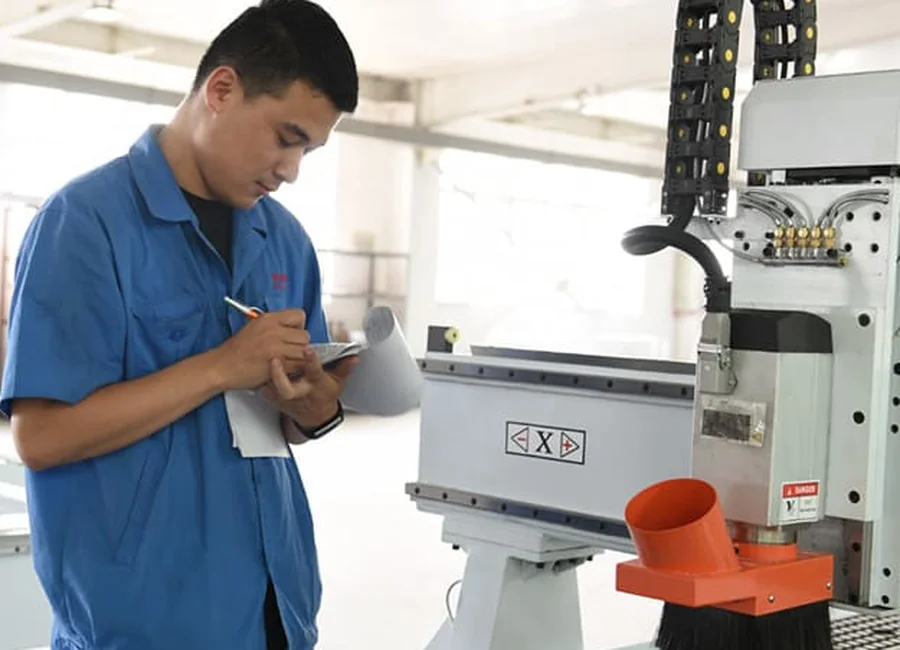
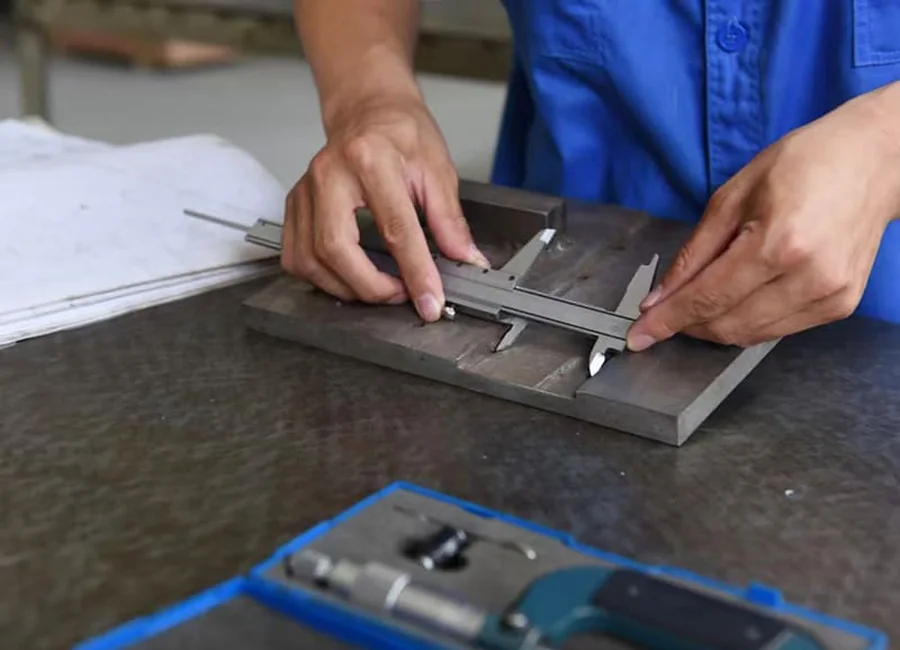
Quick CNC’s published quality-control process covers machine-frame and component checks, assembly inspection, electrical testing, running tests and final packing inspection. Published inspection examples also include dimensional inspection, structural fit verification, component checks and linear-guide calibration.
For the ordered UE-481, the inspection record must match the final configuration rather than being inferred from company-level QC equipment. If your project needs a representative sample cut, dimensional acceptance points or specific shipment documentation, define those requirements before order release so the available records can be tied to the machine being supplied.
| Main job | Machine direction | Why |
|---|---|---|
| Flat parts with several routing tools in one program | UE-481 12-tool linear ATC | Reduces repeated manual tool changes while keeping flexible routing capability. |
| Cabinet panels with dense top, bottom and side hole patterns | Six-side drilling machine | Dedicated drilling handles multi-face hole patterns more efficiently than using the router spindle for every hole. |
| Pre-cut furniture or door panels needing secondary drilling and routing | PTP CNC router | Better aligned with flexible secondary machining of individual panels. |
| Full-sheet cutting plus loading, unloading and production flow | Furniture production line | Addresses material flow and automation beyond the router cycle itself. |
| Angled, rotary or multi-face features | 4-axis / 5-axis direction | Add axes only when the drawing requires cutter access that 3-axis motion cannot provide. |
A multi-step panel job may start with a compression cutter for the main profile, switch to a smaller tool for internal cut-outs, use a grooving cutter for dados or slots, call a suitable drill/router tool for selected vertical holes, and finish with a profile or detail cutter. With those tools preloaded, the control can call the next tool as the program progresses instead of waiting for an operator to change tools between steps.
| Sequence | Tool role | Production effect |
|---|---|---|
| 1. Main profile | Compression / cutting tool | Complete the primary panel or part outline. |
| 2. Internal features | Smaller routing tool | Machine cut-outs or smaller geometry without manual tool replacement. |
| 3. Grooves / slots | Grooving tool | Keep dado or slot operations inside the same programmed job. |
| 4. Selected top-face holes | Suitable drill / router tool | Complete occasional vertical holes before the part leaves the table. |
| 5. Profile / detail | Profile, V-bit or detail tool | Finish the programmed edge or decorative feature. |
Quick CNC has manufactured CNC machinery since 2006. The production process combines application review, machine configuration, manufacturing, testing, delivery preparation and technical support.
We identify the repeated part, material, operations, tool sequence and output target.
We match table size, ATC capacity, workholding, drilling direction and supporting utilities to the job.
The machine is built and integrated around the approved configuration.
Factory checks and running tests are completed; representative sample cutting can be planned when required.
The machine is prepared for export packing and container shipment according to the order.
Manuals, videos, remote guidance, online training and agreed service support continue after delivery.
From these inputs, we can determine whether the standard UE-481 is sufficient, whether the 12-tool capacity is justified, and whether drilling, workholding, table size or automation should move to a different configuration before the quotation is finalized.
Quick CNC does not require a minimum order quantity. Standard production lead time is approximately 45 days after the order and machine configuration are confirmed; freight and ocean transit time are separate.
Machines are prepared with export packing and are normally shipped by container. Final packing method, shipment plan, destination port and freight arrangement are confirmed with the order.
The standard warranty period is one year within the terms of the signed agreement. Quick CNC provides manuals, videos, remote technical guidance and online training. Paid on-site service can be arranged where required and agreed.
Before shipment, prepare the destination electrical supply, compressed air, dust collection, workshop access, unloading method, network/software requirements and operator training plan according to the confirmed machine documents. Completing these items before arrival reduces avoidable commissioning delays.
No. UE-481 can complete selected vertical holes from the top with suitable tools, but dense connector-hole patterns, shelf-pin rows, horizontal holes and multi-face drilling are better handled by a drill-bank, PTP or six-side drilling solution.
You need the 12-position magazine when a normal program uses enough different tools that manual changes interrupt production. If most jobs use one or two tools, a smaller ATC configuration can be more economical.
No. The correct magazine depends on tool count, change frequency, layout, clearance, dust exposure and maintenance access. Choose the arrangement that fits the actual production process.
The listed working area is 1220 × 2440 × 200 mm, which is the common 4 × 8-class panel size used for cabinet and furniture production. Final sheet positioning, edge access and fixture requirements should still be checked against the real job.
No. Full sheets and larger flat parts are well suited to vacuum holding, but small, porous, warped or fully cut-through parts may need zoning, tabs, onion skin, a different cutting sequence or auxiliary fixtures.
Yes, for suitable routable grades. Cutter geometry, chip evacuation and heat control are important, so a sample test is useful when edge appearance or melting risk affects acceptance.
Selected light-aluminum routing can be reviewed after confirming alloy, thickness, tooling, workholding, chip removal and finish requirement. UE-481 should not be treated as a general-purpose metal machining center.
Provide the drawing or program file, actual material, dimensions and thickness, target edge or surface finish, any defined tolerance and expected production volume.
Send one representative panel or component drawing, the material, typical tool sequence and shift target. Quick CNC can build the UE-481 proposal around that job—working area, 12-tool ATC use, tooling, workholding, drilling boundary, utilities to confirm and the quotation—rather than asking you to choose the machine from a specification list alone.
Tell us your material, working size and production needs. Our engineers will recommend a suitable CNC machine for your business.