FK53 Automatic Edge Banding Machine for Furniture Panels
Run straight cabinet, wardrobe and panel-furniture edges through pre-milling, gluing, pressing, end trimming, fine trimming, corner rounding, scraping and buffing in one continuous automatic edge-banding process.
FK53 is an automatic linear edge bander for factories that need more than basic glue-and-press sealing. Pre-milling prepares the cut edge before adhesive is applied, while trimming, corner rounding, scraping and buffing complete the visible edge. Final quality still depends on the panel, edge material, glue, temperature and machine settings, so configuration starts from your real production specification.
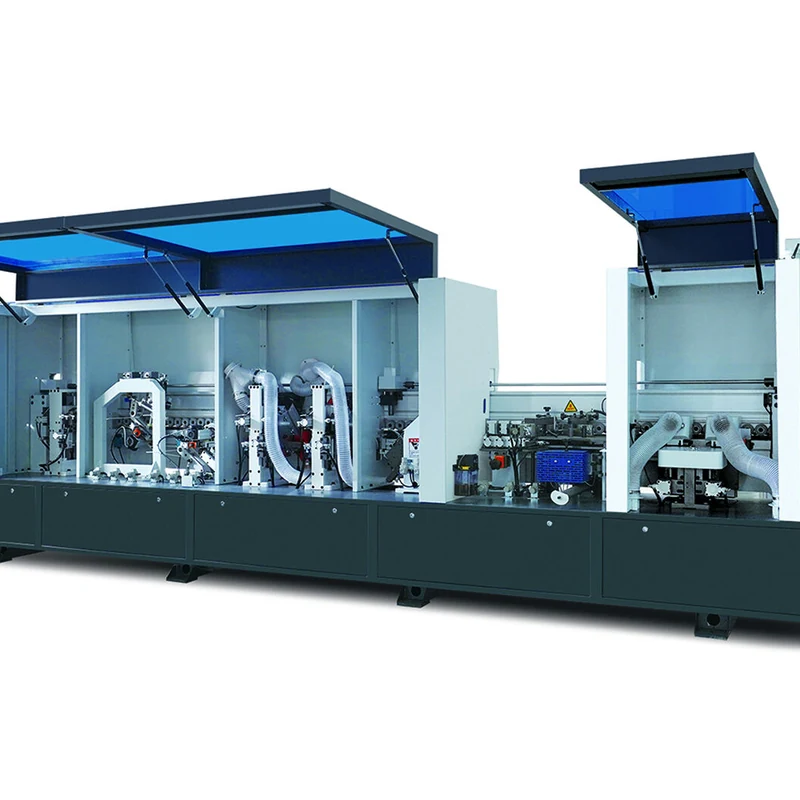
Automatic Edge Banding for Cabinet and Furniture Panels
FK53 is designed around straight, flat panel-furniture parts. The quickest buying decision is whether your material, edge geometry, finish requirement and production flow match that process.
Best Production Fit
MDF, particle board, plywood and melamine-faced furniture panels are the main direction when parts are straight, flat and within the published size range. Typical work includes cabinet, wardrobe, shelf and office-furniture panels.
Needs Material Validation
Solid-wood, acrylic-faced, plastic-faced or special composite panels require confirmation of edge material, adhesive and finish expectations. Use representative production materials when compatibility is uncertain.
Choose Another Process
Curved, shaped or free-form edges are not standard FK53 work. FK53 also does not replace CNC cutting, drilling, nesting or carving equipment, and laser or other zero-joint technology should not be assumed.
FK53 Automatic Edge Banding Machine Functions
Each unit solves a different edge problem. The value is in the full sequence rather than in one trimming operation alone.
Pre-Milling
Removes minor saw marks and edge defects before gluing so the edge material starts from a cleaner, straighter surface.
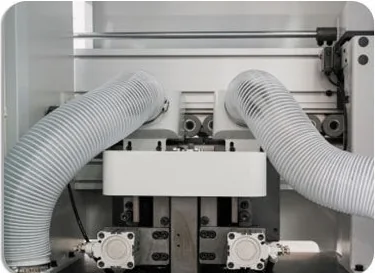
Gluing & Edge Feeding
Applies adhesive and feeds the edge material into the pressure zone. Glue type, temperature, panel condition and final configuration remain part of process setup.
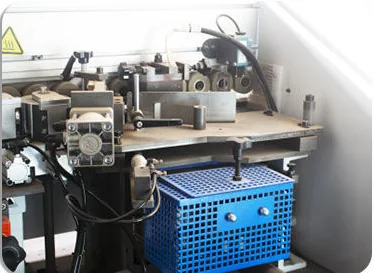
Four-Wheel Pressing
Presses the edge material against the panel after gluing. Stable pressure supports bonding and helps control the visible glue line.
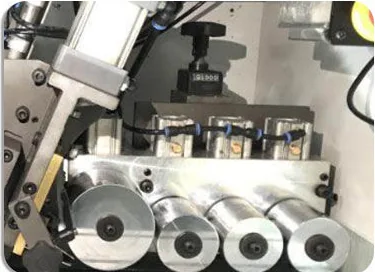
End Trimming
Cuts the leading and trailing edge overhang. The published FK53 design uses two saw blades for the front and rear ends.
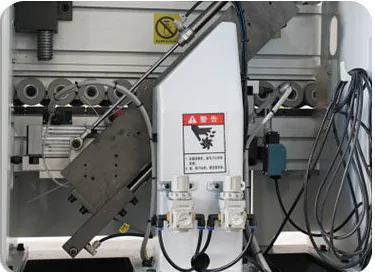
Fine Trimming & Corner Rounding
Trims the top and bottom overhang and finishes the front and rear corners for cleaner visible cabinet and wardrobe edges.
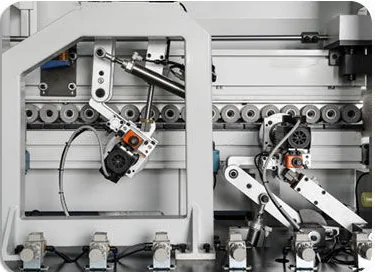
Scraping & Buffing
Scraping reduces trimming marks and buffing cleans the finished edge. Tool condition, tracing surfaces and settings still affect the final appearance.
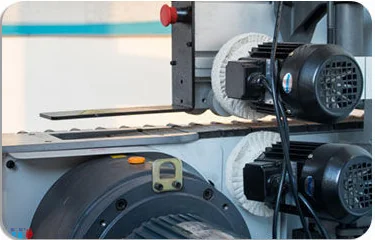
FK53 Automatic Edge Banding Machine Specifications
| Model | FK53 | Machine type | Automatic linear edge banding machine |
|---|---|---|---|
| Machine size | 6500 × 900 × 1600 mm | Feed rate | 16–23 m/min |
| Edge tape thickness | 0.4–3 mm | Panel thickness | 9–50 mm |
| Minimum panel length | 150 mm | Minimum panel width | 60 mm |
| Working air pressure | 0.7 MPa | Total power | 15 kW |
| Conveying transmission | GPG motor | PLC | Delta |
| Air cylinder | AirTAC | Main functions | Pre-milling, gluing, end trimming, fine trimming, edge scraping, corner rounding, buffing |
How the FK53 Automatic Edge Bander Works
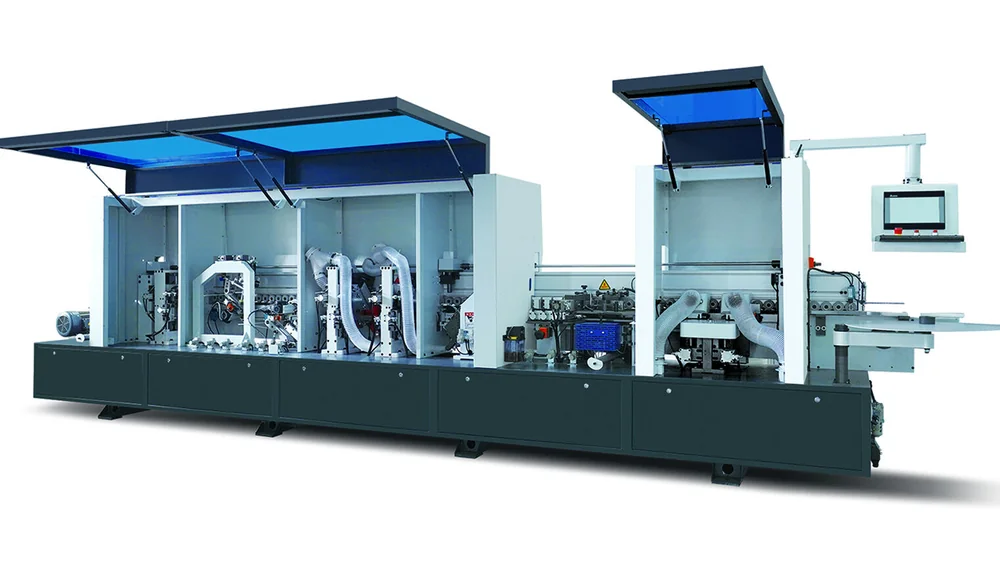
FK53 uses a straight-line layout so the panel moves through edge preparation, adhesive application, pressing and finishing without being carried between separate stations. The 6500 mm machine length comes from this multi-unit sequence rather than from a large cutting envelope.
Each working unit has a specific job: pre-milling prepares the edge, the glue and pressure zones apply and press the edge material, and the downstream units trim, round, scrape and buff the finished edge. Maintenance therefore has to follow the process. Cleaning the glue system does not replace checking cutters, scrapers, tracing surfaces, pressure rollers or extraction.
Furniture Panel, Edge Material and Glue Compatibility
A clean edge is a material-and-process result. Select the machine from the actual panel, edge and adhesive specification instead of from feed speed alone.
Send the Production Inputs
- Panel core and surface: MDF, particle board, plywood, melamine or another material.
- Minimum and maximum panel dimensions, including the smallest recurring part.
- Edge material and thickness; provide the supplier specification when available.
- Glue type, operating temperature and any moisture or heat-resistance requirement.
- Required corner profile, visible glue-line standard and finish photos.
- Representative sample panels when material or finish compatibility is uncertain.
Configuration Items We Must Confirm
- Whether the published 0.4–3 mm edge range covers the actual edge-material mix.
- Whether the selected glue system is compatible with the adhesive requirement.
- Whether PUR or another project-specific glue technology is mandatory.
- Whether the required finish depends on laser or zero-joint technology that is outside the standard FK53 assumption.
- Whether the smallest recurring panel fits the published 150 mm length and 60 mm width limits.
- Whether the 16–23 m/min feed range matches the real line target and downstream capacity.
Test Your Production Material Before Final Configuration
When a representative-panel test is agreed, use the same panel, edge material, adhesive and finish standard intended for production. That gives the configuration and acceptance discussion a real reference instead of a generic demonstration piece.
Is FK53 the Right Edge Bander for Your Production?
| Production requirement | FK53 direction | What to confirm before ordering |
|---|---|---|
| Straight cabinet, wardrobe and shelf panels | Direct FK53 application when dimensions and materials fit the published range. | Panel material, min/max size, edge thickness and finish standard. |
| Rough saw-cut edge before banding | Use FK53 pre-milling before gluing. | Panel surface, edge damage, expected removal and finished-edge requirement. |
| Visible furniture corners | Use the included fine-trimming and corner-rounding process. | Edge material, thickness and required corner appearance. |
| High daily panel volume | Compare the 16–23 m/min feed range with full-shift production. | Panels per shift, average panel length, panel gap, changeovers and downstream bottlenecks. |
| PUR, laser or zero-joint finish is mandatory | Do not assume the standard FK53 configuration includes it. | Required glue/joining technology and the final machine configuration. |
| Curved or irregular edges | Choose a different edge-banding process or machine type. | Part geometry and required shaped-edge process. |
| Cutting or drilling is the real bottleneck | A faster edge bander alone may not increase finished furniture output. | Full production flow from cutting through drilling, sorting and assembly. |
FK53 Edge Banding Machine Factory Testing
For FK53, acceptance should focus on the edge-banding functions installed on the ordered machine and on the production materials agreed for the project.
Functional Sequence Check
Confirm feeding, pneumatic actions, heating and control functions, and the working sequence of the installed pre-milling, gluing, pressing and finishing units.
Edge-Finish Check
Inspect the result after end trimming, fine trimming, corner rounding, scraping and buffing. If a representative panel is part of the agreed acceptance plan, judge the result against that material and finish requirement.
Utilities & Order Documents
Confirm the destination electrical configuration and the agreed machine documentation before shipment. For CE or other destination-market documentation, send the exact country and required document before order confirmation so the applicable scope can be checked.
Built and Supported for Furniture Production
Quick CNC has manufactured CNC machinery since 2006 and supplies CNC routers and panel-furniture production equipment for overseas factories. For an FK53 project, the machine decision should include the panel and edge materials, adhesive requirement, compressed air, extraction, electrical supply, output target and the downstream production steps that affect finished-line capacity.
Send panel sizes, edge material, glue, finish and shift output.
Confirm FK53 fit, utilities, glue/joining requirements and project-specific scope.
Build the machine and complete the agreed functional and representative-panel checks.
Prepare export documents, manuals, remote guidance, training and service coordination.
Send the Inputs That Determine Your Edge-Banding Result
A useful FK53 quotation starts with the real panel and edge process, not just the machine model.
- Panel material and surface finish.
- Minimum and maximum panel length, width and thickness.
- Edge material and thickness range.
- Glue type and finish standard.
- Daily or per-shift output target.
- Typical product: cabinet, wardrobe, shelf, door or other panel.
- Factory voltage, phase and frequency.
- Compressed-air and extraction information.
- Destination country and port.
- Representative-panel or acceptance-test requirement.
MOQ, Production Lead Time, Packing and Shipping
No Minimum Order Quantity
Quick CNC has no minimum order quantity for this machine. One machine can be ordered when it fits the project.
Approximately 45 Days
Standard production lead time is approximately 45 days after order and configuration confirmation. Custom requirements or batch quantity may change the schedule. Ocean freight is separate.
Export Packing
The machine is prepared for export and is normally transported by container. Final packed dimensions, weight, container plan and Incoterm are confirmed for the actual order.
Installation, Utilities, Warranty and After-Sales Support
Prepare the Factory Before Arrival
- Stable compressed air at the required 0.7 MPa working pressure.
- Dust/chip extraction at pre-milling, trimming and scraping areas.
- Electrical capacity for the 15 kW machine plus any external equipment; final voltage, phase and frequency confirmed before build.
- Adhesive storage and workshop temperature suitable for the selected glue and edge material.
- Infeed/outfeed area and safe operator/service clearance around the 6500 × 900 × 1600 mm machine.
Warranty and Support
Quick CNC provides a standard one-year machine warranty from the date the machine is received, subject to the signed agreement and approved exclusions.
Our service team supports installation guidance, training, troubleshooting and spare-parts coordination. Paid on-site service can be arranged when required. Exact travel cost, on-site scope, wearing-parts treatment and warranty responsibilities follow the final agreement.
FK53 Automatic Edge Banding Machine FAQ
What production is FK53 designed for?
FK53 is designed for straight-edge cabinet, wardrobe, shelf, office-furniture and other panel-furniture parts that fit its published size range.
Does FK53 include pre-milling and corner rounding?
Yes. Its published function set includes pre-milling, gluing, end trimming, fine trimming, edge scraping, corner rounding and buffing.
What edge tape thickness can FK53 process?
The published range is 0.4–3 mm. Send the exact edge material and thickness so the glue and finishing process can be confirmed.
What panel thickness fits FK53?
The published panel thickness range is 9–50 mm. Minimum panel length is 150 mm and minimum width is 60 mm.
Is FK53 suitable for curved or shaped edges?
No. FK53 is a straight-line automatic edge banding machine. Curved and irregular edges require a different process or machine type.
Can I use PUR glue on FK53?
Do not assume PUR compatibility from the model name alone. If PUR is mandatory, send the adhesive requirement before order confirmation so the final glue-system configuration can be checked.
Can I use my own panel and edge material for a test?
A representative-panel test can be included when agreed for the project. Use the same panel, edge material, adhesive and finish standard intended for production so the result has a meaningful reference.
Why can an edge peel after it leaves the machine?
Common causes include unsuitable panel or edge temperature, incorrect glue temperature or quantity, a contaminated panel edge, poor pressure or an incompatible glue/edge combination. Record the materials, set and actual temperature and pressure-roller condition so the process can be diagnosed.
What information should I send for an FK53 quotation?
Send panel material and dimensions, panel thickness, edge material and thickness, glue requirement, finish photos or sample standard, shift output, factory voltage and air information, destination country and any representative-panel or acceptance-test requirement.
Check FK53 Against Your Actual Panel and Edge Standard
Send one representative panel specification, edge material, glue requirement and shift target. Quick CNC can confirm whether FK53 fits the process or whether another edge-banding configuration is a better match.